

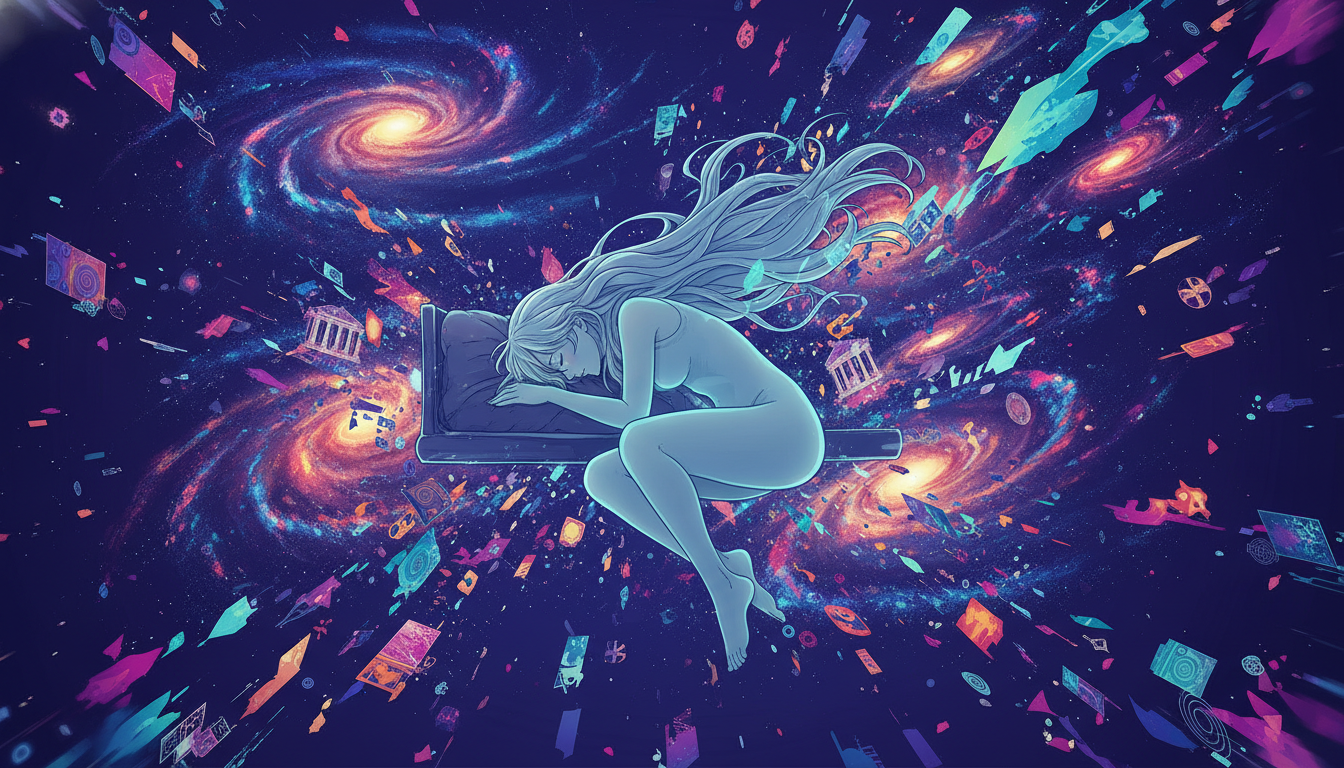
Ever woken up from a dream so vivid, so strange, so emotionally overwhelming that you just lay there staring at the ceiling trying to figure out what your own brain was trying to tell you? Maybe you were flying over a neon-lit city, or being chased by someone whose face kept shifting, or having a perfectly normal conversation with a loved one who passed away years ago. Whatever it was, it felt real — and then it was gone. Sleep and dreams have fascinated humans for as long as we’ve been human, and modern neuroscience is finally starting to crack open what’s actually happening inside your skull when you close your eyes at night. Spoiler: it is absolutely unhinged in the best possible way.
The brain during sleep doesn’t just “turn off.” It shifts into a completely different mode of operation — sometimes more active than when you’re awake, sometimes running cleanup cycles like a late-night server maintenance team, and sometimes generating entire cinematic universes out of emotional residue and half-remembered memories. For geeks and anime fans, this is particularly fascinating territory, because some of the most iconic stories ever told — from Paprika to Evangelion — are basically trying to visualize exactly what neuroscientists are now describing with data and brain scans. Your favorite creators weren’t just being weird for the sake of it. They were onto something real.
This is the deep dive you didn’t know you needed. Let’s talk about what your brain is actually doing while you sleep, why your dreams are basically a chaotic remix engine, and why the whole process is simultaneously one of the most important and most mysterious things your body does every single night.
The Sleep Cycle: Your Brain’s Nightly Playlist
Sleep isn’t one long, flat state. It’s a structured sequence of stages that your brain cycles through multiple times each night, roughly every 90 minutes. Scientists divide sleep into two broad categories: NREM (Non-Rapid Eye Movement) and REM (Rapid Eye Movement) sleep.
NREM itself has three stages:
- Stage 1 – Light sleep, the transition zone. You might experience hypnic jerks here (that sudden falling sensation). Brain activity slows but doesn’t stop.
- Stage 2 – Your body temperature drops, heart rate slows, and the brain begins producing sleep spindles — brief bursts of oscillating neural activity that are thought to play a role in memory consolidation.
- Stage 3 – Deep sleep, also called slow-wave sleep. This is the restorative gold. Growth hormone is released, immune function is boosted, and the glymphatic system — your brain’s waste-clearance network — kicks into high gear, flushing out metabolic byproducts including proteins linked to Alzheimer’s disease.
Then comes REM sleep — and this is where things get truly chaotic.
REM Sleep: The Brain’s Midnight Movie Theater
REM sleep is where most vivid dreaming happens, and from a neuroscience standpoint, it is wild. During REM, your brain’s electrical activity looks almost identical to when you’re fully awake. Your eyes dart around under your eyelids (hence the name). Your heart rate and breathing become irregular. And yet your body is essentially paralyzed — the brainstem actively suppresses motor signals so you don’t physically act out your dreams. That paralysis is called REM atonia, and when it glitches, you get REM Sleep Behavior Disorder — a condition where people literally punch, kick, and shout in their sleep, acting out dream sequences in real time.
During REM, the prefrontal cortex — the rational, critical-thinking part of your brain — is significantly less active. This is why dreams feel logical while you’re in them but completely nonsensical when you wake up. Your brain’s quality control department has clocked out. Meanwhile, the amygdala (emotional processing) and hippocampus (memory) are running hot, which is why dreams are so emotionally charged and why they pull from fragmented memories in such bizarre combinations. It’s less like watching a coherent film and more like your emotional history got fed into an AI generator with no content filters.
Why Dreams Feel So Devastatingly Real
One of the most mind-bending facts about dreaming is that the brain regions responsible for processing real sensory input are the same ones generating the dream experience. When you see something in a dream, your visual cortex is actually firing. When you feel fear, your amygdala is actually responding. The experience isn’t symbolic — it’s neurologically genuine, just generated internally rather than from the outside world.
This is precisely why anime like Paprika (the 2006 Satoshi Kon masterpiece that clearly inspired Christopher Nolan’s Inception) resonates so deeply. Kon visualized the dream state as a place where identity dissolves, logic inverts, and emotion overrides everything — and that’s not artistic exaggeration. That’s pretty much what’s happening at the neural level. Watching Paprika and then reading about REM sleep neuroscience is one of those rare moments where art and science converge completely.
The Memory Remix Engine: Why You Dream About That One Weird Thing
Here’s a question that probably haunts you: why did you dream about your third-grade teacher wearing your coworker’s face and handing you a homework assignment that was actually a shopping list? The answer lies in how the brain consolidates memory during sleep.
During NREM and REM sleep, the brain replays and reorganizes the day’s experiences, integrating new information with older memories. But the process isn’t neat — it’s associative and emotional. The hippocampus communicates with the cortex, and memories get linked not just by logic but by emotional resonance and pattern similarity. The result is exactly the kind of surreal narrative mashup that characterizes most dreams.
Some key facts about dreaming and memory:
- The average person has 4-6 dreams per night, though most are forgotten within minutes of waking.
- Lucid dreaming — becoming aware you’re dreaming while still in the dream — is a documented neurological phenomenon where prefrontal cortex activity temporarily increases during REM.
- Sleep deprivation impairs memory consolidation significantly; pulling an all-nighter before an exam is neurologically counterproductive.
- Emotions felt during the day directly influence dream content, a phenomenon researchers call mood-congruent dreaming.
- People who are blind from birth can still dream — their dreams simply don’t contain visual imagery, relying instead on sound, touch, and emotion.
Nightmares, Sleep Paralysis, and the Horror Genre’s Secret Muse
Not all brain chaos during sleep is pleasant. Nightmares are particularly vivid, distressing dreams that typically occur during REM sleep and are associated with elevated amygdala activity. Chronic nightmares are linked to anxiety, PTSD, and depression, and they can significantly disrupt sleep quality in a vicious cycle.
Then there’s sleep paralysis — arguably one of the most terrifying things the human brain can generate naturally. It occurs when you become conscious while REM atonia is still active, leaving you unable to move while often experiencing vivid hallucinations. Historically, these episodes have been described across cultures as demons sitting on the chest, shadow figures in the room, or supernatural visitations. It’s no coincidence that creatures like the succubus in Western mythology and the kanashibari in Japanese folklore map almost perfectly onto the sleep paralysis experience. These unsolved mysteries are too creepy to be real — until neuroscience explains the mechanism, anyway.
Anime That Gets Sleep Science Disturbingly Right
Anime has a long and distinguished history of using dreams and altered consciousness as narrative tools — and some of it is more neurologically accurate than you might expect.
- ***Paprika* (2006)** – Satoshi Kon’s film uses dream-sharing technology as a metaphor for unconscious desire and identity collapse. The visual logic mirrors what we now know about REM’s suppressed prefrontal activity.
- Neon Genesis Evangelion – The final episodes famously dive into protagonist Shinji Ikari’s internal psychological landscape in a way that structurally resembles therapeutic dream analysis. The tragic backstories hit harder than any plot twist partly because they’re delivered through the language of psychological interiority.
- Serial Experiments Lain – This 1998 series by Yasuyuki Ueda blurs the boundary between dreaming, reality, and networked consciousness in ways that feel increasingly relevant to questions about identity and perception.
- Mushishi – A quieter, more contemplative series that treats the dream world and the spirit world as overlapping territories, which resonates with the idea that sleep is a genuinely altered state of consciousness rather than mere absence of waking.
The Unanswered Questions That Keep Neuroscientists Up at Night
For all the progress science has made, the deepest questions about sleep and dreaming remain genuinely open. Why do we dream at all? Multiple competing theories exist — emotional processing, threat simulation, memory consolidation, random neural noise that the narrative brain tries to stitch into meaning — but none is definitively proven. The hard problem of consciousness makes it incredibly difficult to study subjective experience from the outside.
What we do know is that sleep is not optional. Every animal with a nervous system complex enough to measure appears to sleep in some form. Chronic sleep deprivation causes cognitive decline, immune suppression, emotional dysregulation, and in extreme cases, death. Your brain during sleep isn’t resting. It’s doing some of the most important work of your entire existence — and doing it in the most spectacularly chaotic way imaginable.
Your brain spends roughly a third of your life in a state of controlled, productive, occasionally terrifying chaos — and the more science learns about it, the stranger and more wonderful it gets. Whether you’re here for the neuroscience, the anime parallels, or just because you had a deeply weird dream last night and needed answers, the takeaway is the same: sleep is one of the most powerful and mysterious things your body does. Honor it. Protect it. And maybe, just maybe, pay a little more attention to what happens when you close your eyes.
