

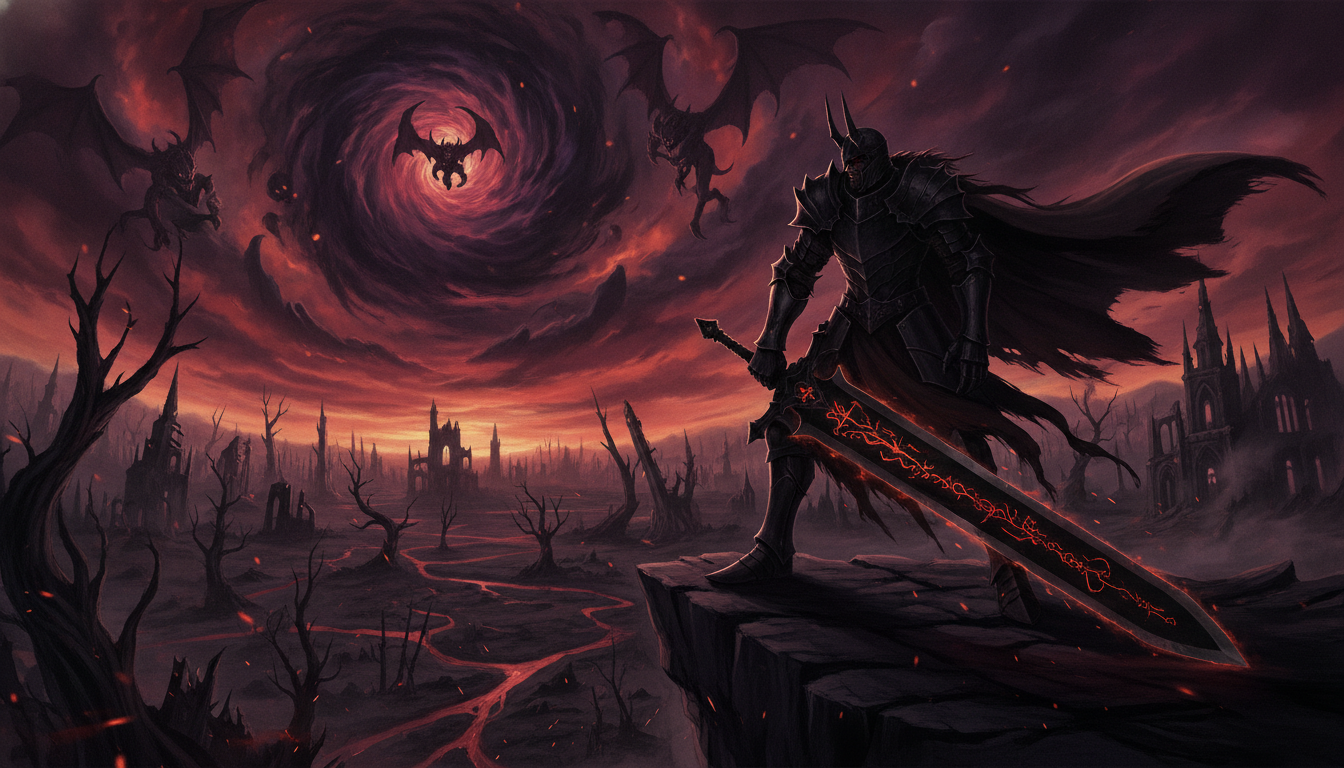
When Berserk Breaks You — And You Want More
There is a specific kind of emotional damage that only dark fantasy anime can inflict. You finish an arc, you sit in silence, you stare at the ceiling, and you wonder why you voluntarily did that to yourself — and then you immediately start looking for something that will do it again. Berserk, Kentaro Miura’s magnum opus (serialized from 1989 until his passing in 2021), is the gold standard of that experience. Following the tortured mercenary Guts as he carves his way through a world of demons, betrayal, and existential despair, Berserk doesn’t just tell a dark story — it excavates the darkest corners of what it means to be human and keeps digging.
The problem, if you can call it that, is that Berserk leaves a void. Whether you came through the legendary 1997 anime adaptation, the controversial 2016–2017 CGI series, or the manga itself, nothing quite fills the space it leaves behind. The good news is that the dark fantasy genre in anime is vast, rich, and populated with series that carry the same bruising emotional weight, the same willingness to punish characters (and viewers), and the same philosophical depth. If you’re chasing that haunt, these are the titles that will find you in the dark.
If you’re new to the territory between shonen and seinen, it’s worth knowing that most of these recommendations fall firmly in the seinen category — anime and manga aimed at adult men, with fewer restrictions on themes like violence, moral ambiguity, and tragedy. That distinction matters when you’re looking for something with Berserk’s uncompromising edge.
Vinland Saga — Revenge Is a Hollow God
If Berserk is a meditation on rage and survival, Vinland Saga is its philosophical cousin. Originally a manga by Makoto Yukimura serialized in Weekly Shōnen Magazine (and later Monthly Afternoon), the anime adaptation produced by Wit Studio (Season 1, 2019) and MAPPA (Season 2, 2023) is a stunning achievement in dark historical fiction.
The story follows Thorfinn, the son of a legendary Viking warrior, who witnesses his father’s murder at the hands of the mercenary captain Askeladd. What follows is years of brutal servitude and hollow revenge — Thorfinn fights for Askeladd’s crew just to earn the right to duel him again and again. The series asks a devastating question: what do you become when hatred is the only thing keeping you alive?
Season 2, often called the “Farmland Saga” arc, strips away the action almost entirely and replaces it with something rarer — quiet devastation. Thorfinn must rebuild himself from psychological ruin. It’s uncomfortable, slow, and one of the most rewarding arcs in modern anime. Like Guts after the Eclipse, he must decide whether survival is enough.
Claymore — The Warrior Women Who Sacrifice Everything
Claymore (2007, Madhouse) is practically required viewing for any Berserk fan, and it’s criminally underrated. In a medieval world infested with shape-shifting demons called Yoma, half-human, half-Yoma warriors known as Claymores are the only ones capable of fighting them. These silver-eyed women walk a razor’s edge — use too much of their demonic power and they transform into the very monsters they hunt.
The lead, Clare, shares Guts’s defining trait: she is not the strongest, and she survives through sheer, bloody-minded will rather than overwhelming power. The series explores themes of sacrifice, identity, and what it costs to become a weapon. The 2007 anime diverges from the manga in its ending but delivers 26 episodes of consistent, beautifully brutal fantasy. Think of it as Berserk’s darker sister — same medieval horror bones, different emotional architecture.
Demon Slayer vs. Dark Fantasy — Knowing the Difference
It’s worth pausing here to draw a line. Demon Slayer: Kimetsu no Yaiba is an exceptional series, and it absolutely features demons, tragedy, and gorgeous fight choreography. But it is fundamentally hopeful. Its characters suffer, but they are buoyed by love, found-family bonds, and the promise of justice.
True dark fantasy — Berserk-tier dark — is defined not just by violence but by moral ambiguity, systemic cruelty, and the real possibility that the protagonist might not make it out spiritually intact. If you’ve already seen Demon Slayer, consider it a gateway. The titles in this article are where the path goes darker. For pure combat spectacle comparisons, these anime fights hit different and you know why — but emotional devastation is its own category.
Hellsing Ultimate — Gothic Horror Cranked to Maximum
Hellsing Ultimate (2006–2012, Geneon/Madhouse) is what happens when gothic horror anime decides to completely commit to excess. Based on Kouta Hirano’s manga, it follows Alucard — a vampire of almost incomprehensible power — as he serves the Hellsing Organization, a British secret society dedicated to destroying monsters. The series escalates into a full-scale supernatural war involving rogue vampires, Nazi occult soldiers, and the Vatican’s own monster-hunting army.
Where Berserk finds horror in human suffering and demonic corruption, Hellsing Ultimate finds it in sheer overwhelming scale and the terrifying nature of power itself. Alucard is not a hero in any traditional sense — he is a force of nature wearing a red coat and smiling at things that should not be smiled at. The OVA format (10 episodes) means no filler, no padding. Just escalating, beautifully animated carnage with real theological and moral weight underneath the gore.
Key facts about Hellsing Ultimate:
- Released as a 10-episode OVA series between 2006 and 2012
- Production was split between Geneon, Madhouse, and later Satelight
- The manga ran from 1997 to 2008 in Young King OURs magazine
- Often cited alongside Berserk as a benchmark of dark seinen manga
Dororo — Ancient Japan’s Debt Written in Flesh
Dororo (2019, MAPPA/Tezuka Productions) is based on Osamu Tezuka’s original 1960s manga, reimagined with modern production values and considerably more brutal emotional honesty. The premise is devastating: a samurai lord sacrifices his unborn son’s body parts — eyes, limbs, organs — to 48 demons in exchange for power. The child, Hyakkimaru, is born a shell and cast away. He survives, is fitted with prosthetics that conceal weapons, and hunts the demons one by one to reclaim his body.
Each demon killed restores a piece of him — a sensation, a sense, a limb. It sounds like a power fantasy, but Dororo refuses to let it be one. Each restoration comes with pain, with new vulnerability, with the question of whether Hyakkimaru’s humanity is being restored or invented for the first time. The series draws on Japanese folklore and Shinto concepts of impurity and spiritual debt in ways that give it a texture most fantasy anime can’t match.
A Short Dark Fantasy Watchlist for the Haunted
If you’re building your queue, here’s a structured guide to what scratches which specific Berserk itch:
| Series | What It Shares with Berserk | Tone |
|---|---|---|
| Vinland Saga | Trauma, revenge’s hollow cost, brutal medieval warfare | Philosophical, devastating |
| Claymore | Female warriors, body horror, demonic corruption | Grim, action-driven |
| Hellsing Ultimate | Gothic horror, monstrous power, moral ambiguity | Operatic, extreme |
| Dororo | Sacrifice, reclaiming humanity, feudal Japan horror | Melancholic, folklore-rich |
| Devilman Crybaby | Demonic transformation, apocalyptic stakes, lost innocence | Surreal, nihilistic |
Devilman Crybaby (Netflix, 2018, directed by Masaaki Yuasa) earns its spot on this list for one reason: it commits fully to its ending in a way that almost no other anime dares to. Go in knowing it is not a comfortable watch. It is not meant to be.
The Haunting Is the Point
What separates dark fantasy anime like Berserk from mere shock content is intentionality. These series use their darkness to say something true — about power structures, about what war does to people, about the cost of survival and the weight of the choices made to achieve it. Miura’s work endures because underneath the demons and the viscera, it is a story about a man refusing to stop being human even when everything conspires to make him otherwise.
The series above carry that same commitment. They will follow you out of the episode. They will make you think about characters who don’t exist while you’re doing something completely unrelated three days later. That’s not a flaw in the genre. That’s the whole point. The haunting is proof that something real was communicated — and in a world full of disposable entertainment, that’s rarer and more valuable than it looks.
