

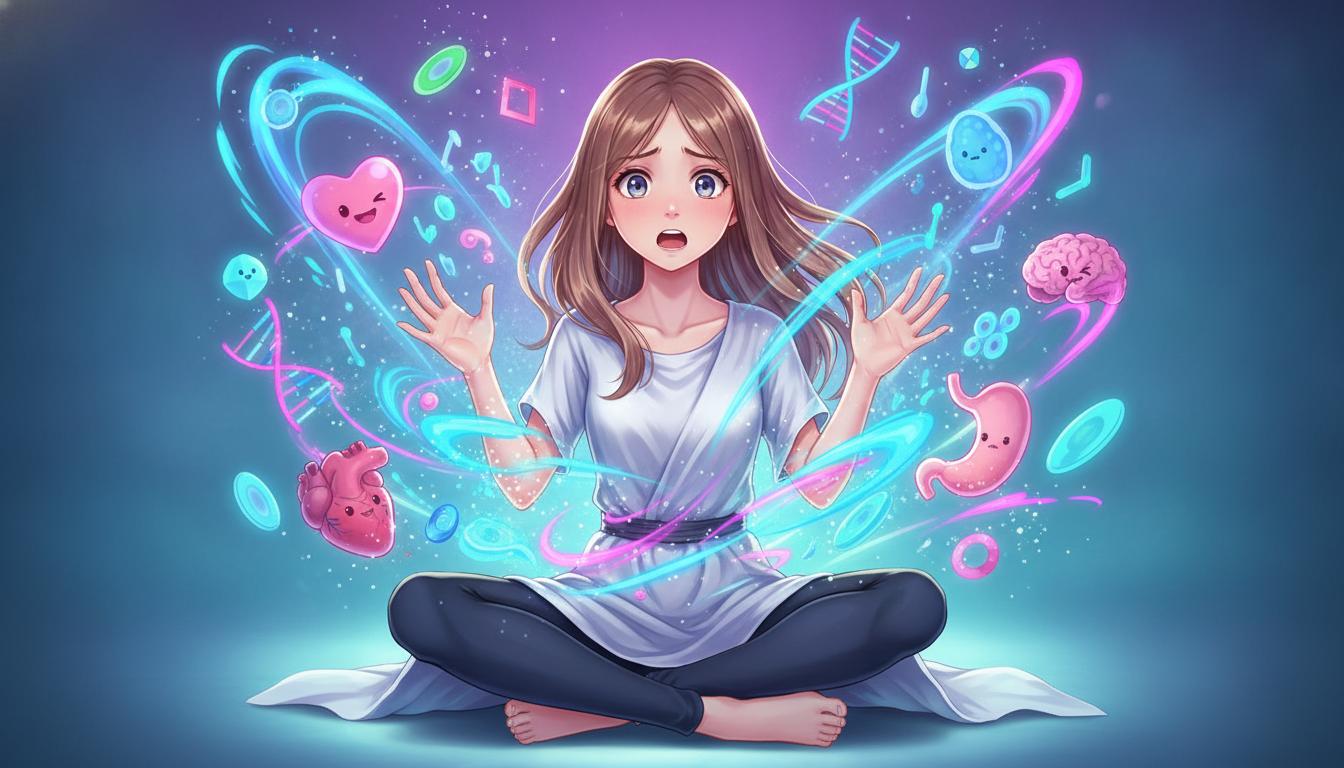
You signed no terms and conditions. You never clicked “agree.” And yet, your body has been running its own background processes since day one — hiccupping at the worst moments, twitching you awake right as you drift off to sleep, making your stomach growl loudly in a silent room full of people. It’s a biological betrayal of the highest order, and the wildest part? None of it is a glitch. Your body is doing exactly what it was designed to do. You just weren’t informed.
If you’ve ever wondered why you jump awake for no reason, why your eye won’t stop twitching, or why your fingers get pruney in water like a raisin someone forgot about, welcome to the club. These moments feel random, embarrassing, or just plain bizarre — but they’re actually the result of millions of years of evolution doing its weird, wonderful best. The human body is basically running software written by ancient ancestors who needed to survive predators, not survive Zoom meetings. The mismatch is… spectacular.
And look, if you’re an anime fan, you already know that the body doing unauthorized things is practically its own genre. From Fullmetal Alchemist‘s brutal lessons about flesh and equivalent exchange to Cells at Work! literally anthropomorphizing your immune system, Japanese animation has long been fascinated with the strange machinery inside us. So let’s break down some of the weirdest, most fascinating things your body does completely without your permission — and why it actually makes a lot of sense, once you understand what’s really going on.
The Hypnic Jerk: Your Brain Hitting the Panic Button at Bedtime
You know the feeling. You’re finally drifting off. Peaceful. Then — BAM — your whole body convulses like you just missed a step on a staircase. You jolt awake, heart pounding, feeling vaguely ridiculous. This is called a hypnic jerk, and it happens to the vast majority of people.
The most widely accepted theory? As your muscles relax during the transition to sleep, your brain misreads the situation as you literally falling and fires an emergency signal to “catch yourself.” It’s a reflex inherited from our primate ancestors, who slept in trees and genuinely needed to not tumble out of them in the night. Your ancient brainstem is, essentially, still worried about falling out of a tree. Very helpful. Very modern.
If you’ve ever watched Your Brain During Dreams and Sleep Is Pure Chaos, you already know that the sleeping brain is doing absolutely unhinged things at all hours. The hypnic jerk is honestly just the beginning.
Goosebumps: Armor for a Body That Has No Fur
Here’s an embarrassing truth about goosebumps: they’re vestigial. Completely useless on modern humans. When you’re cold or frightened, tiny muscles around your hair follicles — called arrector pili — contract and make your (very small, very thin) body hair stand up. In our ancestors, who had significantly more body hair, this created insulation against the cold and made them look bigger and more threatening to predators.
On you? It just makes your arm look like a plucked chicken. Evolution kept the mechanism; it just forgot to keep the fur that made it useful. It’s the biological equivalent of a button on a sleeve — decorative, purposeless, but very much still there.
Stomach Growling: Your Gut’s Extremely Public Announcement System
Your stomach growls when it’s empty, yes — but it also growls when it’s full, when you’re nervous, and pretty much whenever it feels like it. The technical term is borborygmi (try saying that three times fast), and it refers to the sounds made by your gastrointestinal tract as it moves gas and fluid through muscular contractions called peristalsis.
Your digestive system does this constantly. It just gets louder when your stomach is empty because there’s no food to muffle the sound. The timing, of course, is always perfect — a quiet presentation, a solemn movie scene, a first date. Your gut is not your friend. It is a chaotic neutral entity.
Pruney Fingers: A Surprisingly Useful Superpower
For a long time, scientists assumed pruney fingers were just osmosis — water soaking into your skin and causing it to wrinkle. But research has shown something far more interesting: the wrinkling is actually controlled by your nervous system. It doesn’t happen in fingers where the nerves are damaged. Your brain is actively choosing to make your fingertips look like a raisin.
The leading theory is that the wrinkled texture improves grip on wet objects, similar to tire treads channeling water away. Studies have suggested that people with pruney fingers perform better at picking up wet objects. So the next time you get out of a long bath, just know: your body just quietly activated a wet-weather grip enhancement system. Completely without asking you. Incredibly thoughtful of it.
Yawning: The Social Contagion You Can’t Escape
Nobody fully agrees on why we yawn. Theories include cooling down the brain, increasing alertness, or equalizing ear pressure. What is agreed upon is that contagious yawning is real — reading about yawning can make you yawn. Even thinking about it can trigger one. Go ahead, try not to.
Some research suggests contagious yawning is linked to empathy — it tends to be stronger between people with close emotional bonds, and it appears later in children with developmental delays in social cognition. It might be a social bonding behavior, an ancient signal that it’s time for a group to rest together. Your yawn is, potentially, an act of community.
Here are a few other genuinely strange body behaviors that deserve an honorable mention:
- Tearing up when you yawn — your facial muscles compress your tear ducts, squeezing out a little moisture. You’re not sad. You’re just yawning aggressively.
- The diving reflex — when cold water hits your face, your heart rate slows and blood redirects to your vital organs. It’s an involuntary survival response that activates automatically.
- Blushing when embarrassed — adrenaline causes blood vessels in your face to dilate. It’s meant to be part of the fight-or-flight response. Instead, it just tells everyone around you that you’re embarrassed. Peak betrayal.
- Eye twitching (myokymia) — usually caused by stress, caffeine, or lack of sleep. Your eyelid muscle is just having a small, private crisis and inviting you to observe.
- Laughing when tickled — even if you hate it. Tickling triggers a panic response in the brain. Your laughter is not joy. It is distress, expressed differently.
What Anime Gets Right About the Body’s Chaos
Cells at Work! — the manga by Akane Shimizu, adapted into anime — does something genuinely clever: it makes the body’s internal systems feel like a living city under constant siege, with anthropomorphized red blood cells, white blood cells, and platelets working chaotic, thankless jobs. It’s played for laughs and drama, but it’s also rooted in real immunology and cellular biology. When you watch a white blood cell enthusiastically obliterate a pathogen, you’re seeing a dramatized but structurally accurate depiction of your immune response.
The show captures something true: your body is not a passive vehicle you’re riding around in. It is a civilization, constantly at war, constantly repairing, constantly managing systems you will never see or consciously control. That’s both comforting and slightly terrifying, which is probably why it makes such good anime.
For a different but equally fascinating look at human connection and the bizarre gap between what people feel and what their bodies actually do, You and I Are Polar Opposites Is the Rom-Com You Need taps into that same energy — the chaos of being a human person in an uncooperative body, trying to connect with other human persons in their own uncooperative bodies.
The Body Is Not the Enemy (Even When It Feels Like One)
Here’s the thing: none of these behaviors are malfunctions. Every single one of them — the hypnic jerks, the goosebumps, the borborygmi at the worst possible moment — is your body running ancient, deeply optimized code in a world it was never designed for. Evolution is slow, and modern life is fast, and the mismatch is just… life.
Your body is doing its absolute best with several million years of legacy programming, zero documentation, and no customer support line. The least you can do is appreciate the chaos. You didn’t agree to any of it, but you’re living through it anyway — and honestly? That’s kind of impressive.
