


Ever stared at the ocean and wondered why you can’t just gulp it down when you’re thirsty? You’re basically surrounded by water and completely dying of thirst at the same time — it’s nature’s cruelest joke. The ocean covers about 71% of Earth’s surface, holds roughly 97% of all the water on our planet, and yet none of it is drinkable. If that doesn’t sound like a villain origin story, nothing does. The short answer to why it’s salty is surprisingly geeky, involving ancient geology, chemistry, and billions of years of planetary-scale processes that make even the most elaborate anime world-building look simple.
Think of the ocean as a massive, slow-cooking pot that has been simmering for about 3.8 billion years. Over all that time, it has been collecting minerals, ions, and dissolved salts from every river, volcano, and seafloor vent it touches. Nothing really escapes it — water evaporates from the surface, rises into clouds, falls as rain, but the salt stays behind. It’s the ultimate hoarder. And just like your favorite overpowered shonen protagonist who keeps getting stronger with every arc, the ocean just keeps accumulating.
Here’s the wild part: this isn’t a mystery. Scientists understand it really well, and the explanation is elegant in the way that the best science always is — almost poetic when you break it down. So let’s put on our metaphorical lab goggles, channel our inner Senku from Dr. Stone (the genius scientist who rebuilds civilization from scratch using pure chemistry knowledge), and dive deep into one of Earth’s oldest and saltiest secrets.
The Rock and Rain Partnership: Where the Salt Journey Begins
How Rain Slowly Dissolves the Land
Salt doesn’t just appear in the ocean out of nowhere. It begins its journey on land, of all places. When rain falls from the sky, it isn’t pure — it’s very slightly acidic because it picks up carbon dioxide from the atmosphere and forms a weak carbonic acid. That mildly acidic rainwater then lands on rocks and begins to slowly dissolve minerals from them. This process is called chemical weathering, and it happens constantly, everywhere on Earth.
The dissolved minerals — including sodium, calcium, magnesium, potassium, and chloride ions — get carried by tiny streams into rivers, and rivers flow into the ocean. Every single river on Earth is delivering a small but continuous dose of dissolved minerals to the sea. The Amazon, the Nile, the Mississippi — all of them are basically mineral delivery trucks that have been running for billions of years without a day off.
Why Rivers Are Fresh but the Ocean Is Salty
Here’s where the real magic happens. Rivers are also slightly salty in terms of dissolved minerals, but we don’t notice it because the concentrations are very low. When all that river water reaches the ocean, the water itself evaporates from the surface — especially in warm, sunny regions — and rises into the atmosphere as water vapor. But the dissolved salts? They can’t evaporate. They stay behind. Every time water evaporates, it leaves its mineral cargo in the ocean, and the ocean’s salt concentration slowly but steadily increases over geological time.
This is sometimes called the concentration effect, and it’s the reason the ocean gets saltier while rivers stay relatively fresh. It’s a one-way accumulation system. Rain washes minerals off the land, rivers deliver them to the ocean, water evaporates back into the sky, and the minerals remain. Rinse, repeat, for 3.8 billion years.
Volcanoes and Hydrothermal Vents: The Ocean’s Other Salt Suppliers
Earth’s Interior Is Constantly Contributing
Rivers aren’t the only source of ocean salt. The Earth itself contributes directly. Underwater volcanoes and hydrothermal vents — cracks in the seafloor where superheated water shoots up from inside the planet — release enormous amounts of minerals and gases into the surrounding ocean water. These vents can reach temperatures above 400°C (752°F) and are constantly pumping out chemically rich fluid.
The gases released by underwater volcanism include things like hydrogen chloride, which dissolves into the water and contributes chloride ions — the same chloride that pairs with sodium to form table salt (sodium chloride). So in a very real sense, the ocean is partly salty because Earth’s volcanic interior has been seasoning it from below for billions of years. That’s honestly a level of commitment most of us could never match.
What Exactly Is in Ocean Salt?
It’s Not Just Sodium Chloride
When most people think of “salt,” they think of the white stuff in the shaker on your kitchen table — sodium chloride. And yes, that’s the dominant compound in seawater. But the ocean is actually a complex chemical soup. Here are the major dissolved ions found in seawater:
- Chloride (Cl⁻) — the most abundant ion in seawater
- Sodium (Na⁺) — the second most abundant, giving us that classic salty taste
- Sulfate (SO₄²⁻) — third most abundant
- Magnesium (Mg²⁺) — yes, the same mineral in your multivitamins
- Calcium (Ca²⁺) — crucial for sea creatures building shells
- Potassium (K⁺) — another electrolyte important for ocean biology
The average salinity of the ocean is about 3.5% by weight, meaning roughly 35 grams of dissolved salts per kilogram of seawater. That might not sound like much, but scaled up to the total volume of the world’s oceans, you’re looking at an almost incomprehensible amount of salt. It’s estimated that if you could remove all the salt from the ocean and spread it across the land surface of the Earth, it would form a layer more than 150 meters thick.
Why Drinking Seawater Makes Dehydration Worse
The Osmosis Problem That Will Actually Kill You
This is where your body is doing weird things you never authorized becomes brutally relevant. Drinking seawater doesn’t hydrate you — it actively dehydrates you. Here’s why: your kidneys need to excrete excess salt, and they can only produce urine that is less salty than seawater. So to flush out the salt you just drank, your body has to use more water than you consumed in the first place. You end up in a net deficit.
Beyond that, osmosis is the key villain here. When there’s a high concentration of salt outside your cells (in your blood and body fluids), water naturally moves out of your cells to try to equalize the concentration — a process called osmosis. Your cells literally shrink as they lose water. This damages tissues, strains your organs, and in a survival situation can accelerate your death. It’s like trying to solve a debt crisis by taking out more loans.
Is the Ocean Getting Saltier Over Time?
The Surprising Answer: Not Really Anymore
You might assume that because salt keeps getting added to the ocean, it must be getting saltier every century. But scientists believe the ocean’s salinity has actually been relatively stable for hundreds of millions of years. The reason is that natural processes remove salt from the ocean at roughly the same rate it’s being added.
Some of those removal processes include:
- Sea spray that deposits salt on coastal land
- Salt getting trapped in sedimentary rock as ocean basins shift
- Marine organisms that incorporate calcium and other minerals into their shells and skeletons, which then sink to the seafloor
The ocean has essentially reached a chemical equilibrium — inputs and outputs are balanced. It’s a remarkably self-regulating system, and honestly, it makes the ocean feel even more like a living, breathing entity, which is appropriate given how often the sea is personified in mythology, anime, and literature.
Fun and Geeky Salt Facts You Can Use to Win Arguments
- The Dead Sea, located between Israel and Jordan, has a salinity of about 34% — nearly ten times the average ocean. You literally float without trying.
- The least salty major body of water is the Baltic Sea, with a salinity of about 0.5-1% due to massive freshwater inflow from rivers.
- Ancient Roman soldiers were sometimes paid partly in salt, which is where the word “salary” is thought to originate.
- Some deep-sea fish have bodies adapted to high-salt environments through specialized cells that actively pump excess salt out of their tissues.
- Desalination plants — which remove salt from seawater to make it drinkable — exist in over 150 countries, though they are energy-intensive and expensive.
These are the kinds of weird, fascinating facts that make exploring science feel like discovering hidden lore in your favorite RPG — the deeper you go, the more intricate and surprising the world becomes. Speaking of hidden complexity, if you enjoy digging into unsolved mysteries that are too creepy to be real, the deep ocean has plenty more where that came from.
The Ocean as Earth’s Greatest Passive Accumulator
Billions of Years of Patient Chemistry
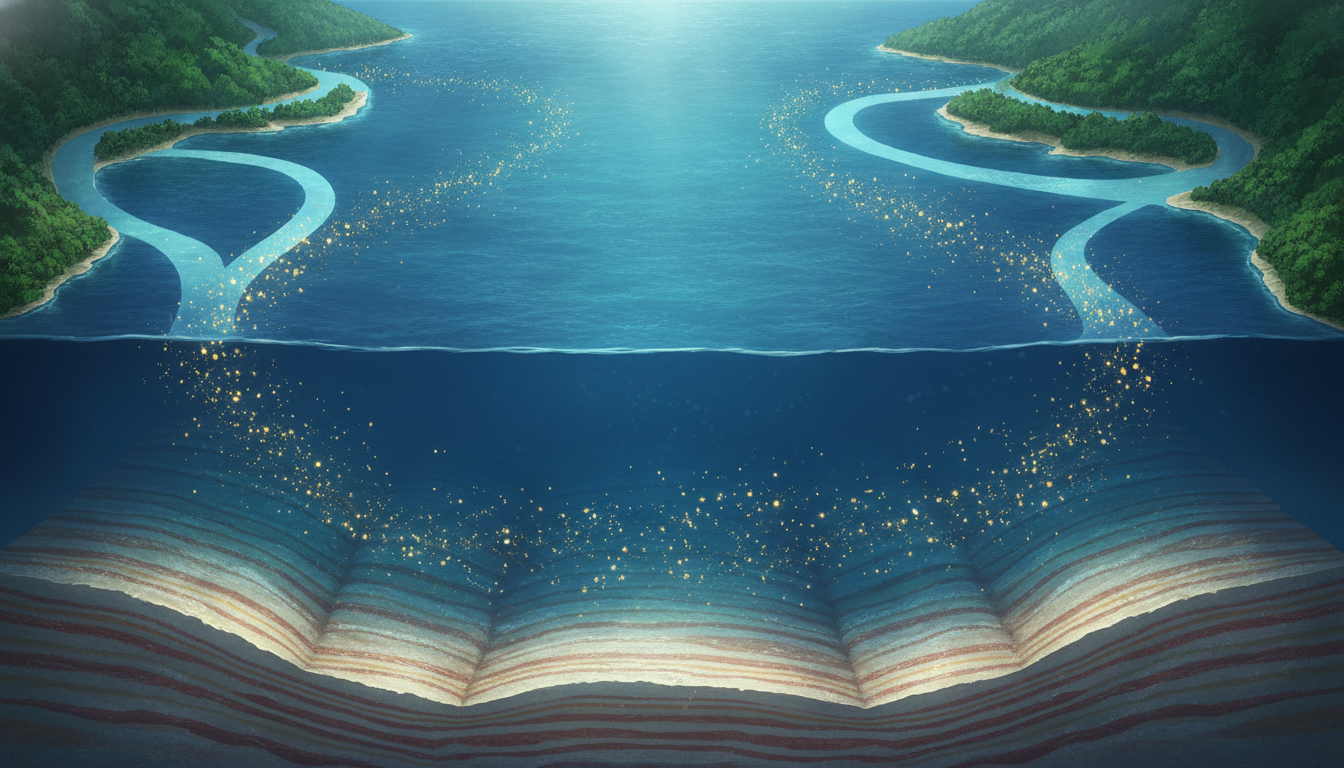
The reason the ocean is salty is ultimately a story about time. Not dramatic, explosive events, but patient, relentless accumulation over geological timescales. Rain falls, rocks dissolve, rivers flow, water evaporates, and salt remains. Volcanoes vent, seafloor spreads, minerals accumulate. Over and over again for nearly four billion years. The ocean didn’t become salty because of one dramatic event — it became salty the way any great thing is built: slowly, consistently, one small contribution at a time.
In a way, it’s a humbling reminder that the most profound things in the universe often happen through processes so gradual we’d never notice them in a single human lifetime. The ocean’s saltiness is Earth telling its own origin story, written in chemistry and measured in geological epochs. Pretty geeky, when you think about it.
So the next time you’re at the beach and take that ill-advised sip of seawater, now you know exactly why it tastes awful and why it won’t hydrate you — you’re tasting billions of years of continental erosion, volcanic activity, and planetary chemistry all at once. The ocean isn’t salty because of any one villain or any single dramatic event. It’s salty because Earth is very, very old, and it has been doing chemistry homework for longer than complex life has existed. And honestly? That’s way cooler than any fictional explanation could ever be.
