

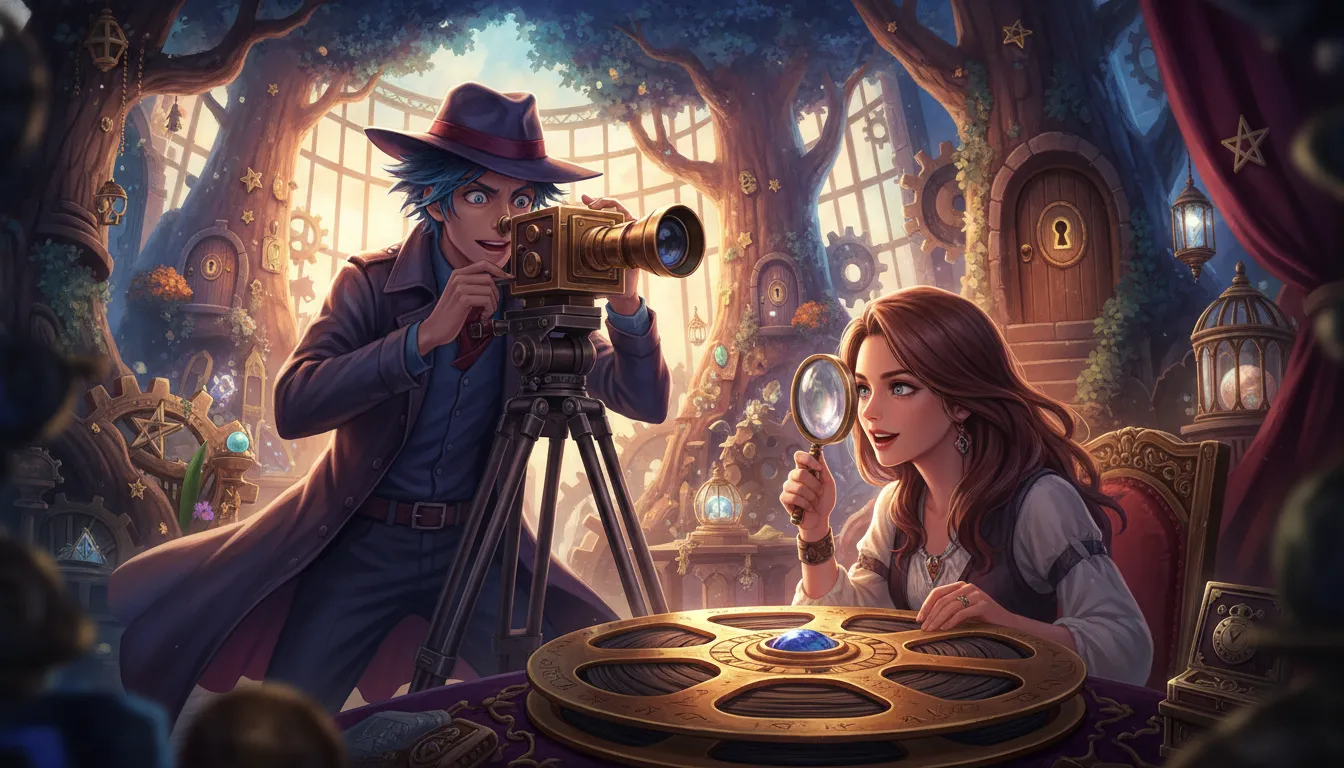
Most Movie Easter Eggs Are Hidden In Plain Sight — And You’ve Been Walking Past Them
Picture this: you’re watching a movie for the fifth time, completely relaxed, when suddenly something in the background snaps into focus. A poster on the wall. A license plate. A name on a coffee cup. And just like that, your brain lights up like a pinball machine because you just spotted it — the Easter egg you missed every single time before. That rush? That’s what directors, animators, and screenwriters have been engineering for decades, quietly planting little gifts for the most attentive viewers in the room.
Easter eggs in film are deliberate hidden references, jokes, or callbacks embedded by creators for audiences sharp enough to catch them. They might nod to a previous project, tease an upcoming sequel, honor a crew member, or just exist because someone in the production had a wicked sense of humor. The term itself borrows from the tradition of hiding decorated eggs — there’s something inherently playful about the concept, a creative game between filmmaker and fan. And here’s the twist that makes it all so satisfying: most of these secrets aren’t buried in impossible-to-find corners. They’re right there in front of you, hiding in plain sight.
Whether you’re a lifelong cinephile or a casual viewer who just wants to know what everyone else is screaming about on social media at 2 a.m., this is your guide to how Easter eggs work, where they live, and why filmmakers can’t seem to stop planting them.
Why Filmmakers Love Hiding Secrets in Their Own Movies
At its core, an Easter egg is a love letter. Directors and writers have spent years — sometimes entire careers — consuming the same pop culture, comic books, and films that their audiences grew up on. When they finally get to sit in the big chair and make their own movie, the temptation to wink at the people who “get it” is almost irresistible.
There’s also a deeply practical reason: rewatchability. A film that rewards a second (or tenth) viewing is a film that maintains cultural relevance long after its theatrical run. Studios benefit from that ongoing conversation. When a fan community spends months dissecting a background detail, that’s essentially free marketing — passionate, organic, and infinitely more credible than any ad campaign.
Beyond commerce, there’s genuine craft involved. Hiding an Easter egg well requires compositional awareness. The filmmaker has to place the reference where the camera naturally lands, where lighting draws the eye, and where it makes thematic or narrative sense. A poorly hidden Easter egg feels like a shout; a perfectly hidden one feels like a whisper only you were meant to hear.
The Marvel Cinematic Universe and the Art of the Visible Secret
No franchise has weaponized the Easter egg quite like the Marvel Cinematic Universe. Since Iron Man launched the MCU in 2008, Marvel Studios has used Easter eggs as connective tissue between films, threading references through background props, throwaway dialogue, and blink-and-you’ll-miss-it visual gags.
One of the most celebrated examples is the Infinity Gauntlet appearing in the background of Thor’s visit to Odin’s vault in Thor (2011) — years before Thanos became the central villain of the saga. Another is Howard the Duck appearing in a crowd scene in Guardians of the Galaxy (2014), a nod to the notoriously campy 1986 Marvel film. These aren’t accidents. Marvel’s production designers work with a meticulous awareness of lore, deliberately staging props that fans will recognize and debate.
The MCU also introduced a new kind of Easter egg: the post-credits scene. What started as a fun surprise — Nick Fury appearing after the credits of Iron Man to talk about the Avengers Initiative — became a genre standard. Today, viewers will sit through ten minutes of production credits just for a thirty-second clip, which is either a testament to great storytelling or a sign that audiences have been very successfully trained. Probably both.
Pixar’s Hidden Universe of Recurring References
Pixar Animation Studios has built an entire mythology around its Easter eggs, centered on one recurring prop: the Pizza Planet truck. This battered yellow delivery vehicle first appeared in Toy Story (1995) and has since shown up — in some form — in nearly every Pixar film. It’s become a tradition and a challenge, with fans scouring each new release to find where it’s been tucked away.
Equally famous is the A113 code, which appears as a room number, license plate, or signage across dozens of Pixar and Disney animated films. The reference points to a classroom at the California Institute of the Arts where many of Pixar’s founders — including John Lasseter and Brad Bird — studied animation. It’s a piece of institutional memory transformed into a running gag that spans decades.
Here are some standout Pixar Easter eggs that reward sharp eyes:
- The Pizza Planet truck appears in Cars as a toy in a pile of junk near a highway
- A113 shows up in WALL-E as a directive code on the robot’s memory files
- Boo’s Jessie doll (from Toy Story 2) can be spotted in Monsters, Inc. — suggesting the films share a universe
- The number 237 appears in multiple Pixar films, a nod to The Shining (1980)
- In Ratatouille, Linguini’s apartment contains a small shadow silhouette that resembles Nemo from Finding Nemo
This tradition of cross-film referencing isn’t just fan service — it suggests a unified, playful creative culture that prizes continuity and self-awareness.
When Easter Eggs Span Entire Franchises
Some Easter eggs operate on a scale so large they function more like architectural blueprints than hidden jokes. The shared universe concept — where different film properties exist in the same fictional world — is essentially one enormous Easter egg that keeps paying off over years of storytelling.
Consider the Spider-Man: No Way Home (2021) multiverse narrative, which brought together characters from three different Spider-Man film series. Every costume detail, every piece of dialogue referencing earlier films, every villain redesign was simultaneously a plot point and an Easter egg for fans who’d grown up with those characters. The film grossed nearly $1.9 billion worldwide, suggesting that this kind of deeply referential storytelling has massive mainstream appeal — not just niche appeal.
Similarly, horror filmmaker James Wan and the broader DC Extended Universe have used Easter eggs to lay groundwork for future installments, seeding references that only make sense in retrospect once the next film lands. This kind of “delayed Easter egg” — where the reward comes much later — is one of the most sophisticated uses of the technique.
Anime Films Join the Easter Egg Tradition
Easter eggs aren’t limited to live-action Hollywood productions. Anime films and series have a rich tradition of hidden references, internal jokes, and cross-property nods that rival anything the MCU has produced. Studio Ghibli films, for example, frequently feature background cameos from characters in other Ghibli productions — a quiet acknowledgment of the studio’s shared aesthetic and spiritual universe.
If you’re the kind of viewer who obsesses over these details, you’ll understand exactly why these anime fights prove this medium has no limits — the same meticulous visual craftsmanship that goes into a great battle sequence is exactly what goes into hiding a perfect Easter egg. The care is the same. The love for the audience is the same.
How to Train Yourself to Spot Easter Eggs
Finding Easter eggs is a learnable skill, and it mostly comes down to shifting how you watch. Most first-time viewers are plot-tracking — their attention follows the main characters and central action. Easter eggs live in the peripheral vision of the film: background signage, extras’ costumes, ambient sound design, prop labels, and transitional shots that don’t seem to serve the story directly.
A few strategies that actually work:
- Rewatch with the volume low — your eyes compensate by scanning more of the frame
- Pause during establishing shots — wide angle shots of rooms and cities are Easter egg goldmines
- Read the credits closely — sometimes the egg IS the credit (unusual names, joke job titles)
- Pay attention to mirrors and reflections — filmmakers love hiding references in surfaces
- Notice what characters are reading, wearing, or drinking — prop departments are in on the joke
The Joy of Being in on the Joke
Ultimately, Easter eggs exist because storytelling is a shared act. A filmmaker puts something into a frame; a viewer pulls it out. That loop — creation, discovery, delight — is one of the purest pleasures that movies offer. It transforms passive watching into active participation, turning an audience into a community of detectives.
The next time you’re settling in for a rewatch, let your eyes wander a little. Linger on the background. Read that sign in the corner. Notice what’s on the shelf. Chances are, someone put something there just for you — hidden in plain sight, waiting patiently for the viewer who would finally look.
