

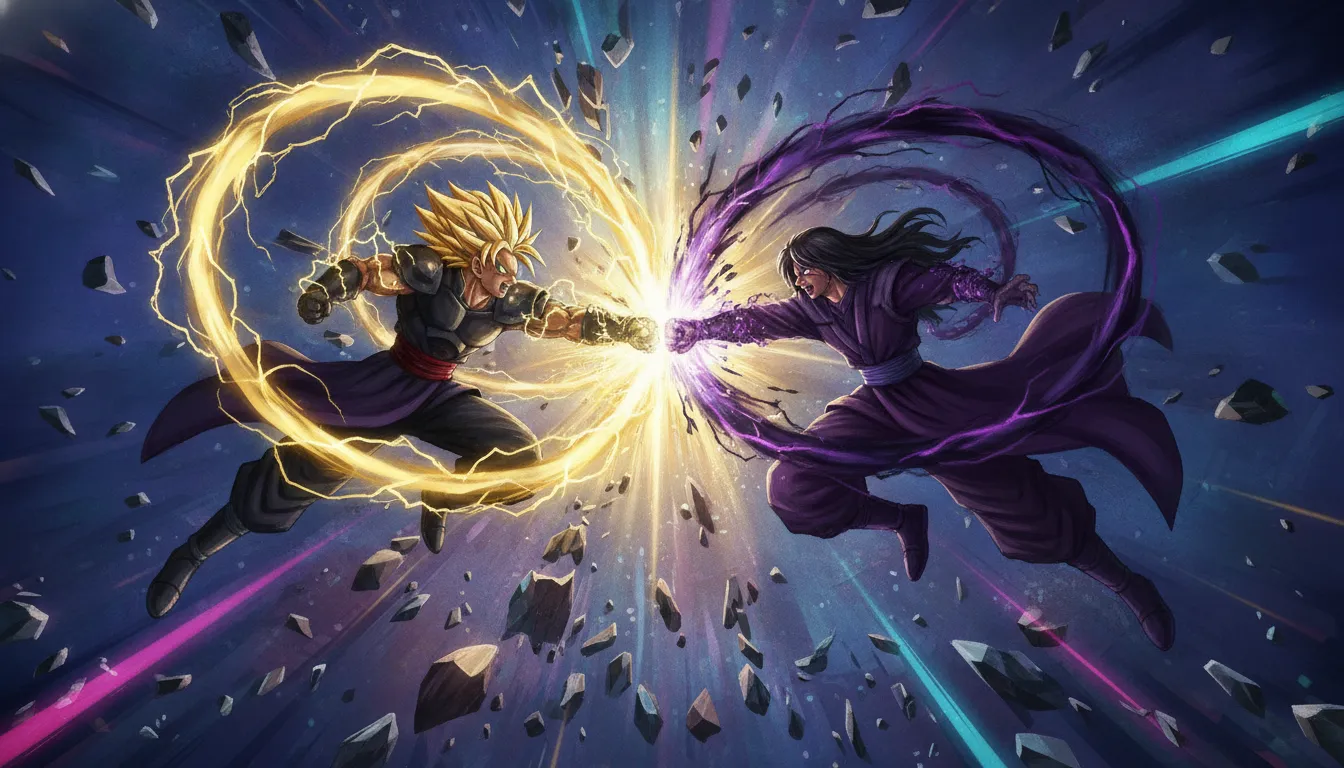
There is a moment in every anime fan’s life when a fight scene stops being entertainment and becomes something closer to a religious experience. Your jaw drops. Your hands go cold. You forget to breathe. The animation moves so fluidly, the music swells so perfectly, and the emotional stakes hit so hard that you genuinely cannot believe what you are watching was drawn by human hands. Live-action cinema, video games, and comics have all tried to capture that feeling, but anime keeps arriving at a destination none of them can quite reach.
What makes anime fights uniquely powerful is not just the animation quality — though that matters enormously — but the combination of decades-long character development, thematic weight, jaw-dropping visual direction, and music that lands like a physical force. A great anime battle is not just two people hitting each other. It is the culmination of everything the story has been building toward, delivered in a medium with virtually no physical constraints. No wire budget. No actor safety concerns. No limits on what the camera can do. The only ceiling is the imagination of the animators, and the best studios in the industry have proven, repeatedly, that their imaginations have no ceiling at all.
From underground cult classics to streaming mega-hits, here are some of the anime fights that prove this medium is genuinely operating in a league of its own.
Goku vs. Frieza: The Fight That Defined a Generation
Before we get to the modern era, it is impossible to talk about anime’s unlimited potential without acknowledging the battle that put the medium on the global map. Goku vs. Frieza in Dragon Ball Z — specifically the moment Goku transforms into a Super Saiyan for the first time on the planet Namek — remains one of the most culturally significant sequences in animation history.
The transformation scene itself is relatively simple by today’s standards. The animation team at Toei Animation worked under notorious production pressure in the early 1990s, and corners were visibly cut. But none of that matters, because the idea was so electrifying that it transcended its technical limitations. A golden aura. A scream of pure grief and rage. A power level that shattered the rules of the entire series. That moment proved anime could deliver emotional escalation that no other medium had attempted at that scale, for a mass audience, on a weekly television schedule.
Decades later, that fight is still being discussed, analyzed, and lovingly parodied. These retro anime shaped an entire generation forever — and Goku going Super Saiyan is perhaps the single most defining proof of that statement.
Demon Slayer’s Visual Revolution: Rengoku vs. Akaza
When Demon Slayer: Kimetsu no Yaiba — The Movie: Mugen Train released in 2020, it became the highest-grossing film in Japanese box office history at the time. The fight that closes that film, Flame Hashira Rengoku Kyojuro vs. the Upper Moon Three demon Akaza, is exhibit A in the case that anime has surpassed every other medium in pure visual storytelling.
Studio ufotable, known for its obsessive attention to detail and its pioneering blend of 2D and 3D animation, created a sequence that still leaves viewers slack-jawed on rewatch. The flame effects do not look like animated fire — they look like something alive, breathing, hungry. Every slash carries weight. Every impact feels brutal. And when the sun begins to rise and the fight reaches its devastating conclusion, the visual language communicates everything the audience needs to feel without a single line of dialogue.
Key reasons why this fight set a new bar for the medium:
- ufotable’s proprietary animation pipeline blends hand-drawn character work with digitally rendered environmental effects in a way that feels seamless rather than uncanny
- The fight lasts roughly fifteen minutes but feels both enormous in scope and deeply intimate
- Rengoku’s final words recontextualize the entire battle as a meditation on legacy, not victory
- The color grading shifts throughout the sequence, moving from cold midnight blues to the warm golds of sunrise in a way that mirrors the emotional arc perfectly
Mob Psycho 100: When Raw Emotion Becomes Animation Itself
If ufotable’s approach is meticulous technical craft, Studio Bones’s work on Mob Psycho 100 is something wilder and more instinctive. The series follows Shigeo Kageyama, known as Mob, a middle schooler with near-limitless psychic power who desperately tries to suppress his emotions because he knows what happens when they overflow.
The fight sequences in Mob Psycho 100 — especially throughout Season 2 and the climactic moments of Season 3 — are designed to look intentionally unstable. Animators use deliberately rough, almost sketch-like linework during moments of peak emotional release. The art style degrades and explodes in ways that feel spontaneous and dangerous. It is animation that is made to look like it is barely holding itself together, because the character it depicts is barely holding himself together.
This is anime doing something no live-action medium can do: using the visual language of the art form itself as an emotional storytelling tool. The medium and the message become the same thing.
Jujutsu Kaisen and the Age of Hyperspeed Choreography
MAPPA’s Jujutsu Kaisen arrived in 2020 and immediately established itself as the defining action anime of its era. The fight between Yuji Itadori and Mahito in Season 1, and more explosively the Gojo Satoru vs. Toji Fushiguro fight in the prequel arc of Season 2, demonstrated that anime choreography had entered a new phase of complexity.
The Gojo vs. Toji fight in particular — animated across multiple episodes of Jujutsu Kaisen Season 2 in 2023 — features movement so fast and spatially complex that freeze-framing reveals detail invisible at normal playback speed. Animators working on that sequence reportedly produced frames that exist for less than a single second of screen time, packed with character acting and environmental interaction that most productions would never attempt.
Did you know?
- The key animator Shota Goshozono received widespread fan recognition for his work on the Gojo vs. Toji sequence
- MAPPA also produced Attack on Titan: The Final Season, handling two major franchises simultaneously during one of the most demanding production windows in recent anime history
- Fan communities on social media dissected individual frames of the Gojo fight for weeks after its release, discovering micro-expressions and detail hidden in frames lasting fractions of a second
Vinland Saga and the Weight of Purposeful Violence
Not every landmark anime fight is about spectacle. Thorfinn vs. Askeladd across the first season of Vinland Saga (produced by Wit Studio) is a masterclass in using combat to convey moral complexity. Thorfinn is a child soldier driven entirely by the desire for revenge. Every time he fights Askeladd, he reveals not how powerful he is becoming, but how trapped he remains in his own grief.
The fights are brutal and realistically grounded. There are no energy blasts or impossible acrobatics. There is just swords, exhaustion, and the hollow victory of a boy who wins battles but cannot win back what he lost. Vinland Saga proves that anime’s lack of limits applies not just to visual ambition but to the emotional and philosophical territory the medium is willing to explore through action.
Why Anime Fight Scenes Hit Differently Than Anything Else
| Element | Live-Action Film | Western Animation | Anime |
|---|---|---|---|
| Physical constraints on camera | Yes | Limited | None |
| Budget limits on spectacle | Very high | High | Moderate to low |
| Emotional + visual storytelling integration | Variable | Rare | Consistent |
| Decades-long character investment payoff | Rare | Very rare | Common |
| Style as emotional language | Difficult | Occasional | Frequent |
The table above does not declare anime a winner at everything — live-action cinema has achievements animation never will. But in the specific discipline of fight-scene storytelling, anime holds structural advantages that its competitors cannot replicate without abandoning what makes them what they are.
The Future of Anime Fights Is Already Here
With continuing developments in digital animation tools and studios like ufotable, MAPPA, Bones, and Wit Studio pushing their craft further every year, the trajectory is clear. Anime fights in 2026 are operating at a level that would have seemed impossible to the animators who worked on Goku’s Super Saiyan transformation. And in another decade, today’s benchmark sequences will probably feel like the starting line.
If you want to understand where anime is headed narratively as well as visually, checking out coverage of upcoming releases — like Re:Zero Season 4 and what we know so far — gives a sense of how the medium’s storytelling ambitions are scaling alongside its visual achievements.
Anime fights are not just animated action sequences. They are proof that when storytelling ambition meets a medium with no physical constraints and a creative culture that treats craft as sacred, something genuinely new under the sun becomes possible. We are watching it happen in real time, and there is nothing quite like it anywhere else in entertainment.
