

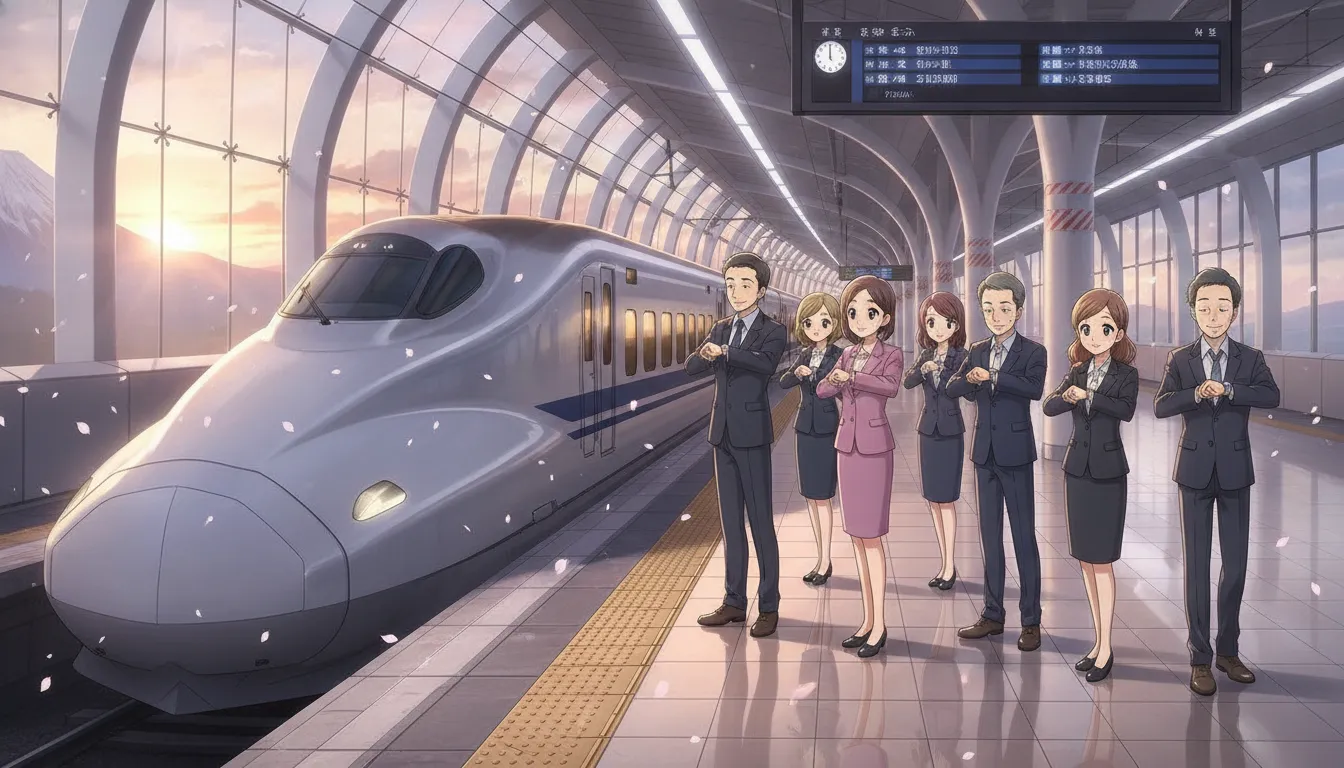
Imagine stepping onto a train platform in Tokyo, glancing at your watch, and watching the doors slide shut at the exact second the schedule promised. No delays, no crackled apology over the intercom, no frustrated commuters checking their phones for updates. For most of the world, that scenario sounds like science fiction — maybe something out of an anime where a hypercompetent character makes the impossible look effortless. But in Japan, it’s just a Tuesday. The country’s rail network has built a reputation so legendary that it has become a cultural export unto itself, inspiring awe in tourists, envy in urban planners, and a genuine sense of national pride in Japanese citizens.
This isn’t just folklore or tourist-brochure hype. Japan’s trains really are that punctual, and there’s a mountain of data, engineering philosophy, and deeply human dedication behind the phenomenon. The Shinkansen — Japan’s famous bullet train network — has maintained average annual delays measured in seconds, not minutes. The entire system is so precise that when a train runs even a minute late, the railway company issues a formal public apology. A minute. Meanwhile, commuters in other major cities around the world would celebrate if their subway arrived within fifteen minutes of schedule. So how does Japan actually pull this off? Let’s break it down.
The Numbers That Make the Rest of the World Jealous
Shinkansen Punctuality Stats That Defy Belief
Let’s start with the headline figures, because they deserve to be savored. The Tokaido Shinkansen — the world’s busiest high-speed rail line, running between Tokyo and Osaka — has historically maintained an average delay of under one minute per train. That figure accounts for all causes of delay, including weather events and the rare passenger incident.
In a country where over 150 million passengers ride the Shinkansen network annually, that level of precision is almost surreal. Compare that to high-speed rail systems in Europe or North America, where delays of five to fifteen minutes are considered perfectly acceptable, and the gap in performance becomes genuinely staggering.
Some key numbers worth knowing:
- The Tokaido Shinkansen has been operating since 1964, originally launched to coincide with the Tokyo Olympics
- Average annual delay on the Tokaido Shinkansen line has repeatedly been recorded at around 54 seconds per train
- JR Central, the operator of the Tokaido Shinkansen, runs roughly 120 to 130 trains per day on that single corridor
- Japan’s urban metro systems, like the Tokyo Metro, regularly achieve 99%+ on-time rates defined as arriving within one minute of schedule
- When a Shinkansen was 25 seconds late in 2018, the company issued a formal written apology — the incident made international news
Why Punctuality Is a Cultural Value, Not Just a Policy
Kaizen, Omotenashi, and the Philosophy Behind the Timetable
To understand why Japan’s trains are so punctual, you have to understand that this isn’t merely an engineering achievement. It’s a cultural one. Two concepts are particularly central to the Japanese approach.
Kaizen (改善) means “continuous improvement.” It’s a philosophy applied in manufacturing, business, and yes, railway operations. Every inefficiency is identified, studied, and corrected. There’s no such thing as “good enough” — only “better than yesterday.”
Omotenashi (おもてなし) refers to a form of selfless hospitality and anticipatory service. In the context of rail travel, it means that station staff and train operators don’t just meet passenger expectations — they try to exceed them before passengers even realize they had an expectation. That means cleaning crews that sprint through Shinkansen carriages in seven minutes between arrivals, station attendants who bow as trains depart, and schedules built with human dignity as a design requirement.
These aren’t just nice ideas on a poster in the breakroom. They are operationalized through intensive training programs, rigorous staffing protocols, and a work culture where lateness — personal or professional — carries genuine social weight.
The Engineering Marvel Behind the Magic
Tracks, Technology, and the Men and Women Who Maintain Them
Japan’s rail infrastructure is a technological achievement that rivals anything in the world. The Shinkansen tracks are dedicated lines — meaning high-speed trains never share tracks with slower regional or freight services. This alone eliminates a massive category of potential delays.
The trains themselves use sophisticated onboard systems that communicate constantly with central control. Speed, spacing, and braking are all managed to tolerances that would make an aerospace engineer nod in appreciation. The newer N700S series Shinkansen trains, for example, feature improved battery systems that allow them to reach the nearest station even during a power outage — a detail that tells you everything about the priority Japan places on not leaving passengers stranded.
Maintenance is equally obsessive. The Doctor Yellow — a special diagnostic Shinkansen that inspects track conditions at high speed — has become something of a beloved icon in Japan. Spotting one is considered good luck, partly because it runs infrequently and its schedule is not publicly announced. It checks track geometry, overhead wire condition, and signal systems, ensuring problems are found before they cause delays rather than after.
The Human Element: Staff Training and Shisa Kanko
Pointing and Calling — The Safety Ritual That Works
One of the most visually distinctive aspects of Japanese rail operations is a practice called shisa kanko, or “pointing and calling.” You’ve probably seen videos of it: station staff and train operators physically point at instruments, signals, and track elements while verbally announcing what they’re checking.
This isn’t theater. Studies have shown that shisa kanko reduces errors in task completion by a significant margin compared to silent, passive observation. By engaging both the physical and verbal faculties simultaneously, workers are far less likely to miss a step or overlook a problem. The technique has since been studied and adopted in safety-critical industries around the world, from aviation to healthcare.
Train drivers in Japan also undergo extensive simulation training and regular performance reviews. The culture around the job is one of intense professional pride. Being a Shinkansen driver is considered a prestigious occupation, which means candidates are highly motivated and attrition among trained operators is relatively low.
When Things Go Wrong: Japan’s Response to Delays
Apology Culture and the Delay Certificate
Even in Japan, delays happen. Natural disasters, medical emergencies, and occasional infrastructure issues do interrupt the schedule. What’s revealing is how the system responds when things go wrong.
Passengers who are late to work because of a train delay can request a chien shoumeisho — a delay certificate — directly from station staff. These formal documents are taken seriously by employers as legitimate excuses for tardiness, which tells you something important: the implicit social contract is that if you’re late, and the train caused it, the railway is acknowledging responsibility in writing. That’s accountability baked into the bureaucracy.
When a major delay occurs, announcements are made with specific, accurate information rather than vague reassurances. Passengers are told what happened, what is being done, and when service is expected to resume. Compare that to the experience of being stuck in a tunnel with a crackling intercom muttering something about “an earlier incident at another station,” and the contrast is stark.
Japan’s Trains in Pop Culture: The Anime Connection
From Spirited Away to Your Name — Trains as Storytelling Icons
Japan’s rail culture has left a deep mark on its pop culture output, and anime is full of it. In Spirited Away (2001), directed by Hayao Miyazaki, a ghostly train crossing a flooded plain is one of the film’s most haunting and beautiful sequences. In Your Name (2016), trains are woven into the emotional geography of the story, connecting characters across distance and time. Even in more action-focused series, the precision and rhythm of Japanese train travel feels embedded in how the culture imagines movement and connection.
This love for trains isn’t nostalgia — it’s a living relationship. Japan has some of the most fascinating cultural quirks you’ll find anywhere, and rail culture is genuinely one of the richest veins to explore. Geek culture and train culture overlap more than you might expect: there are dedicated train otaku (enthusiasts) called tetsudo fans who catalog lines, photograph rolling stock, and debate the relative merits of different Shinkansen series with the same energy that anime fans bring to debating the greatest characters of all time.
Conclusion: A Moving Argument for What’s Possible
Japan’s train punctuality isn’t an accident, and it isn’t magic — it’s the result of deliberate cultural values, engineering rigor, institutional accountability, and a workforce that takes genuine pride in what it does. Every second-perfect departure is a quiet argument that when a society decides something matters, truly decides it, remarkable things become routine. The next time your own city’s transit system lets you down, you now know what the alternative looks like. And it departs exactly on time.
