

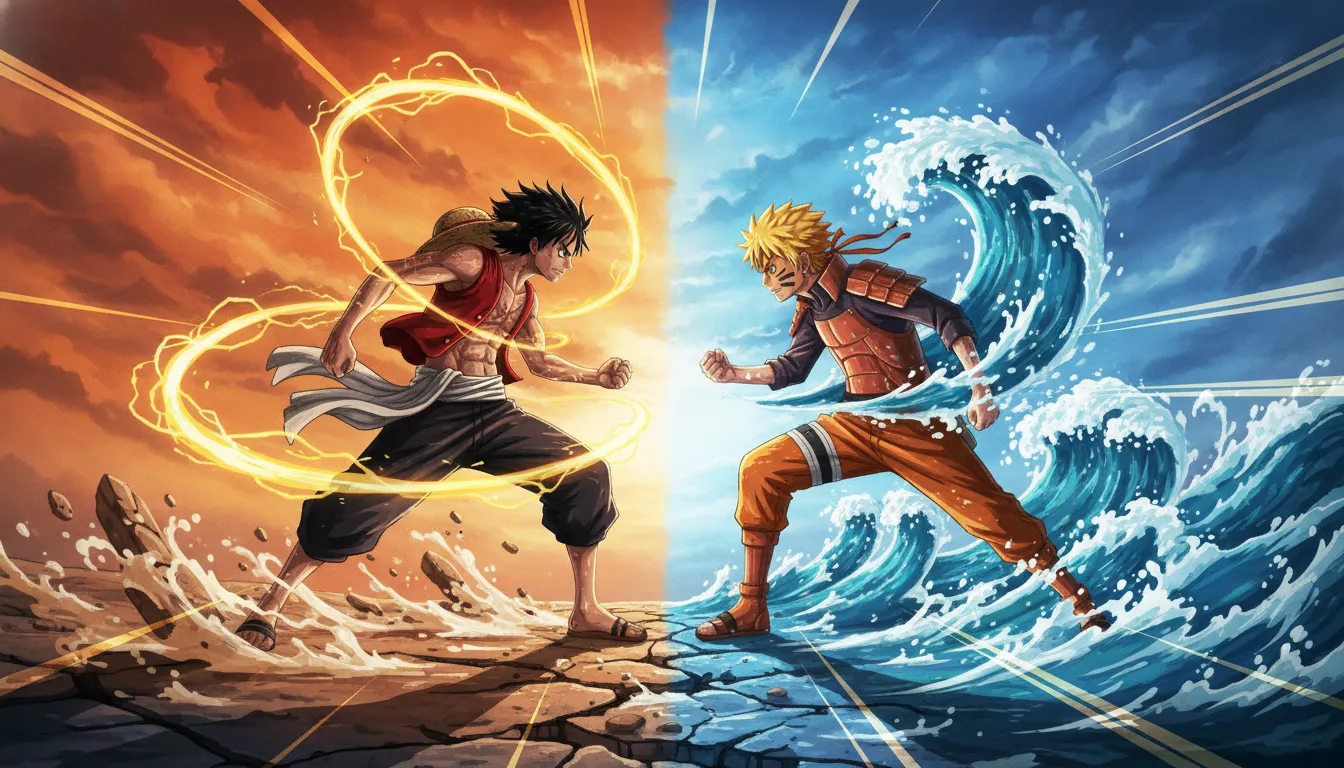
Two legends. One throne. For decades, anime fans have clashed in comment sections, Reddit threads, and convention hallways over a single, beautifully divisive question: who is the true Greatest of All Time — Monkey D. Luffy from One Piece or Naruto Uzumaki from Naruto? Both characters launched entire generations into the world of anime. Both made us cry, cheer, and throw our snacks at the screen. And both carry the kind of narrative weight that is almost impossible to fully measure. Yet here we are, measuring it anyway.
This isn’t just a debate about power levels or fight statistics. It’s a conversation about cultural impact, storytelling depth, thematic resonance, and what it truly means to be a generational icon. Luffy and Naruto are the two biggest names in what fans often call the “Big Three” era of Shonen Jump — a golden period of manga and anime that also included Ichigo from Bleach — and their legacies continue to evolve. With One Piece still ongoing in both manga and anime form as of 2026, and the Naruto universe expanding through Boruto: Two Blue Vortex, this rivalry is far from settled.
So let’s break it down properly. No bias. Well, maybe a little bias. But we’ll be fair about it.
The Origin Stories: Underdog Energy at Its Finest
Luffy’s Dream Was Always Bigger Than Logic
Monkey D. Luffy debuted in Weekly Shonen Jump in July 1997, created by Eiichiro Oda. From the very first chapter, Luffy declared he would become King of the Pirates — not because he had the power to back it up, but because he simply refused to believe otherwise. His Devil Fruit ability, the Gomu Gomu no Mi (which later was revealed to actually be the Hito Hito no Mi, Model: Nika — a mythical Zoan-type fruit), gave him a rubber body and, eventually, one of the most creative and visually wild power systems in all of anime.
What makes Luffy’s origin special is how ordinary he is at heart. He’s not calculating. He doesn’t train for revenge or to prove something to the world. He just wants to be free and have adventures with his friends. That purity of spirit is disarming, and Oda has used it to explore some of the deepest themes in manga — oppression, justice, systemic corruption, and the true meaning of freedom.
Naruto’s Story Is Built on Pain and Perseverance
Naruto Uzumaki arrived in Weekly Shonen Jump in September 1999, created by Masashi Kishimoto. An orphan who had a nine-tailed fox demon (the Kyuubi) sealed inside him as a baby, Naruto was shunned by his entire village from birth. His signature catchphrase — “Dattebayo!” (often translated as “Believe it!”) — became the rallying cry of a generation of kids who also felt like outsiders.
Naruto’s journey is one of the most emotionally detailed in anime. The themes of loneliness, self-worth, and the cycle of hatred give the series genuine philosophical weight. By the time Naruto achieved his dream of becoming Hokage (the leader of his village, Konoha), fans felt every single step of that climb. It wasn’t handed to him. He earned it — repeatedly, painfully, and beautifully.
Cultural Impact: Numbers Don’t Lie (Much)
When we talk about cultural footprint, both franchises operate at a scale most other media can only envy.
- One Piece manga has sold over 500 million copies worldwide as of recent reports, making it the best-selling manga series in history.
- The Naruto manga sold over 250 million copies globally, placing it among the highest-selling manga of all time.
- The One Piece anime, produced by Toei Animation, began airing in October 1999 and continues to this day in 2026.
- The Naruto anime ran from 2002 to 2007, followed by Naruto: Shippuden from 2007 to 2017 — both produced by Studio Pierrot.
- Naruto consistently ranks among the most-watched anime on streaming platforms globally, years after the original series ended.
- Luffy’s Gear Fifth transformation, first animated by Toei in 2023, broke social media entirely — trending worldwide for days.
If sales figures are the scoreboard, Luffy wins on raw numbers. But if we’re talking about penetrating mainstream pop culture beyond anime circles, Naruto has an argument. The “Naruto run” literally became a global meme. That’s a different kind of victory.
Power Scaling: Who Would Actually Win in a Fight?
Let’s be honest — this is what half the internet really wants to know.
Naruto, by the end of Shippuden and into Boruto, is operating at a godlike level. In his Six Paths Sage Mode, combined with Kurama’s chakra (prior to story events that changed that dynamic), he could move at near-light speeds, regenerate from severe injuries, and match the power of divine beings like Kaguya Otsutsuki.
Luffy, post-Gear Fifth, is essentially a cartoon god made real. His Haki (a spiritual force all powerful fighters in One Piece can use) has reached Conqueror’s-level coating, which is reserved for only the most exceptional warriors in his world. Gear Fifth Luffy can reshape reality around him to a degree, turning the environment into what appears to be a Looney Tunes sketch — with genuine destructive consequences.
In a straight fight? Most power-scaling analysts lean toward this being an extremely close match, with Gear Fifth Luffy having a slight edge in terms of raw unpredictability. But this debate will never truly be settled — and honestly, that’s part of the fun. If you want to go even deeper into top-tier anime power rankings, check out Who Are the Strongest Jujutsu Kaisen Characters Really? for some fascinating cross-series context.
Emotional Depth: Which Story Hit Harder?
Naruto’s Emotional Peaks Are Almost Unfair
The death of Jiraiya — Naruto’s mentor and one of the most beloved characters in the series — remains one of the most discussed moments in anime history. The scene where Naruto learns of his death, set against a haunting soundtrack, is devastating. The Pain arc, where Naruto returns to a destroyed Konoha, is peak storytelling.
One Piece’s Ohara, Marineford, and Everything After
One Piece answers back with the Marineford War (one of the most chaotic and emotionally brutal arcs in manga), the backstory of Nico Robin and the destruction of Ohara, and — most memorably — the death of Portgas D. Ace, which left millions of fans in genuine mourning. Oda has a gift for making you love a character and then absolutely wrecking you with their fate.
Both series excel at this. The emotional coin lands differently for different fans, and that’s completely valid.
Legacy and Longevity: Who Will Still Matter in 20 Years?
This might be where the gap becomes clearer. One Piece is still actively building its mythology. The final saga of the manga is currently underway as of 2026, and Oda has indicated the series is approaching its conclusion — though he has said this before. The fact that One Piece remains a massive, ongoing cultural event after nearly 30 years is staggering.
Naruto’s legacy is preserved and expanding through Boruto: Two Blue Vortex, which has received much stronger reception than its predecessor. The original series also benefits from one of the most iconic anime soundtracks ever composed. (Speaking of iconic soundtracks, Are These the Most Epic Anime Soundtracks Ever Made? is worth a read if you’re a music nerd.)
Both franchises will matter in 20 years. The question is whether Luffy’s story, once fully completed, eclipses everything else — or whether Naruto’s emotional universality keeps it perennially relevant.
The Verdict: Is There Even a GOAT?
Here’s the uncomfortable truth that every honest anime fan eventually arrives at: you cannot objectively crown one GOAT between Luffy and Naruto. The two serve different needs, hit different emotional notes, and represent different philosophies of what a hero can be.
Naruto is the hero of the wounded — the kid who needed to be seen, believed in, and loved despite his flaws. Luffy is the hero of the free — the force of nature who doesn’t need the world’s approval because he already knows who he is.
Both of those archetypes are profoundly human. Both resonate across cultures, languages, and generations. The debate isn’t really about who wins. It’s about which philosophy speaks louder to you at this moment in your life.
And if your answer changes over time? That just means you’re growing. Which, honestly, is exactly what both Luffy and Naruto would want for you.
