

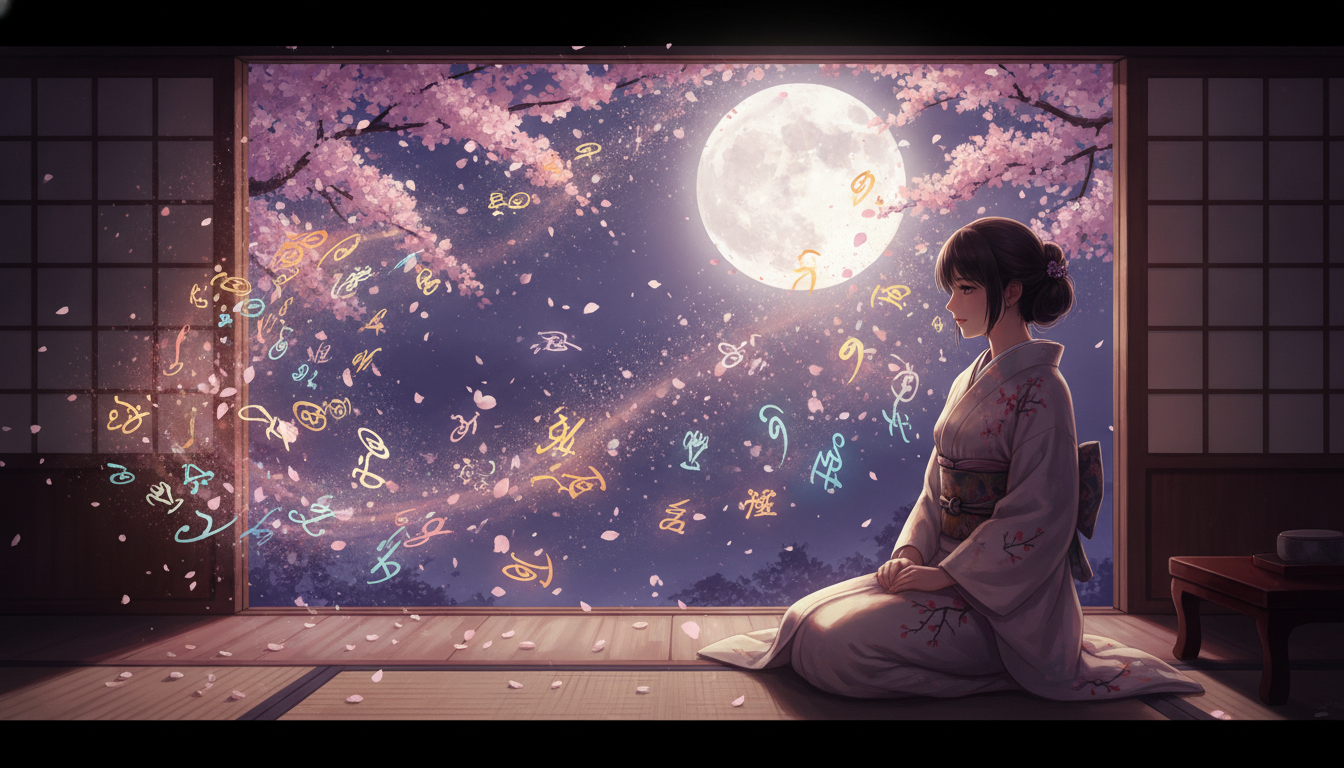
Imagine trying to explain to someone who has never seen snow exactly what it feels like when a quiet Sunday afternoon wraps around you like a warm blanket — that specific, cozy satisfaction of having nowhere to be and nothing urgent to do. In English, you might string together a dozen words and still fall short. In Japanese, you simply say komorebi, or natsukashii, or wabi-sabi, and every listener immediately understands the feeling in their bones. Japanese is absolutely packed with words like these — concepts so precise and emotionally resonant that English speakers hear them and immediately think, “Wait, that’s a word? Why don’t WE have that word?”
For anime fans, J-pop lovers, manga readers, and anyone who has ever tumbled headfirst down a Japanese culture rabbit hole, these untranslatable words are more than linguistic curiosities. They are windows into an entire worldview, a way of seeing life that values the ephemeral, the bittersweet, the quietly beautiful, and the deeply communal. They explain, in many ways, why anime hits so hard emotionally, why certain scenes from Your Lie in April or Anohana make you cry in ways you cannot fully articulate. The Japanese language already had a word for what you were feeling. You just didn’t know it yet.
This is a love letter to the Japanese words that have no clean English equivalent — the ones that make you stop mid-scroll and whisper, “that’s beautiful.”
The Philosophy Hiding Inside Japanese Vocabulary
Before diving into individual words, it helps to understand why Japanese has so many of these untranslatable gems. Japanese culture places enormous value on subtlety, on emotional sensitivity, and on the relationship between humans and the natural world. Concepts like impermanence (mujō) are deeply embedded in Buddhist thought, which has shaped Japanese aesthetics for centuries. There is also a strong cultural emphasis on shared feeling — on the idea that certain emotions are universal enough to name, even when they are subtle.
This philosophy bleeds into everything: architecture, cuisine, art, and of course, storytelling. It is a significant reason why anime and manga are so extraordinarily good at depicting emotional nuance. Japanese creators are literally working in a language that has dedicated words for feelings most cultures leave nameless.
Words That Will Immediately Change How You See the World
Let’s get into the magic. These are some of the most beloved and mind-expanding untranslatable Japanese words:
- 木漏れ日 (Komorebi) — The interplay of light and leaves; the dappled sunlight that filters through tree branches. There is an entire visual phenomenon here that English lumps vaguely under “sunlight through trees,” but komorebi captures it with precision and poetry.
- 物の哀れ (Mono no Aware) — Often translated as “the pathos of things,” this phrase describes the bittersweet awareness of impermanence — the ache you feel watching cherry blossoms fall, knowing their beauty is amplified by the fact that it won’t last. If you’ve ever felt your heart tighten during a gorgeous sunset, you’ve felt mono no aware.
- 懐かしい (Natsukashii) — More than plain nostalgia, natsukashii is the warm, slightly melancholy feeling triggered by something from your past. Hearing an old song, smelling something from childhood — natsukashii is the emotional echo of who you used to be.
- 侘び寂び (Wabi-Sabi) — A profound aesthetic philosophy that finds beauty in imperfection, incompleteness, and transience. A cracked old tea bowl is more beautiful because of its crack. An overgrown path is more beautiful because nature is reclaiming it.
- 木霊 (Kodama) — The spirit of a tree, or a word for an echo in the mountains. Studio Ghibli fans will immediately recognize this from Princess Mononoke (1997), where the silent, rattle-headed forest spirits are called Kodama — spirits of the ancient trees that Ashitaka encounters in the forest of the Deer God.
- 積ん読 (Tsundoku) — The act of buying books and letting them pile up, fully intending to read them but never quite getting around to it. This word will be painfully familiar to anyone with a three-digit manga backlog.
- 木枯らし (Kogarashi) — The first cold wind of winter. The Japanese named the specific wind that signals summer is truly, finally over. That’s the level of emotional precision we are working with.
How These Words Live Inside Anime and Manga
This is where things get genuinely exciting for fans. Once you know these concepts, you start seeing them everywhere in Japanese storytelling. Mono no aware is practically the engine that drives slice of life anime that melt every drop of stress away — shows like Mushishi, Laid-Back Camp, or March Comes in Like a Lion are built entirely around the beauty of fleeting moments.
Consider Anohana: The Flower We Saw That Day (2011). The entire narrative is soaked in natsukashii — childhood memories, the ghost of a friend, the ache of growing up and growing apart. The show doesn’t just make you feel nostalgic; it makes you feel the specifically Japanese version of nostalgia, the one with grief wrapped inside it.
Or take Demon Slayer: Kimetsu no Yaiba, where the cherry blossoms that bloom during key scenes — particularly involving the Kamado family — are a deliberate visual invocation of mono no aware. The blossoms are beautiful because they are temporary. The characters are precious because they can be lost.
Wabi-Sabi in Ghibli Films
Studio Ghibli is arguably the greatest visual ambassador for wabi-sabi in global entertainment. Director Hayao Miyazaki has spoken in interviews about his deep connection to aging, imperfection, and the natural world. Films like My Neighbor Totoro (1988) and The Tale of the Princess Kaguya (2013) — the latter directed by the late Isao Takahata — lean heavily into the idea that something broken or impermanent can be more moving than something perfect and permanent.
Nausicaä of the Valley of the Wind (1984) takes this even further, presenting a decayed, toxic world and asking the audience to find it hauntingly beautiful. That’s wabi-sabi operating at the scale of an entire civilization.
The Unique Power of Japanese Sound-Words (Onomatopoeia)
Japanese also has an extraordinary system of sound-symbolic words — gitaigo and giseigo — that describe textures, feelings, and states of being with sounds alone. These are deeply difficult to translate and yet incredibly common in everyday Japanese and in manga.
- ふわふわ (Fuwa Fuwa) — Soft, fluffy, light. The way a fresh pillow feels or the movement of clouds.
- どきどき (Doki Doki) — The sound of a fast-beating heart from excitement or anxiety. Every romance anime fan knows this one.
- ぐるぐる (Guru Guru) — A dizzy, spinning feeling or the act of going around in circles — emotionally or physically.
- しんみり (Shinmiri) — A quiet, subdued melancholy; the mood of a room after something sad has been said and everyone sits in silence.
Manga artists use these words alongside visual cues to create incredibly layered emotional texture — something that often gets partially lost in translation, even in excellent localizations.
Why Learning These Words Makes You a Better Fan
Understanding these concepts doesn’t just make you sound impressive at anime club meetings (though it definitely does that). It genuinely deepens your experience of Japanese media. When you recognize mono no aware at work in the final arc of Fullmetal Alchemist: Brotherhood, or natsukashii in the closing episodes of Clannad: After Story, you are engaging with the material on the level it was intended. You are meeting the storytellers halfway across a cultural and linguistic bridge.
It also reframes what makes anime emotionally distinct from Western animation. As explored in discussions about why shonen and seinen anime hit so differently, the emotional grammar of Japanese storytelling operates by different rules — rules that these untranslatable words help illuminate.
A Language That Honors Feelings Worth Naming
There is something radical about a language that insists your feelings are real enough, specific enough, and worth enough to have their own dedicated word. English often leaves us fumbling — “I feel kind of sad but also happy? And nostalgic? And there’s something peaceful about it?” Japanese just says natsukashii. Done. You are seen.
These words remind us that the human emotional experience is richer and stranger than any single language can fully capture — and that sometimes the most generous thing a culture can do is hand you the exact word for what you have always felt but never been able to name. Japanese does this with breathtaking frequency, and that is, without question, pure magic.
