

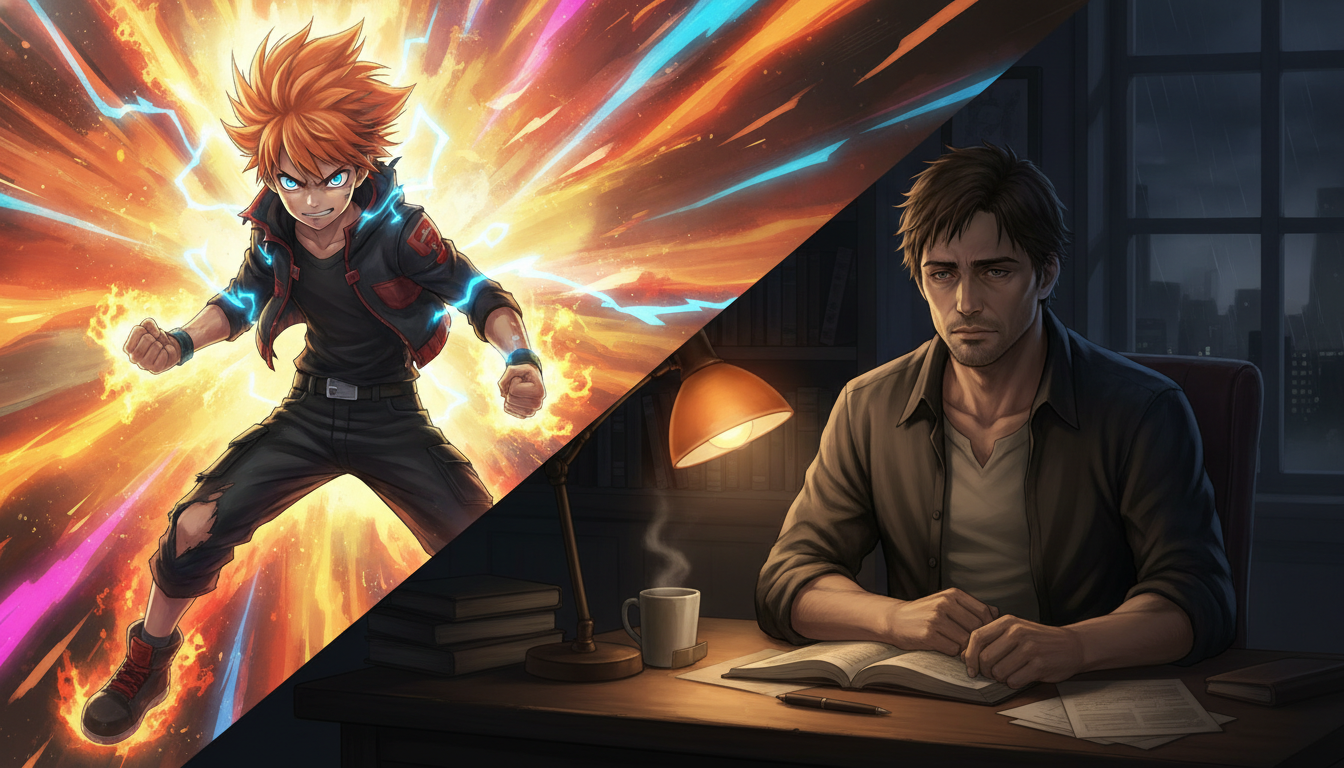
Picture this: you’re mid-twenties, exhausted after a long week, and you sit down to watch anime. You could queue up Dragon Ball Z — fists flying, friendship speeches blazing, pure adrenaline — or you could load up Vinland Saga and spend forty minutes sitting with a viking boy questioning whether violence has any meaning at all. Both experiences are incredible. Both are anime. But they hit you in completely different places, for completely different reasons. That contrast isn’t accidental. It’s by design, rooted in something Japanese publishing has understood for decades: who you are when you sit down to watch determines what kind of story you need.
Shonen and seinen are demographic labels — originally applied to manga magazines — that define the target audience of a series. Shonen (少年) literally means “boy” and targets readers roughly between ages 12 and 18, while seinen (青年) means “young man” and aims at an adult readership, typically 18 and older. In practice, these labels shape everything: the complexity of the themes, the pacing of action sequences, the moral framework characters operate within, and even how much the audience is trusted to sit in discomfort without a resolution. Understanding the difference isn’t just trivia — it’s a lens that completely changes how you experience anime at large.
The DNA of Shonen: Why “Never Give Up” Hits Different at 14
Shonen anime is built on a deceptively simple engine: a protagonist with a dream, obstacles that seem insurmountable, and the unshakeable belief that hard work, friendship, and willpower can conquer anything. That formula sounds reductive, but when it’s executed well, it produces some of the most emotionally resonant television ever made — animated or otherwise.
Think of the titans: Naruto, My Hero Academia, One Piece, Demon Slayer, Bleach, Hunter x Hunter. Each centers a young hero discovering their potential, forming bonds with rivals and allies, and pushing through pain in a way that makes teenage audiences feel genuinely seen. The themes aren’t shallow — they deal with grief, identity, belonging, and justice — but they’re framed through a lens of hope and forward momentum. The protagonist almost always grows stronger. The power of friendship is a real, in-universe force. Moral questions get answered.
Why does this work so effectively for younger audiences? Adolescence is a period of intense identity formation. When Naruto shouts that he will become Hokage despite everyone telling him he’s worthless, or when Izuku Midoriya (Deku from My Hero Academia) inherits a power he was never supposed to have, those aren’t just plot points — they’re emotional lifelines for kids navigating a world that often tells them exactly the same thing. Shonen mirrors ambition back at the audience in its most idealized form.
The DNA of Seinen: When Anime Stops Comforting You
Seinen anime operates on a different frequency entirely. It isn’t trying to inspire you — it’s trying to confront you. Where shonen builds heroes, seinen tends to deconstruct them. Where shonen answers questions, seinen opens wounds and lets them breathe.
Series like Berserk, Vinland Saga, Monster, Vagabond, Gantz, and Psycho-Pass occupy an entirely different emotional register. Characters aren’t rewarded for determination. Morality is genuinely ambiguous. Violence has weight and consequence rather than spectacle and catharsis. Death — when it comes — doesn’t feel like a dramatic plot device. It feels like a gut punch because the series made you believe the world wasn’t protecting its characters at all.
Berserk, based on Kentaro Miura’s legendary manga, is perhaps the defining example. Guts — the protagonist — is a mercenary scarred by trauma and betrayal on a scale shonen would never allow. There is no promise of justice, no safety net of comradeship. The world is cruel in a philosophically deliberate way. Miura wasn’t trying to inspire readers. He was asking them to reckon with darkness and still choose to keep walking. That kind of storytelling requires an audience with the emotional vocabulary to receive it, which is exactly why the seinen label exists.
A Side-by-Side Look: How the Differences Stack Up
| Element | Shonen | Seinen |
|---|---|---|
| Protagonist arc | Growth, empowerment | Survival, disillusionment, complexity |
| Moral framework | Clear heroes and villains | Moral ambiguity; grey areas central |
| Violence | Dramatic, consequence-light | Visceral, consequence-heavy |
| Pacing | High energy, escalating | Slower, introspective |
| Resolution | Hopeful, earned victories | Open-ended or bittersweet |
| Target age | ~12–18 | ~18+ |
| Classic examples | One Piece, Naruto | Berserk, Monster, Vinland Saga |
The Great Crossover: When Fans Grow With the Genre
Here’s something fascinating about the anime audience in 2026: a huge percentage of adult fans were raised on shonen. They grew up with Dragon Ball Z, moved into Naruto, graduated to Fullmetal Alchemist: Brotherhood (which straddles the line beautifully), and eventually found themselves craving something more. Seinen was waiting for them.
This is one reason Vinland Saga — which began as a shonen manga in Weekly Shonen Magazine before shifting thematically into deeply seinen territory — became such a cultural touchstone. Season two, which aired in 2023, essentially abandoned combat entirely in favor of exploring slavery, trauma, and the philosophy of pacifism. Audiences who came for viking action stayed for the existential reckoning. That crossover appeal is rare and precious.
For a deeper dive into two of shonen’s greatest icons facing off conceptually, check out Luffy vs Naruto: Only One Can Walk Away Winner — it’s a great reminder of how richly those characters are built even within the “simpler” shonen framework.
Why Neither Is Better — Just Built for Different Brains
The internet has a habit of framing shonen vs. seinen as a sophistication hierarchy — as if preferring One Piece over Berserk reveals something embarrassing about your intellectual depth. That framing is completely wrong, and genuinely harmful to anime discourse.
Shonen storytelling requires extraordinary craft. Writing a villain compelling enough to make a teenage audience question whether the hero is actually right — the way My Hero Academia handles characters like Shigaraki — is not simple work. Building a world as vast and internally consistent as One Piece over decades is an achievement few storytellers in any medium have matched. And the emotional catharsis of a well-earned shonen victory — Naruto vs. Pain, Tanjiro vs. Rui, Luffy punching a world government official — is a specific kind of magic that seinen rarely even attempts.
Seinen, meanwhile, earns its reputation by treating its audience as capable of sitting in unresolved darkness. If you’re looking for anime that will challenge your assumptions about human nature in the way that great literary fiction does, check out Anime Like Death Note That Will Mess With Your Mind — Death Note itself is a perfect case study in a series that leans seinen in spirit regardless of its technical magazine classification.
Did You Know? Surprising Facts About These Demographics
- Weekly Shonen Jump — the flagship shonen magazine that launched Naruto, One Piece, Dragon Ball, and Bleach — has been published since 1968 and remains one of the highest-circulation manga magazines in the world.
- Fullmetal Alchemist: Brotherhood (2009) is frequently ranked among the greatest anime of all time despite being a shonen title, proving that demographic labels don’t cap quality ceilings.
- Berserk‘s manga began serialization in 1989 and was left unfinished following Kentaro Miura’s passing in 2021 — a real loss for the entire medium, not just seinen fans.
- Some series surprise audiences with their actual classification: Tokyo Ghoul is seinen, while Demon Slayer — viscerally violent — is shonen.
- The josei (targeting adult women) and shojo (targeting younger girls) demographics function under the same logic, demonstrating how deeply Japan’s publishing industry uses audience psychology as a creative foundation.
The Bigger Picture: What Your Watchlist Says About You
Whether you binge shonen for the hype and the heart, or you gravitate toward seinen for the weight and the philosophy, you’re engaging with storytelling that has been precision-engineered for a specific emotional frequency. The best anime fans learn to love both modes — to let One Piece remind them what it felt like to dream without limitation, and to let Monster or Vagabond hold up an unsparing mirror to what those dreams cost in the real world.
The gap between shonen and seinen isn’t a quality gap. It’s a life stage gap — and the beautiful thing about anime as a medium is that it serves you at every single one. So whether you’re Team Shonen, Team Seinen, or comfortably living in the crossover space, one thing is certain: you’re watching the right thing for exactly who you are right now. And that’s the whole point.
