

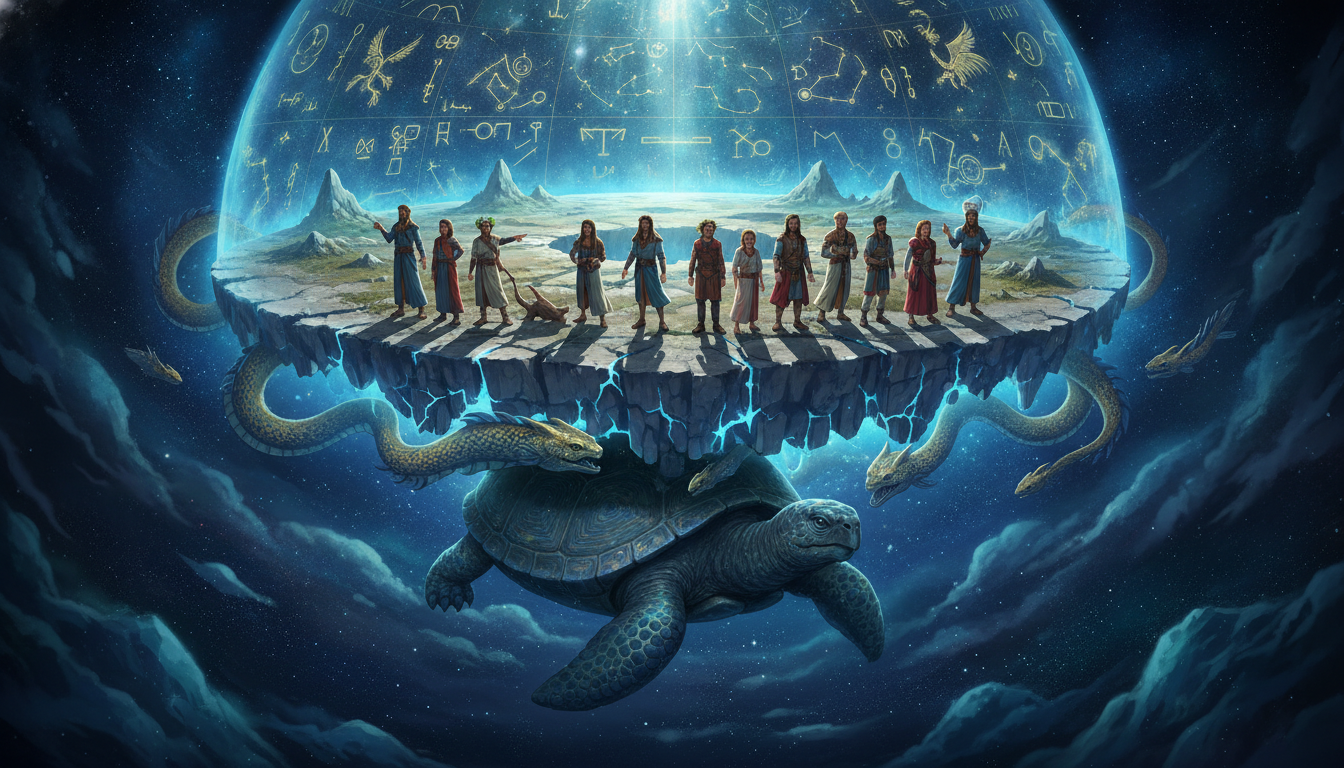
Forget flat Earth — that conspiracy theory is practically mainstream at this point. Sure, it sounds wild that in 2026 people still debate whether the planet is a pancake floating in space, but here’s the thing: flat Earth is actually a pretty tame entry in the grand hall of bizarre human beliefs. Throughout history, civilizations that were genuinely brilliant in many respects held cosmological, medical, and natural views so strange they’d make a flat Earther blush. We’re talking about ideas endorsed by emperors, philosophers, and respected scholars — people who weren’t stupid, just working with the wrong data and a whole lot of imagination.
What makes these past beliefs so fascinating isn’t just their weirdness — it’s how reasonable they seemed at the time. Every civilization builds its understanding of the world from available evidence and cultural framework. When your best tools are naked-eye observation, philosophical reasoning, and ancient texts passed down for centuries, you end up with some genuinely creative explanations for reality. Think of it like watching a shonen anime where the hero keeps powering up based on completely wrong assumptions about how his abilities work — it kind of functions, until it catastrophically doesn’t.
So buckle up, because we’re diving deep into history’s wildest, most confidently-held misconceptions. Some of these will make you laugh, some will genuinely impress you with their internal logic, and all of them will remind you that humanity has always been absolutely unhinged in the most endearing way possible.
The Geocentric Universe — Earth as the Cosmic Main Character
If flat Earth is a D-tier conspiracy, geocentrism was humanity’s S-tier canonical belief for over a thousand years. The geocentric model placed Earth at the absolute center of the universe, with the Sun, Moon, planets, and stars all orbiting around us in perfect crystalline spheres. This wasn’t some fringe theory — it was the scientific consensus, backed by Aristotle and later refined by the Greek-Egyptian astronomer Claudius Ptolemy in the 2nd century CE into a detailed mathematical system called the Ptolemaic model.
And honestly? It worked. Sort of. Ptolemy’s system could predict planetary positions with reasonable accuracy by using clever mathematical tricks like epicycles — essentially small circles within larger circles — to explain why planets sometimes appeared to move backward across the sky (what we now call retrograde motion). The Catholic Church eventually adopted this model as theological truth, making it doubly entrenched. It took Copernicus in 1543 and later Galileo’s telescopic observations to begin cracking the foundation — and even then, Galileo was placed under house arrest for his trouble. The universe, it turns out, is deeply unimpressed with how important we think we are.
Phlogiston — The Invisible Fire-Stuff
Imagine a substance that exists inside all flammable materials, releases when things burn, and is completely undetectable by any instrument. That’s phlogiston, the 17th and 18th century’s answer to combustion. Proposed by German chemist Johann Joachim Becher and later developed by Georg Ernst Stahl, phlogiston theory held that fire wasn’t a chemical reaction but rather the escape of this mysterious substance from matter.
The theory had one embarrassing problem: when metals were burned (a process called calcination), the resulting ash actually weighed more than the original metal — meaning something was being added, not released. Defenders of phlogiston theory got creative, suggesting phlogiston might have negative weight. Negative weight. In 1783, Antoine Lavoisier finally demonstrated through careful experiments that combustion involved oxygen, not phlogiston, effectively killing the theory. But for roughly a century, some of Europe’s smartest chemists built entire careers on explaining the world through invisible escape-fire-stuff.
Miasma Theory — Bad Smells Cause Disease
Before germ theory revolutionized medicine in the 19th century, the dominant explanation for disease was miasma theory — the idea that illness spread through “bad air” emanating from rotting organic matter, swamps, and filth. The name malaria literally comes from the Italian mala aria, meaning “bad air,” because people observed (correctly) that marshy areas correlated with fever, while misidentifying the actual cause (mosquitoes).
What’s wild is that miasma theory accidentally produced some genuinely good public health outcomes. Efforts to clean up filthy cities, improve sewage systems, and remove rotting waste — all motivated by the desire to eliminate “bad air” — actually did reduce disease, because they eliminated the environments where disease-carrying insects and bacteria thrived. Sometimes being wrong in the right direction still saves lives. It wasn’t until Louis Pasteur’s germ theory work in the 1860s that the microscopic truth emerged.
The Four Humors — Your Personality Is Just Bodily Fluids
Greek and Roman medicine operated on the theory that human health and personality were governed by four bodily fluids, or humors: blood, phlegm, yellow bile, and black bile. Too much blood? You’re sanguine — cheerful and optimistic. Too much black bile? Melancholic — sad and withdrawn. This system, associated with physicians like Hippocrates and Galen, dominated Western medicine for roughly two thousand years.
Here’s what makes humoral theory genuinely impressive despite being entirely wrong:
- It created a systematic framework linking diet, environment, seasons, and emotional state to health
- It produced the first real effort at personalized medicine — treatments varied by individual “constitution”
- The language is still embedded in English today — we call people “phlegmatic,” “sanguine,” “melancholic,” or “bilious” without realizing we’re referencing 2,000-year-old medical pseudoscience
- Treatments included bloodletting, special diets, and herbal remedies — some of which had genuine therapeutic value independent of the theory
The persistence of humoral theory shows how a coherent, internally consistent system can survive long after evidence should have toppled it.
The Luminiferous Ether — Space Needs Something to Swim Through
By the 19th century, science understood that light traveled as a wave. And waves, logically, need a medium to travel through — sound waves travel through air, water waves through water. So what did light waves travel through in the vacuum of space? Physicists proposed the luminiferous ether: an invisible, massless, perfectly elastic substance filling all of space.
The ether was considered so scientifically credible that in 1887, Albert Michelson and Edward Morley designed an extraordinarily precise experiment specifically to detect Earth’s motion through it. They found nothing. The Michelson-Morley experiment is one of the most famous “failed” experiments in history — failed in that it didn’t find what it was looking for, but succeeded spectacularly by helping clear the path for Einstein’s special relativity in 1905. Sometimes the universe’s answer to “where’s the ether?” is just a flat, cosmic “no.”
Spontaneous Generation — Life Just Appears From Nowhere
Before microbiology, the origin of small creatures like maggots, mice, and insects was explained through spontaneous generation — the idea that life could arise fully-formed from non-living matter. Maggots appeared in meat (because flies laid invisible eggs there, but no one knew that). Mice appeared in grain stores. Frogs emerged from mud after rain. The logic seemed airtight if you didn’t know what you were missing.
The Italian physician Francesco Redi challenged part of this in 1668 by showing that maggots only appeared in meat exposed to flies — a beautifully simple controlled experiment. But spontaneous generation clung to life for microscopic organisms until Louis Pasteur’s famous swan-neck flask experiments in 1859 definitively showed that even microbial life didn’t spontaneously appear in sterilized, sealed environments. The idea that life begets life — rather than emerging magically from cheese or old rags — seems obvious now, but it took centuries of careful work to prove.
What These Beliefs Tell Us About Human Nature
There’s a reason this history matters beyond just laughing at past centuries. Every single one of these theories — geocentrism, phlogiston, miasma, humoral medicine, luminiferous ether, spontaneous generation — was held by intelligent, educated people who were doing their genuine best to explain observable reality. They weren’t primitive or foolish. They were working scientists and philosophers building on the best available knowledge.
This is exactly why the ending of Attack on Titan hits so hard — it’s a story about how entire civilizations can build their worldview on foundational lies and defend those lies violently when challenged. Eren’s world isn’t so different from a society that would put Galileo under house arrest for pointing a telescope at Jupiter. And just like your dreaming brain is constantly constructing and reconstructing reality, human civilization has always been in the business of telling itself stories that feel completely true — until they don’t.
We’re Not Done Being Wrong

Here’s the humbling conclusion: scientists today openly acknowledge that our current models of physics, cosmology, and biology are incomplete. Dark matter, dark energy, the interpretation of quantum mechanics — these are active, unresolved questions. In 200 years, students might look back at some of our confident 21st-century beliefs the way we look at phlogiston today.
Flat Earth was never really the wildest belief humans have held — it’s just the most visible current one. The actual hall of fame for confident wrongness belongs to the centuries of brilliant minds who built elaborate, internally consistent, institutionally supported systems on foundations that turned out to be completely off. That’s not an insult to them. It’s a reminder that curiosity, humility, and the willingness to be proven wrong aren’t weaknesses — they’re the whole point of the scientific game.
