


Ever wake up from a dream so vivid that you had to sit still for a moment just to confirm you were actually in your bedroom? Maybe you were flying over a neon-lit Tokyo skyline, or locked in an intense battle straight out of Demon Slayer, only to have reality crash back in like a poorly timed alarm clock. That disorienting split-second isn’t a glitch — it’s evidence of something absolutely wild happening inside your skull every single night. Your brain, far from powering down when you close your eyes, shifts into a completely different mode of operation. It processes memories, regulates emotions, rehearses fears, and apparently finds time to produce elaborate cinematic experiences entirely without your permission.
Dreams have fascinated humans since before we had written language to describe them. Ancient Egyptians built temples specifically for dream incubation. The Greeks thought dreams were messages from the gods. Modern neuroscience has a different — and arguably even more mind-bending — explanation. The truth about what your brain does while you sleep is the kind of information that makes you look at your morning grogginess in a whole new light. So buckle up, because we’re going deep into the neuroscience of dreams, and yes, we’ll be making stops in anime territory along the way.
Why Your Brain Is Basically Running a Background App 24/7
Think of your brain like a smartphone that never fully shuts off. Even in sleep, it consumes roughly 20% of the body’s total energy despite making up only about 2% of your body weight. That’s not idle consumption — something is actively happening in there.
Sleep is divided into cycles, each lasting approximately 90 minutes, and within each cycle there are distinct stages. The most famous is REM sleep (Rapid Eye Movement), which is when the most vivid dreaming tends to occur. During REM, your brain’s activity on an EEG (electroencephalogram) looks remarkably similar to when you’re wide awake. Neurons are firing, regions are communicating, and your eyes are darting around under your eyelids — hence the name.
What’s doing the heavy lifting? Primarily:
- The prefrontal cortex (responsible for logic and decision-making) becomes less active, which is why dream logic feels completely reasonable in the moment
- The amygdala (the emotional center) is highly active, which is why dreams often carry intense emotional weight
- The hippocampus (critical for memory) is busy replaying and consolidating the day’s experiences
- The visual cortex fires as if you’re actually seeing things — because in a neural sense, you kind of are
The Memory Factory: How Sleep Literally Makes You Smarter
One of the most practically useful discoveries in sleep science is that sleep isn’t just rest — it’s active memory consolidation. During slow-wave (non-REM) sleep, the brain replays experiences from the day, essentially filing them away for long-term storage. During REM sleep, it appears to connect those new memories to existing knowledge, helping you find patterns and creative solutions.
This is why pulling an all-nighter before an exam is such a bad strategy. You might cram the information in, but without sleep, your brain never gets the chance to properly store and integrate it. Studies have consistently shown that people who sleep after learning something new retain significantly more than those who stay awake.
The anime Cells at Work! (produced by David Production and first aired in 2018) does a brilliant job of visualizing the body’s internal systems as bustling city workers. While it doesn’t go deep into neuroscience, the show captures that same spirit of “your body is doing a LOT more than you realize.” Dreams are the brain’s version of that behind-the-scenes operation — complex, purposeful, and absolutely non-stop.
The Emotional Reset Button You Never Knew You Had
Here’s where things get genuinely poetic. According to neuroscientist Matthew Walker, author of Why We Sleep (2017), REM sleep functions as a kind of overnight therapy. During this stage, the brain reprocesses emotionally charged memories, but does so in a neurochemical environment stripped of stress hormones like noradrenaline. The result? You can revisit painful or intense memories without the same emotional sting.
This helps explain why “sleep on it” is actually solid advice. Emotional problems that feel catastrophic at midnight often feel more manageable in the morning — not because the problem changed, but because your brain literally processed the emotional charge while you slept.
It also explains why sleep deprivation so quickly leads to emotional dysregulation. Without REM sleep, the amygdala becomes hyperreactive, making people more anxious, more irritable, and less able to distinguish genuine threats from minor inconveniences.
Dream Logic and the Anime Connection
If you’ve ever watched what is isekai anime — that beloved genre where characters are transported to fantastical parallel worlds — you’ll notice something immediately familiar about the structure. In isekai, the protagonist simply accepts the new reality with minimal questioning. A high schooler wakes up as a skeleton overlord in another dimension? Fine. That’s just how things are now.
That’s dream logic in a nutshell. In dreams, your reduced prefrontal cortex activity means the part of your brain responsible for saying “wait, this makes no sense” is largely offline. You accept flying, impossible conversations with deceased relatives, and physics-defying environments as completely normal. Isekai creators — consciously or not — have essentially bottled that neurological state and turned it into a genre.
Shows like Re:Zero − Starting Life in Another World (White Fox, 2016) and That Time I Got Reincarnated as a Slime (Eight Bit, 2018) are basically extended, stylized dreamscapes. The world-building follows internal emotional logic rather than strict physical law, which is exactly how your brain constructs a dream narrative.
Did You Know? Wild Facts About Dreams and the Sleeping Brain
- You dream every night, even if you don’t remember it. Most people forget 90–95% of their dreams within minutes of waking.
- Blind people dream too. Those blind from birth dream using their other senses — sound, touch, taste — rather than visual imagery.
- Animals dream. REM sleep has been observed in mammals and birds. If you’ve ever watched a dog twitch and whimper in its sleep, it’s almost certainly dreaming.
- Lucid dreaming is neurologically real. In a lucid dream, the dreamer becomes aware they’re dreaming. Brain scans show that during lucid dreaming, parts of the prefrontal cortex reactivate — meaning you briefly regain some logical awareness.
- Sleep paralysis has been misidentified across cultures as supernatural. The “old hag” sitting on your chest in British folklore, the kanashibari in Japanese tradition — these are sleep paralysis experiences, where the body’s REM-induced muscle paralysis overlaps with waking consciousness.
- The record for the longest intentional period without sleep stands at approximately 11 days, set by Randy Gardner in 1964. By the end, he was hallucinating and showing symptoms of psychosis.
- Tetris Effect: People who play Tetris extensively often report seeing falling blocks in their dreams or in the hypnagogic state just before sleep. This is the brain compulsively rehearsing new skills.
Nightmares, Trauma, and the Brain That Won’t Let Go
Nightmares aren’t just bad entertainment — they’re the brain’s failed attempt at emotional processing. In people with PTSD (Post-Traumatic Stress Disorder), the normal REM mechanism breaks down. Instead of processing trauma in a low-stress neurochemical environment, the brain replays it with full emotional intensity, producing the recurring nightmares that are a hallmark of the condition.
Understanding this has led to real therapeutic interventions. Image Rehearsal Therapy (IRT), for example, asks patients to rewrite the ending of their recurring nightmare while awake, then rehearse the new version mentally. Over time, the brain can be guided toward a different narrative — proof that we have more influence over our dreaming brains than it might seem.
Conclusion: Respect Your Sleep, Respect Your Brain
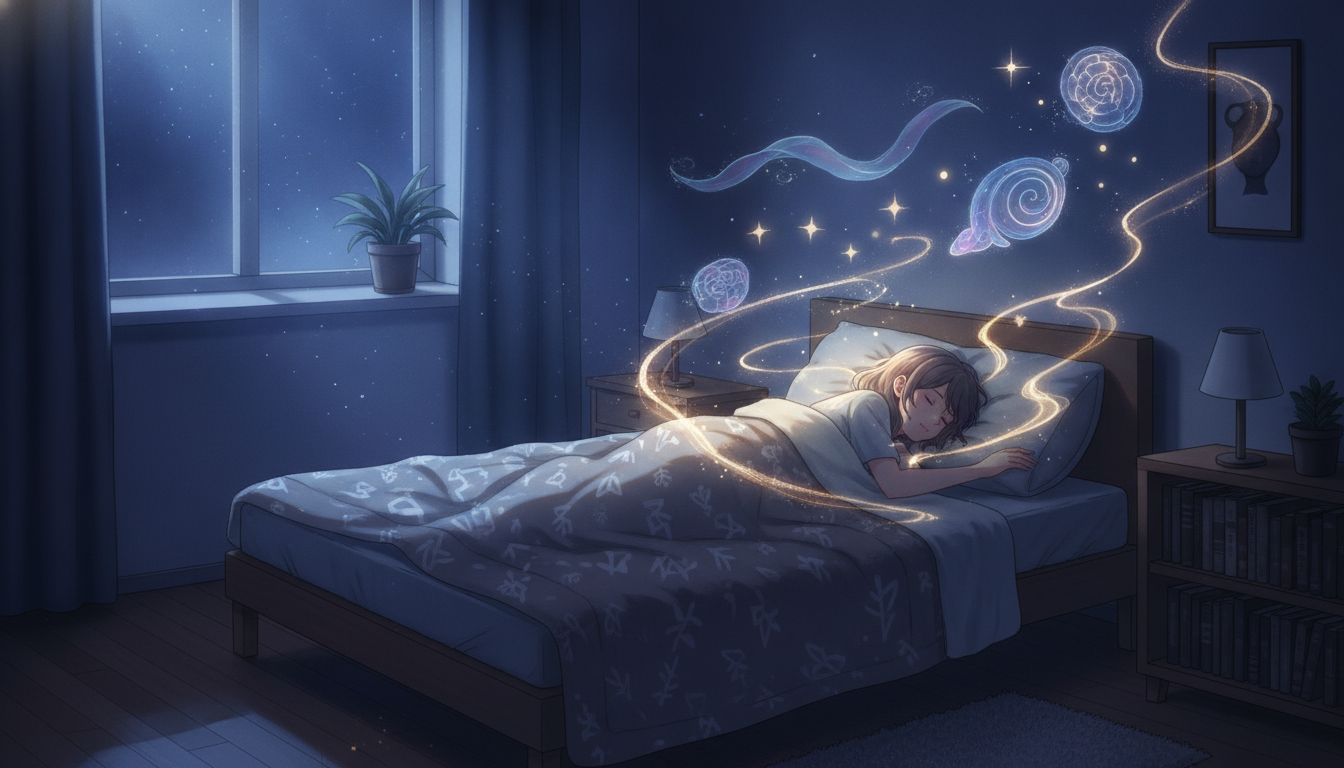
Your brain isn’t resting at night — it’s working a completely different shift, one that’s arguably just as important as everything it does during daylight hours. From memory consolidation to emotional regulation, from creative insight to the bizarre cinema of dreams, the sleeping brain is doing extraordinary things under the cover of darkness.
Next time you’re tempted to sacrifice sleep for a late-night binge session — even if the episode count on a great show is dangerously inviting — remember: your brain has a full night of essential operations scheduled. The dreams aren’t the weird side effect. They’re the proof that something remarkable is running, right behind your closed eyes, every single night.
