

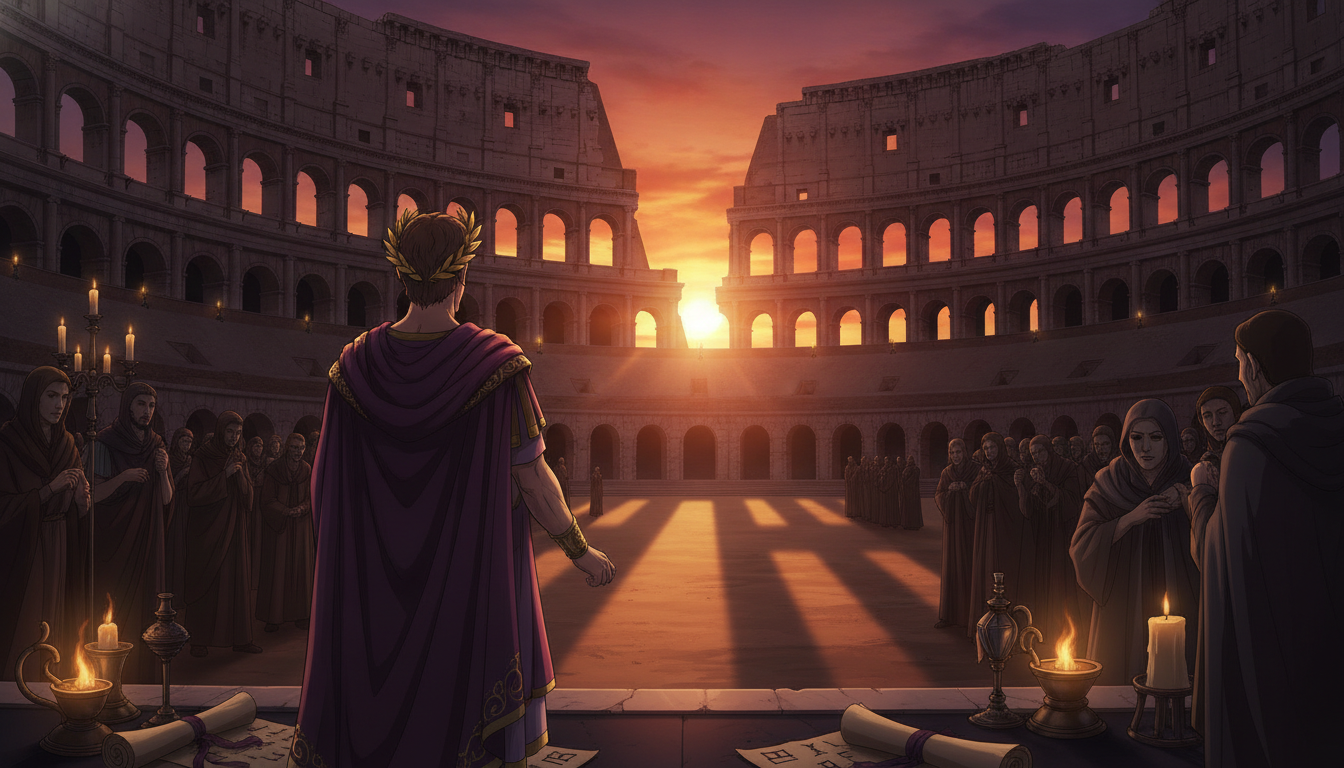
Imagine scrolling your feed and suddenly coming across something so unhinged, so boundary-obliterating, that your phone physically cannot handle it. That’s basically what would happen if the full, unfiltered truth of Ancient Rome landed on the internet today. We’re talking about a civilization that built the Colosseum, invented concrete, and somehow also normalized behaviors that would generate enough controversy to crash every server from TikTok to Twitter/X simultaneously. Rome wasn’t just an empire — it was a 24/7 content machine that made the wildest reality TV look like a bedtime story.
The Romans are romanticized (pun absolutely intended) in pop culture constantly. From the legendary anime-inspired Italian manga Thermae Romae by Mari Yamazaki — which became an anime series in 2012 and later a live-action film — to massive video game franchises and Hollywood epics, Ancient Rome keeps getting the glamour treatment. But strip away the marble columns and the epic orchestral scores, and you’ll find a civilization that operated by rules so alien to modern sensibilities that it reads more like dark fantasy world-building than actual history. Buckle up, because we’re diving deep into the secrets Rome didn’t put on the travel brochure.
The Colosseum Was Even More Brutal Than You Think
Everyone knows gladiators fought in the Colosseum. What most people don’t fully grasp is the sheer industrial scale of the violence Romans organized for public entertainment. The Colosseum, officially known as the Flavian Amphitheatre, was completed in 80 CE under Emperor Titus and could hold an estimated 50,000 to 80,000 spectators. On its inauguration alone, Titus reportedly held 100 days of games.
But here’s where it gets truly dark: it wasn’t just gladiator duels. The Romans staged naumachiae — full-scale naval battles inside flooded arenas. They hunted exotic animals from across the known world, including lions, elephants, rhinoceroses, and hippos, driving several species to local extinction in North Africa. They also executed criminals and prisoners in spectacularly theatrical ways, sometimes staging mythological reenactments where the condemned person played a doomed character from Greek myth — and actually died performing the role. The line between entertainment and execution was essentially nonexistent.
Roman Social Norms That Would Get You Cancelled in Seconds
Modern internet culture moves fast, but even the most chaotic corners of social media have lines Rome crossed without a second thought:
- Public bathrooms were communal and conversational. Romans used shared latrines — long stone benches with holes — as social gathering spots. There was no privacy, no shame, and apparently plenty of small talk.
- Blood was considered a medicine. Epilepsy sufferers were sometimes advised to drink the blood of slain gladiators, a practice documented by the physician Pliny the Elder in his Naturalis Historia.
- Urine was a cleaning product. Fullonicae (laundries) collected urine from public pots because its ammonia content helped clean wool. There was even a urine tax introduced by Emperor Vespasian. When his son Titus complained about the tax’s origin, Vespasian allegedly held up a coin and said, “It doesn’t smell.”
- Garum was on everything. This fermented fish sauce — made by aging fish guts in salt for months — was the Roman equivalent of ketchup. It went on basically every dish. Food historians confirm it was intensely pungent.
- Cosmetics contained lead and crocodile dung. Roman beauty culture was advanced but absolutely terrifying by modern health standards. White lead-based foundation was common, and various animal-derived substances appeared in beauty treatments.
The Political Chaos That Makes Modern Drama Look Tame
If you think current political discourse is chaotic, the Roman Imperial period had it beat by a landslide. The Year of the Four Emperors in 69 CE saw four different men claim the title of emperor within a single calendar year — Galba, Otho, Vitellius, and finally Vespasian. Political assassinations, poisonings, and backstabbings were practically a job requirement for Roman leadership.
Emperor Caligula, who ruled from 37 to 41 CE, became notorious for erratic and cruel behavior that still generates historical debate. Whether he truly appointed his horse Incitatus as a priest (some historians argue it was a deliberate political insult to the Senate rather than actual madness) or committed the atrocities described by ancient sources like Suetonius and Cassius Dio, his reign represents a case study in unchecked power going spectacularly off the rails. He was assassinated by members of his own Praetorian Guard after less than four years in power.
Nero, ruling from 54 to 68 CE, had his own mother Agrippina the Younger assassinated, reportedly after a failed scheme involving a boat designed to sink. The level of interpersonal drama in the imperial family makes any fictional royal family — anime or otherwise — look quaint by comparison.
Roman Religion Was Wildly Different From What You’d Expect
Roman religion wasn’t the solemn, organized faith structure many imagine. It was transactional, layered, and frankly chaotic in the best way. Romans practiced a polytheistic religion that essentially absorbed the gods of every culture they conquered, syncretizing Greek gods with Roman ones (Zeus became Jupiter, Ares became Mars, and so on). But it went further — when Rome conquered Egypt, they enthusiastically adopted Isis and other Egyptian deities into their already crowded pantheon.
The Vestal Virgins were among Rome’s most respected and powerful religious figures — priestesses dedicated to keeping the sacred flame of Vesta burning. They held significant legal privileges, could free condemned prisoners, and had reserved front-row seating at public events. But the penalty for breaking their vow of chastity was being buried alive. The stakes were, to put it mildly, extreme.
Saturnalia, the Roman winter festival honoring Saturn, temporarily reversed social norms: slaves were served by their masters, gifts were exchanged, and general revelry was encouraged. Many scholars note its influence on later winter holiday traditions.
Roman Engineering Achievements That Still Seem Like Cheating
Let’s give credit where it’s absolutely due: Rome’s engineering was so advanced it genuinely feels like they were running on cheat codes.
- The Romans built over 80,000 kilometers of roads across their empire, many of which influenced European road layouts still in use today.
- Roman concrete (opus caementicium) has proven more durable than modern concrete in certain marine environments. Scientists studying ancient Roman harbor structures discovered that seawater actually strengthens the material over centuries — something modern concrete cannot claim.
- The aqueduct system supplied Rome with an estimated 1 million cubic meters of fresh water daily, supporting fountains, public baths, and private homes.
- The Pantheon, completed around 125 CE under Hadrian, features the world’s largest unreinforced concrete dome — and it’s still standing in near-perfect condition.
This engineering mastery is part of why Rome’s collapse around 476 CE sent Europe into centuries of infrastructural regression. They built things to last, even if the society running them was absolutely feral.
Why Rome Still Captivates Anime and Geek Culture
Rome’s influence on anime, manga, and geek culture is genuinely underrated. Beyond Thermae Romae, which cleverly sends a Roman architect through time to modern Japanese bathhouses and became a beloved cultural crossover, Roman aesthetics and mythology show up throughout fantasy and sci-fi storytelling. The empire-building, the political intrigue, the gladiatorial combat — these are storytelling gold mines. If you enjoy the kind of morally complex, high-stakes world-building found in shows with these anime fights hit different and you know why, Rome’s real history provides endless inspiration.
The power structures, betrayals, and philosophical conflicts of Roman civilization mirror the narrative complexity that makes great anime compelling. Rome essentially wrote the template for epic storytelling — the hero’s journey, the fall of empires, the weight of legacy — before the genre even existed as a concept.
The Legacy That Refuses to Stay Buried
Rome collapsed, but it never truly disappeared. Its legal frameworks influenced virtually every Western legal system. Its language, Latin, spawned the entire Romance language family — Spanish, French, Italian, Portuguese, and Romanian all evolved from it. Its calendar, reformed under Julius Caesar and later adjusted under Pope Gregory XIII, is essentially the one we still use in 2026.
And its darkest secrets? They remind us that civilization is always more fragile, more strange, and more morally complicated than the marble monuments suggest. Much like how Japanese superstitions can reveal surprising truths about cultural psychology, Rome’s uncomfortable truths tell us something profound about human nature across millennia.
The Romans built aqueducts, wrote philosophy, created art — and also did things that would generate millions of horrified reaction videos. That contradiction is what makes them endlessly fascinating. History’s greatest empire was also history’s wildest content creator, and honestly? We can’t look away.
