

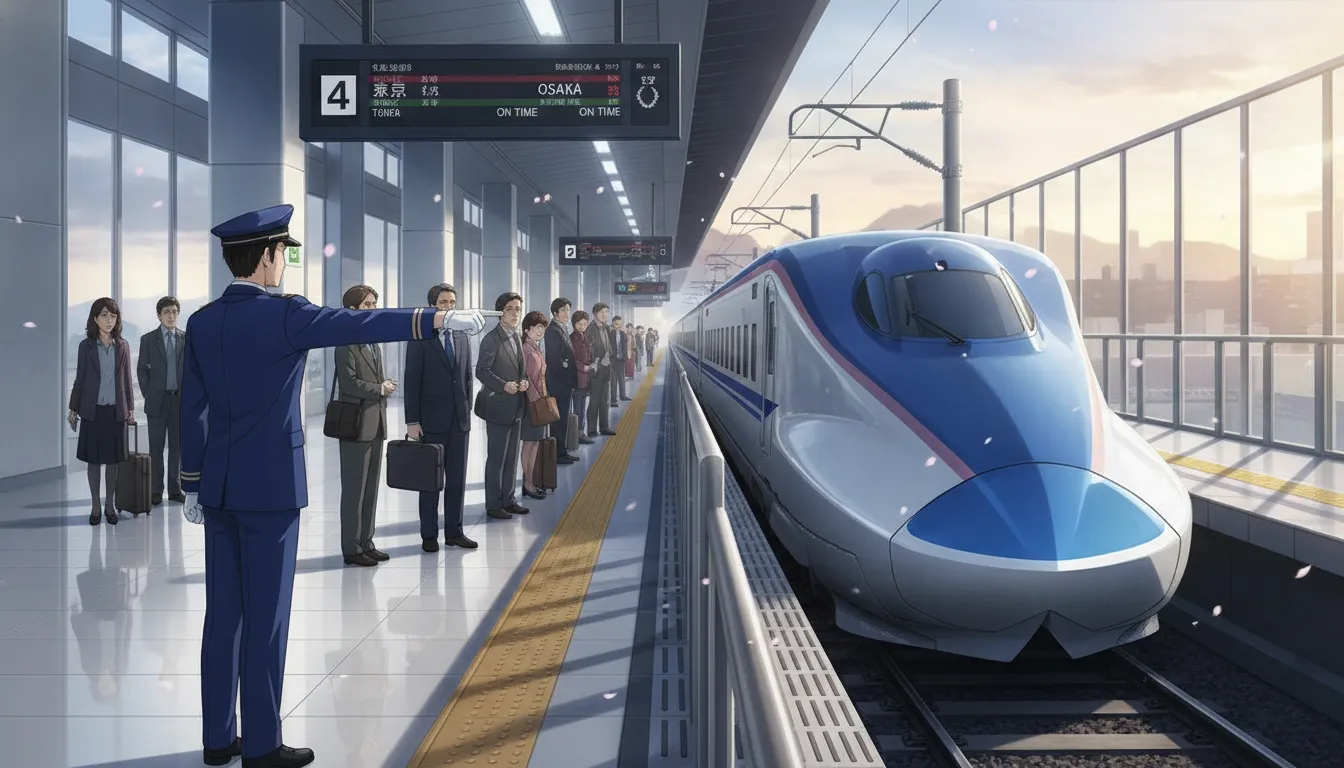
Imagine boarding a train and knowing — with near-absolute certainty — that it will arrive within seconds of its scheduled time. Not minutes. Seconds. For most of the world, that sounds like a fantasy borrowed from a science-fiction anime where everything runs on some futuristic AI overlord’s perfect algorithm. But in Japan, this is simply Tuesday morning. The country’s rail network is so legendarily punctual that when a train in Tokyo departs 20 seconds early, the operating company issues a formal public apology. That actually happened. And the internet, understandably, lost its collective mind.
Japan’s railway punctuality isn’t a happy accident or a lucky byproduct of good infrastructure. It is the result of a deeply ingrained cultural philosophy, decades of obsessive engineering, rigorous staff training, and a national attitude toward time that borders — in the best possible way — on the extraordinary. It’s the kind of systemic perfection that anime fans might recognize from series like Spirited Away, where the spirit world’s train runs on an unknowable but utterly unbreakable schedule. Art imitating life, perhaps.
So what exactly is going on under the surface of Japan’s train culture? Why does it work so extraordinarily well, and what can the rest of the world learn from it? Buckle up (or rather, stand behind the yellow line), because we’re going deep into one of the most fascinating obsessions in modern human civilization.
The Numbers That Make the Rest of the World Jealous
Let’s start with the raw data, because it is genuinely staggering. Japan’s Shinkansen — the famous bullet train network — has maintained an average annual delay of under one minute for decades. The Tōkaidō Shinkansen line, which connects Tokyo and Osaka and first opened in 1964, runs hundreds of trains per day and consistently records average delays measured in seconds, not minutes.
Tokyo’s broader commuter rail network moves an estimated 8 to 9 million passengers per day through its greater metropolitan area alone. Coordinating that volume of people while maintaining near-perfect timing requires a level of logistical precision that most countries’ air traffic control systems would envy.
Some quick facts that highlight just how serious Japan is about this:
- Train operators carry pocket watches and synchronize them before shifts to ensure everyone is working from the exact same time reference.
- Station staff are trained in precise door-opening and closing procedures timed to the second.
- Some rail companies publish performance reports showing delay statistics down to the minute, openly holding themselves publicly accountable.
- Delays caused by passenger behavior — someone holding the doors, for example — are still recorded and analyzed by operations teams.
The Culture Behind the Clock: Jikan o Mamoru
In Japanese, the phrase jikan o mamoru (時間を守る) translates roughly to “protect time” or “keep time.” Punctuality in Japan is not just a professional expectation — it is a social and moral value. Showing up late is considered disrespectful, not merely inconvenient. This cultural baseline shapes everything from school schedules to business meetings, and it permeates the railway industry at every level.
Railway workers in Japan often describe their relationship with the schedule in almost philosophical terms. The train is not just a machine moving people from point A to point B. It is a promise. And in Japanese professional culture, breaking a promise — even by 30 seconds — is taken with a seriousness that Western workplaces rarely match.
This cultural attitude also extends to passengers. Japanese commuters are famously orderly: they queue in marked spots on the platform, board in organized lines, refrain from phone calls, and move efficiently. The system works partly because the humans inside it are also trying to make it work.
Engineering Obsession: The People Who Keep the Trains Running
Japan’s railways didn’t become legendary by accident — they were engineered into excellence. Behind every on-time departure is a support system of remarkable complexity.
The ATC (Automatic Train Control) systems used on Shinkansen lines electronically manage train speed and spacing, reducing the risk of human error on high-speed routes. Meanwhile, ground staff use sophisticated scheduling software that models ripple effects — if one train is delayed by two minutes, the system calculates which connections are impacted and how to recover the schedule fastest.
Maintenance crews work almost exclusively at night, during the brief windows when the trains are not running. These “night window” maintenance schedules are planned with military precision. Workers know exactly how many minutes they have on each section of track, and they stick to it.
There is also a fascinating practice called “pointing and calling” (shisa kanko), where workers physically point at objects and call out their status aloud — signals, gauges, doors — before confirming they are safe. Studies have shown this technique reduces workplace errors by a significant margin. It looks theatrical to outsiders, but it works.
When Things Go Wrong: Japan’s Honest Apology Culture
No system is perfect, and Japan’s railways do occasionally experience delays. But what makes Japan unique is how those delays are handled. When significant disruptions occur, passengers receive printed delay certificates (chien shomeisho) from station staff. These certificates are accepted by employers and schools as official documentation, because being late due to a train delay is understood to be outside the passenger’s control.
The public apologies that rail operators issue for delays are also genuine — not corporate PR spin. In 2017, a West Japan Railway Company train departed 20 seconds ahead of schedule, and the company issued a sincere written apology, acknowledging it was “inexcusable.” To a Western audience, this is almost incomprehensible. To Japan, it was the only appropriate response.
What Anime Gets Right About Japanese Train Culture
If you’ve watched enough anime, you’ve noticed that trains appear constantly — not just as transportation, but as emotionally loaded settings. Think of the silent, atmospheric train in Spirited Away, or the commuter rail scenes that punctuate slice-of-life series like Toradora! and Your Lie in April. The train in Japanese storytelling often represents transition, the in-between space where characters reflect, change, or meet fate.
This is no coincidence. For Japanese creators, the train is deeply woven into daily experience. It is the backdrop of millions of ordinary lives — and when ordinary life is rendered faithfully in animation, the train comes with it, running exactly on time.
Much like these anime collectibles that sold for insane money, Japan’s train culture has become a kind of cultural export in itself — something the world watches with a mix of awe and mild envy.
Could the World Copy Japan’s Railway Model?
It’s the obvious question. The honest answer is: partially, yes — but it’s complicated. Japan’s railway success is built on a specific combination of cultural values, population density, enormous public and private investment, and decades of institutional knowledge. You can’t simply import the pointing-and-calling technique and expect Rome’s train network to suddenly run on time.
That said, the lessons are real:
- Accountability culture matters. When delays are tracked, published, and taken seriously, organizations perform better.
- Passenger behavior is part of the system. Infrastructure alone cannot create punctuality.
- Investment in maintenance pays off. Japan’s night-window maintenance model prevents the kind of systemic degradation that plagues older rail networks globally.
- Human error reduction is engineering. Behavioral systems like pointing-and-calling are as important as hardware.
Conclusion: The Train as a Mirror
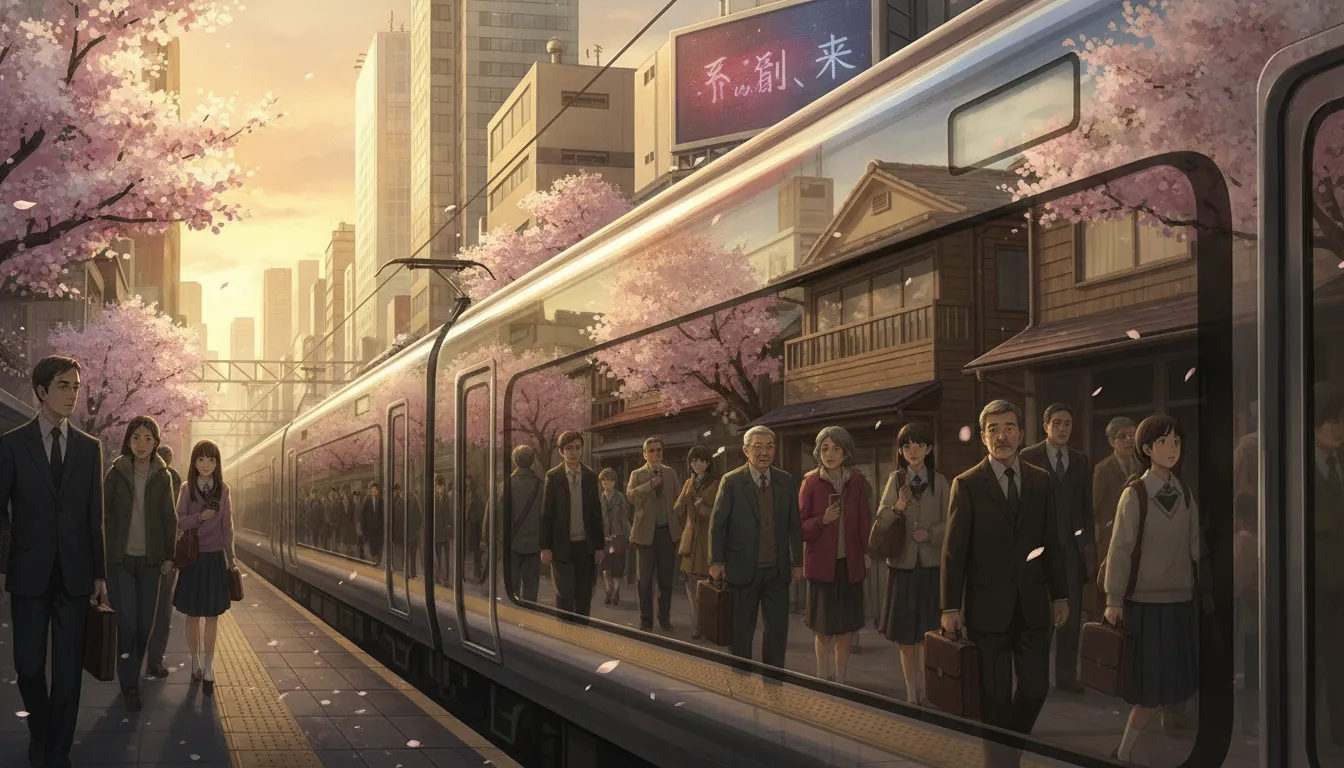
Japan’s trains are a mirror held up to its society — a reflection of what happens when an entire culture decides that precision matters, that time is something worth protecting, and that the gap between “good enough” and “excellent” is always worth closing. It’s obsessive, yes. But it’s the kind of obsession that sounds almost too extraordinary to be real, like one of those facts you have to double-check before you believe it.
The next time your own city’s train shows up 12 minutes late with a shrug, you’ll know exactly what’s missing. It’s not just better tracks. It’s a different relationship with time — and with the promise that a schedule represents.
