

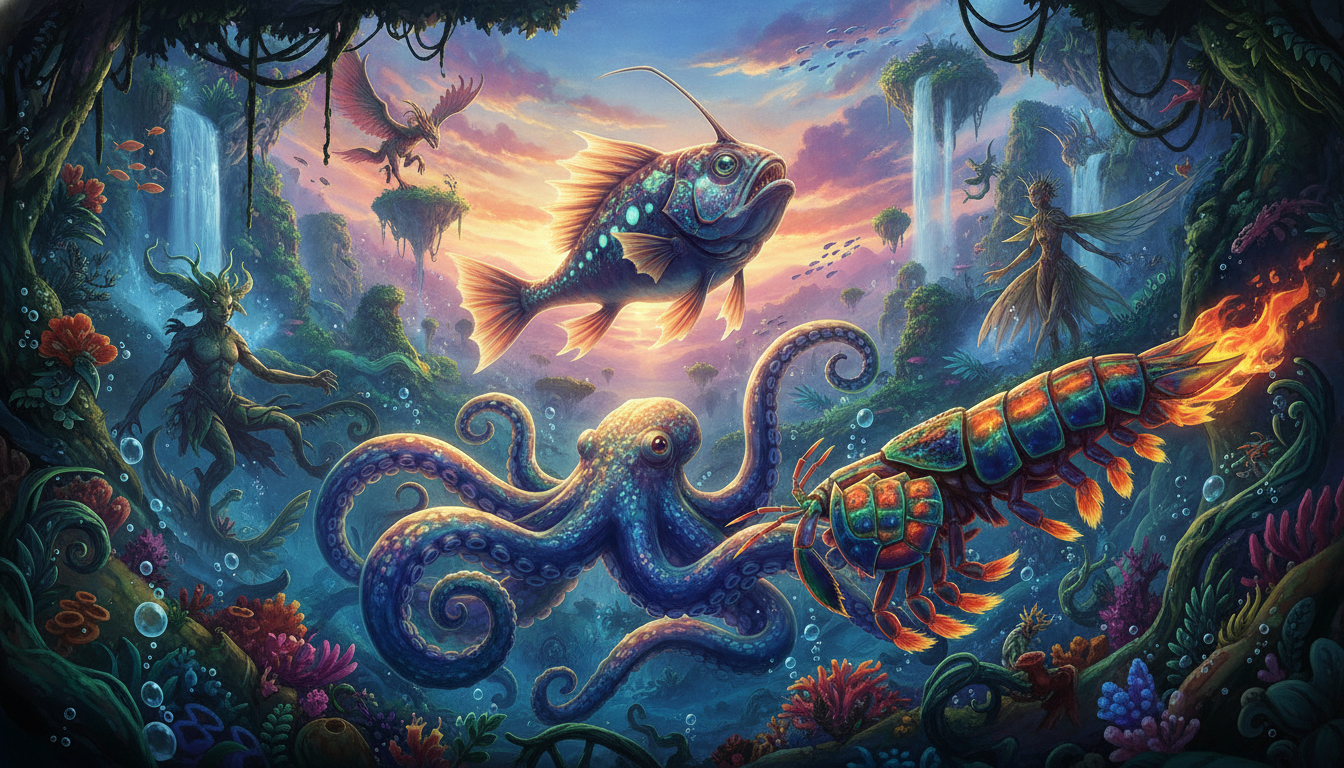
Nature has always been the original worldbuilder — and honestly, it puts most fictional universes to shame. You think Naruto’s chakra system is wild? Try explaining to someone that there’s a jellyfish out there that can technically live forever. You think the power-scaling in Dragon Ball Z breaks logic? Meet the mantis shrimp, a crustacean that sees colors humans can’t even imagine and punches with the force of a bullet. The animal kingdom is packed with abilities so absurd, so genre-defying, that if you dropped them into an anime, fans would call the writers lazy for making things too overpowered.
And yet, here we are. Every single fact in this article is 100% real, verifiable, and absolutely certified to mess with your perception of what’s possible. Whether you’re a die-hard shonen fan who thought “power-ups” were a Japanese invention, or a curious newcomer who stumbled in looking for something that would genuinely surprise you — buckle up. Reality is about to out-weird your favorite fantasy series. These animals don’t need magic systems or ancient bloodlines. They just exist, and that’s enough to question everything.
The Immortal Jellyfish That Cheats Death Like an Anime Protagonist
If you’ve ever watched an anime where the main character gets dramatically defeated only to return stronger than ever, you’ve basically already met Turritopsis dohrnii — the so-called immortal jellyfish. When this tiny marine creature faces extreme stress, starvation, or physical damage, it does something no other multicellular organism on Earth is known to do consistently: it reverts back to its juvenile polyp stage and starts its life cycle over again.
This process, called transdifferentiation, means the jellyfish’s cells don’t just heal — they literally transform into different types of cells, rewinding the biological clock entirely. It’s not metaphor. It’s not folklore. Scientists have observed it in controlled laboratory settings, and it remains one of the most mind-bending phenomena in all of zoology. In theory, this cycle could repeat indefinitely, making Turritopsis dohrnii biologically immortal — at least in the absence of predators or disease.
Think of it as the Kars from JoJo’s Bizarre Adventure situation, except the jellyfish doesn’t get shot into space. It just… keeps going.
The Mantis Shrimp Is Running a Completely Different Visual Reality
The mantis shrimp (Stomatopoda) is one of the most visually extraordinary animals ever discovered, and it would absolutely be classified as some kind of ancient super-weapon in any self-respecting fantasy series. While humans have three types of photoreceptor cells in their eyes (allowing us to see red, green, and blue and mix those into all the colors we perceive), the mantis shrimp has 16 types of photoreceptors. Sixteen.
To be clear, this doesn’t necessarily mean they “see more colors” in the way we’d imagine — research suggests their brains process color differently from ours, more like a rapid-fire recognition system than a blended palette. But the implication is staggering: their visual world operates by rules we genuinely cannot fully comprehend from the inside.
And that’s before we even get to the punching. The mantis shrimp’s striking appendage, called the dactyl club, can accelerate at the speed of a .22 caliber bullet. The impact is so fast and powerful that it creates cavitation bubbles — small implosions of water that release a second shockwave even after the physical hit lands. The prey gets hit twice from a single punch. If that’s not an anime combo attack, nothing is.
Axolotls Can Regrow Almost Any Body Part — Including Their Brains
The axolotl (Ambystoma mexicanum) is a Mexican salamander that has become something of an internet celebrity in recent years, beloved for its permanently “smiling” face and feathery external gills. But beneath that adorable exterior lives one of biology’s most remarkable regenerators.
Axolotls can regrow:
- Lost limbs, complete with bone, muscle, and nerves
- Parts of their hearts
- Sections of their spinal cords
- Portions of their brains
Yes, brain tissue. Scientists have been studying axolotl regeneration for decades, and the implications for human medicine are enormous. Researchers at institutions around the world continue to investigate the molecular mechanisms behind this ability, hoping to unlock clues for treating spinal injuries and neurodegenerative conditions in humans.
The axolotl also practices neoteny — it retains its larval features (like those external gills) throughout its entire adult life, essentially staying in a permanent juvenile state. Combine that with radical regeneration and you have an animal that practically reads like a character sheet from a JRPG. Its native habitat is the lake complex of Xochimilco in Mexico City, and sadly, it is critically endangered in the wild.
Crows Are Running Cognitive Circles Around Most Animals
If you’ve ever felt like a crow was watching you with suspicious intelligence, you weren’t wrong to feel uneasy. Crows (family Corvidae) are among the most cognitively advanced non-human animals ever studied. Their feats include:
- Tool use and tool manufacture — New Caledonian crows have been documented crafting hooked tools from leaves to extract insects from crevices
- Facial recognition — crows can remember individual human faces and hold grudges for years
- Causal reasoning — studies have shown crows can understand the concept of water displacement and use it to retrieve floating objects
- Future planning — research suggests some corvids can plan for future needs, a trait once thought unique to humans and great apes
Perhaps most unsettling: crows engage in what researchers call “funerals” — gatherings where groups of crows investigate and mob a dead crow while avoiding the area afterward. Scientists believe this is a form of social learning about danger, not mourning in the human sense, but it’s still extraordinarily complex behavior for a bird.
This is the kind of animal that, if it appeared in a cyberpunk anime, would clearly be a government surveillance drone. Why Does Reality Work Like This? School Lied to You covers more of these reality-bending revelations if you’re already spiraling.
Tardigrades Are Basically Unkillable on a Cosmic Scale
The tardigrade — also affectionately called the “water bear” or “moss piglet” — is a microscopic eight-legged animal that measures less than a millimeter in length. It is also, without exaggeration, one of the most resilient lifeforms ever discovered on Earth.
When conditions get hostile, tardigrades enter a state called cryptobiosis, essentially pressing pause on all metabolic activity. In this state, they have survived:
- Temperatures approaching absolute zero (-273°C)
- Temperatures exceeding 150°C
- Radiation levels that would be lethal to virtually every other known animal
- The vacuum of outer space — confirmed in real experiments conducted on spacecraft
- Pressures up to six times greater than the deepest ocean trenches
A 2019 study estimated that tardigrades could survive most astrophysical catastrophes, including asteroid impacts and nearby gamma-ray bursts, meaning they could potentially outlast humanity on Earth. They are, in a very practical sense, a life form built to survive the end of the world. If an overpowered main character in anime had the tardigrade’s ability set, fans would riot in the forums for being “too broken.”
Electric Eels Are More Like Living Batteries Than Animals
The electric eel (Electrophorus electricus and related species) is not actually an eel — it’s more closely related to catfish and carp. But that naming confusion is the least interesting thing about it. Electric eels can generate electric discharges of up to 860 volts, making them the most powerful bioelectric generator of any known living animal.
They use electricity for three distinct purposes:
- Low-voltage pulses for navigation and sensing their environment (like biological sonar)
- Medium-voltage pulses for communicating with other electric eels
- High-voltage discharges for stunning or killing prey and defending against predators
Research published in the last decade has also shown that electric eels can use their electrical discharges to remotely control the muscles of nearby prey — essentially causing involuntary muscle spasms in fish hiding under sand, flushing them out into the open. That’s not a hunting technique. That’s a superpower with a tactical application.
Reality Is Weirder Than Any Script
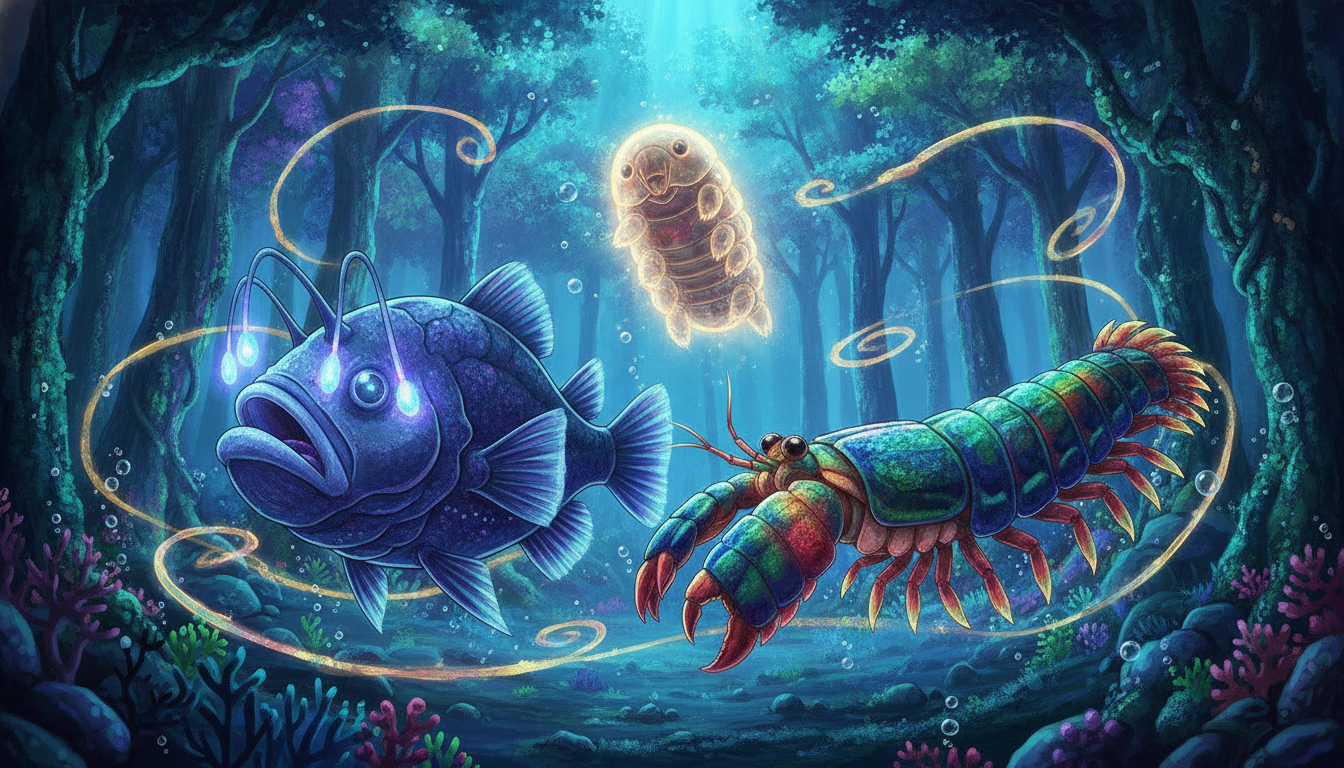
The animal kingdom doesn’t need elaborate power systems, ancient prophecies, or dramatic backstories to be extraordinary — it just needs to exist. Immortal jellyfish, bulletproof micro-animals, color-perceiving super-shrimp, and brain-regrowing salamanders are all living proof that the universe is operating on rules far stranger than anything a writing room could invent. Next time someone tells you an anime is “too unrealistic,” point them here. Nature already wrote the blueprint — the animators just borrowed it.

1 Comment
Pingback: Still Illegal in 2026: Weirdest Laws You Won't Believe Exist - ICL Geek Curiosities