

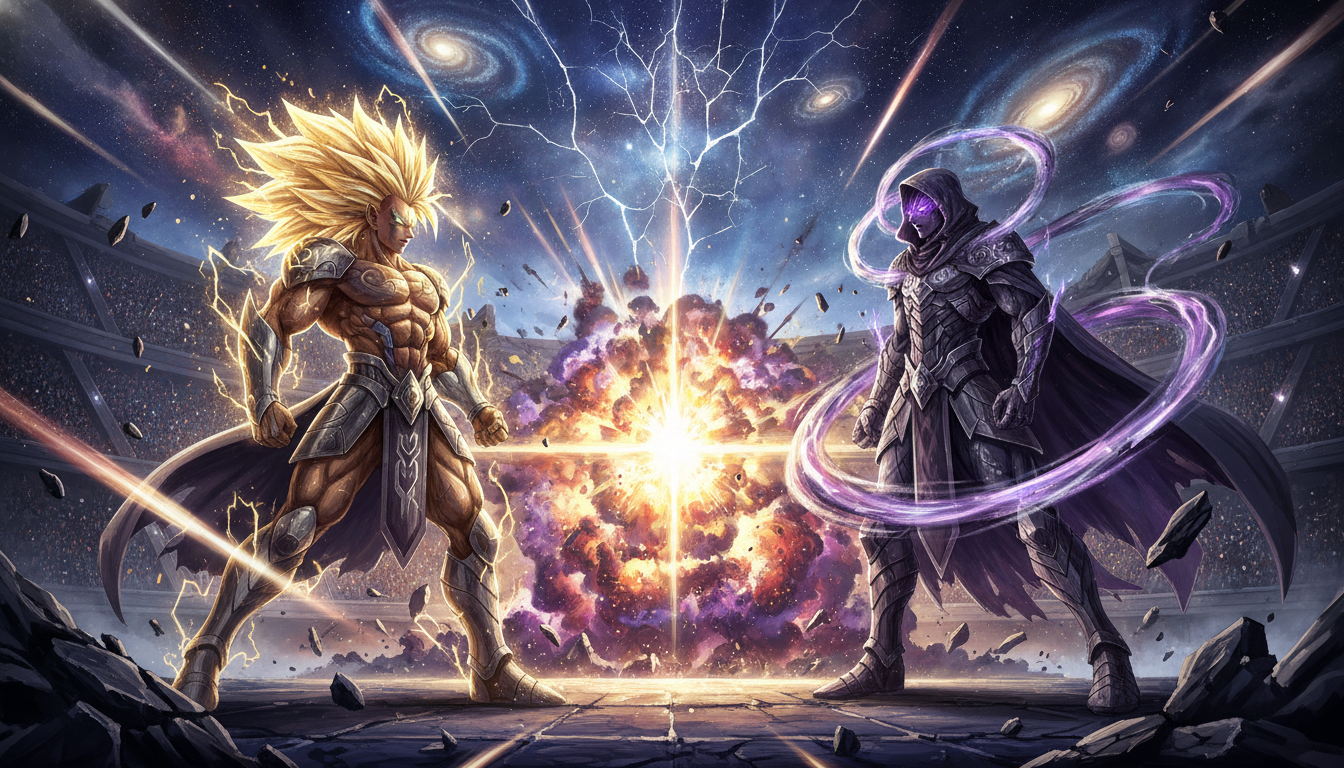
Every anime fan has had this argument at least once — usually late at night, fueled by energy drinks and righteous passion. “Goku can’t be beaten.” “Yes he can.” “Name one character.” And then silence. Because honestly? Most suggestions fall apart the moment you apply even a little logic. Goku — Son Goku from Dragon Ball, created by Akira Toriyama — has been climbing a power ladder for over four decades, and with transformations like Ultra Instinct giving him god-tier reflexes and combat ability, the bar for beating him is almost cosmically unfair. Almost.
Here’s the thing: the “Goku debate” isn’t really about who can punch harder. It’s about how different anime universes define power. Goku operates within a system of ki, physical training, and transformation. Other universes operate on entirely different rules — reality manipulation, causality erasure, omniscience. And when you start comparing across those systems, one name keeps rising to the top of serious fan discussions, not because of hype or nostalgia, but because of cold, brutal narrative logic. That name is Zeno — no, wait, he’s from Dragon Ball itself, so he doesn’t count. The real answer? Featherine Augustus Aurora from Umineko: When They Cry.
But before the purists close the tab — stick around. Because this isn’t just a flex. It’s a deep dive into power scaling, narrative structure, and why one witch from a visual novel adaptation might be the most genuinely unbeatable character in all of anime fiction. Buckle up.
Understanding Why Goku Is So Hard to Beat in the First Place
To appreciate why beating Goku matters, you need to understand what you’re actually up against. Son Goku debuted in Dragon Ball in 1984 and has spent over four decades getting stronger in ways that redefine what “strong” even means. By the time Dragon Ball Super rolled around, Goku had achieved Ultra Instinct — a state where his body moves and reacts independently of conscious thought, essentially removing human error from combat entirely.
In the Dragon Ball Super manga and anime, gods of destruction and angels are established as some of the most powerful beings in existence. Goku’s Ultra Instinct puts him in conversation with those beings. His training under Whis, the angelic attendant to Beerus, gave him access to techniques that even most gods haven’t mastered. The point is: Goku scales upward constantly, and the ceiling of his universe keeps rising to meet him.
Beating Goku physically — matching his speed, his output, his durability — is nearly impossible unless you’re operating on a similarly escalating scale. So the only realistic path to defeating him isn’t out-punching him. It’s operating on a fundamentally different axis of existence entirely.
Who Is Featherine Augustus Aurora?
Featherine Augustus Aurora is a character from Umineko: When They Cry (Umineko no Naku Koro ni), a visual novel series created by Ryukishi07, originally released between 2007 and 2010. The series received a manga adaptation and a 2009 anime adaptation by Studio DEEN. Featherine is known within the story as a Witch of Theatergoing, Dreams, and Magic — one of the highest-tier beings in the When They Cry cosmology.
She is classified as a Creator-class entity, meaning she exists at a level of reality that transcends the narrative itself. In the lore of Umineko, there are multiple layers of existence — the “game board” (the story level), the “meta” level, and above that, beings who write the story. Featherine operates at the Author level. She doesn’t just exist in fiction; she is one of the beings responsible for crafting it. She requires a “headpiece” to maintain her memories due to the sheer span of her existence, which itself hints at a scale of being that dwarfs most anime characters entirely.
Why Featherine’s Power Set Breaks Every Rule Goku Plays By
Here’s where it gets philosophically interesting — and this is why Featherine isn’t just “another strong anime character.” Her abilities aren’t defined in terms of energy output or combat stats. They’re defined in terms of narrative authority.
- She can rewrite events — not time travel, but literal story editing. What happens is what she writes.
- She exists outside causality — cause and effect as physical laws don’t apply to beings at her tier.
- She cannot be killed by conventional means — because death, as a concept, is something that happens inside stories, and she is outside the story.
- Her perception of “games” (narratives) means she views entire universes as fiction she can engage with or discard.
- She has existed for an incomprehensible span of time, accumulating magical knowledge across what the series implies are countless ages.
Goku’s Ultra Instinct makes him nearly untouchable in physical combat. Featherine doesn’t do physical combat in a meaningful sense. She engages at the level of what is real, which is a category Goku — even at his absolute peak — simply doesn’t operate in.
The Author vs. The Warrior: A Conceptual Mismatch
Think of it this way. Imagine you’re writing a story about the world’s greatest boxer. That boxer can beat every other boxer in the story. But the author — the person holding the pen — isn’t in the story in the same way. If the author decides the boxer loses, the boxer loses. Featherine is that author.
This is sometimes called “author-level” or “meta” power in power-scaling communities, and it’s one of the few conceptual frameworks that genuinely breaks the loop of “just make Goku stronger.” You can make Goku infinitely stronger within his narrative, and Featherine simply exists at the layer above narrative. It’s not about power levels. It’s about ontological hierarchy — the layering of reality itself.
For fans who love overpowered main characters who break every rule in anime, Featherine is the logical endpoint of that concept. She doesn’t just break rules — she writes them.
The Fan Debate: Is This Actually Fair?
Of course, not everyone accepts this framing. The counterarguments are real and worth engaging with:
- “Cross-universe comparisons don’t count” — Many fans argue that Goku can only be judged against characters within a shared fictional universe. Fair point, but that argument applies equally to every other “Goku beater” candidate, so Featherine is no worse off than Saitama or Rimuru.
- “Featherine’s abilities aren’t well-defined in the anime” — True. The 2009 anime adaptation is widely considered incomplete and doesn’t cover the full scope of the visual novel’s lore. For full context, the source material matters.
- “She’d never actually fight Goku” — Also true. But power-scaling debates have never required two characters to meet canonically. That’s never stopped anyone.
The honest answer is that no cross-series comparison is “fair” in a strict canonical sense. These debates exist because they’re fun, because they force fans to engage deeply with the rules of their favorite fictional universes, and because arguing about it is basically a love language for anime fans.
Other Honorable Mentions Worth Knowing
Featherine is the strongest argument, but she’s not the only one that holds up under scrutiny. A few others that serious power-scaling communities treat as legitimate contenders:
- The Anti-Spiral (Gurren Lagann) — operates on a scale of spiral energy capable of compressing entire universes
- Hajun (Kajiri Kamui Kagura) — a being whose passive existence erases all other life in creation
- Kami Tenchi (Tenchi Muyo!) — implied to be an absolute existence beyond all dimensional layers
- Ryougi Shiki (The Garden of Sinners / Kara no Kyoukai) — possesses the Mystic Eyes of Death Perception, capable of killing the “concept” of a thing
None of these are casual picks. Each comes from franchises with deeply developed metaphysical systems. If you want to go deeper on the films tied to some of these universes, these anime movies ranked will redefine your watchlist is a great place to start exploring.
Why This Debate Will Never Truly End (And Why That’s the Point)
The “who can beat Goku” debate has been running since the late 1980s and shows absolutely no sign of stopping in 2026. New Dragon Ball content continues to raise the ceiling. New anime series introduce new paradigms of power. And the community keeps engaging, arguing, theorizing, and loving every second of it.
Featherine Augustus Aurora represents something genuinely interesting in this conversation: the idea that the strongest character isn’t necessarily the one who trains the hardest or fights the longest, but the one who exists at a level where those concepts are irrelevant. That’s a philosophical curveball, and it’s exactly the kind of thinking that makes anime such a rich, strange, endlessly fascinating medium.
So next time someone challenges you with “name one character who can beat Goku” — say Featherine’s name. Watch the chaos unfold. Bring snacks.
