

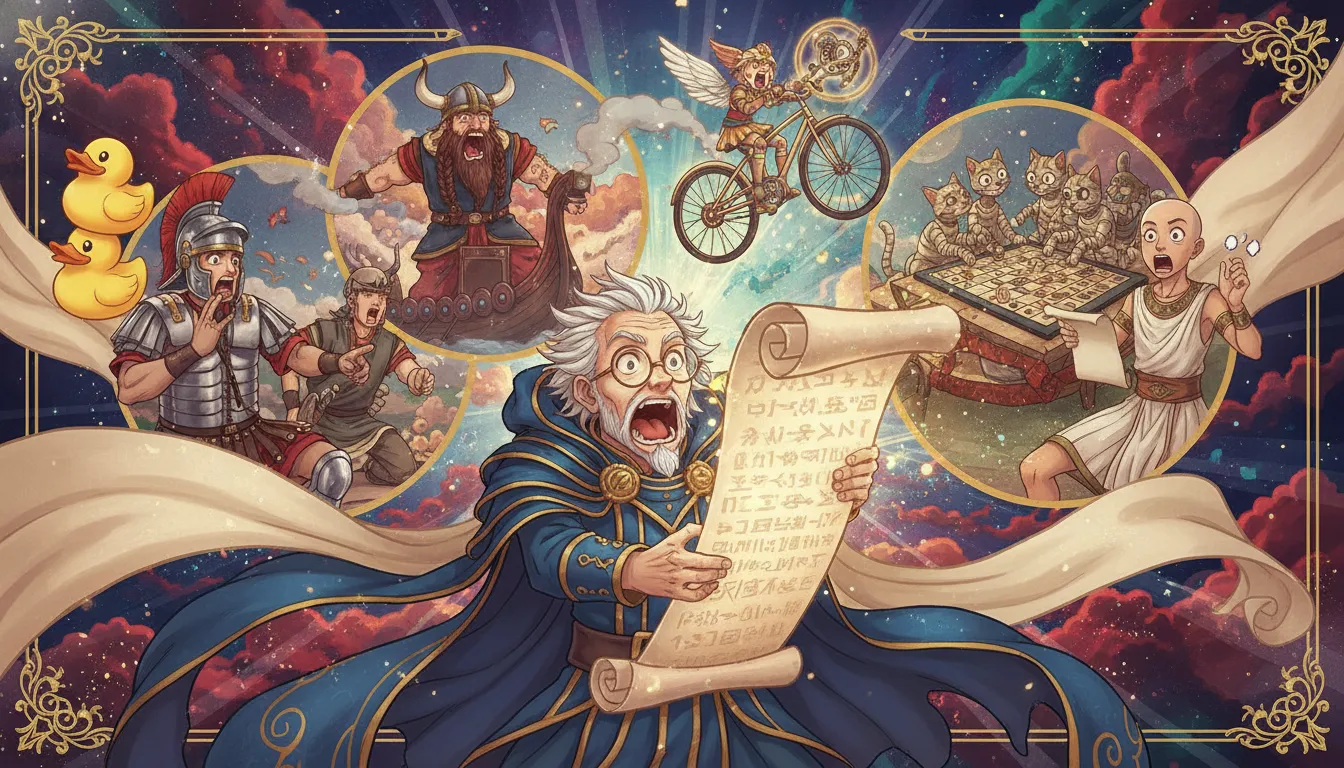
History class had a way of making the most jaw-dropping human story feel like a sedative delivered in chalk dust. Textbooks handed us dates, names, and sanitized narratives — but they conveniently skipped the parts where Roman soldiers used vinegar-soaked sponges on sticks as communal toilet paper, or where Napoleon Bonaparte was once reportedly chased and attacked by a horde of rabbits. The real past is messier, stranger, and infinitely more entertaining than any curriculum committee dared to admit. And honestly? That’s what makes it so addictive.
Think of history the way a seasoned anime fan thinks about lore drops — the surface story is fine, but the hidden details are where the magic lives. If you’ve ever fallen down a rabbit hole reading about hidden details in animated movies that will blow your mind, you already know the feeling: that electric little shock when something you thought you understood reveals a completely unexpected layer. History works the same way. Pull back the curtain, and the ancient world starts looking less like a museum exhibit and more like a fever dream written by a committee of chaos goblins. Let’s dig in.
The Roman Empire Was Surprisingly Modern — and Deeply Bizarre
Concrete, Fast Food, and Surprisingly Good Plumbing
The Romans built concrete so advanced that marine structures made from it are still intact more than 2,000 years later. Modern engineers have studied Roman marine concrete and discovered it actually grows stronger over time due to a mineral reaction — something our contemporary concrete can’t do. Meanwhile, Pompeii (the city famously frozen by the eruption of Mount Vesuvius in 79 CE) had a thriving fast-food culture. Archaeologists have excavated dozens of thermopolia — street counters with built-in vessels for keeping food warm — essentially ancient food stalls serving hot meals to people on the go.
But here’s where it gets strange. Romans used crushed mouse brains as toothpaste. They believed urine — collected in public pots on street corners — was an effective teeth whitener and laundry cleaner, because of its ammonia content. Fullers (Roman laundry workers) actually paid for the collected urine. Emperor Vespasian famously taxed the urine trade, and when his son Titus complained it was undignified, Vespasian reportedly held a coin to his nose and said, “Money doesn’t stink.” That phrase, loosely, is still used in several European languages today.
Medieval Life Was Gross, Loud, and Surprisingly Funny
Knights, Flatulence Taxes, and Trained Bears
The Middle Ages get a reputation for being nothing but plague and suffering, but the historical record is also full of moments of absurd comedy. In medieval England, there was a man named Roland the Farter (yes, really) who held land in Suffolk granted to him by King Henry II — in exchange for performing a jump, a whistle, and a fart before the king every Christmas. This was an actual feudal arrangement, documented in historical records. Performance art has a very long history.
Medieval courts also took animals extremely seriously — as defendants. Pigs, rats, weevils, and even swarms of insects were formally tried in courts of law, given legal representation, and sentenced. A pig in Falaise, France, was tried and executed in 1386 for attacking a child, dressed in human clothes for its execution. It sounds like a dark comedy sketch, but the records are real.
And if you thought humanity used to believe the weirdest things imaginable, medieval medicine will confirm your suspicions — physicians believed that pressing a live hen against a plague bubo (swollen lymph node) would draw out the disease. The hen was then buried. Spoiler: it did not work.
Ancient Egypt Had Surprisingly Complex Labor Rights
Strikes, Sick Days, and Worker Complaints Carved in Stone
Forget the image of whip-cracking overseers. Archaeological evidence — including papyrus records — shows that workers who built the royal tombs in the Valley of the Kings staged what may be the earliest recorded labor strike in human history, around 1170 BCE during the reign of Ramesses III. The workers downed tools and marched to the mortuary temples demanding their grain rations, which had been delayed. They even sat down outside the gates in organized protest until their demands were partially met.
These workers had medical records, days off for illness, religious holidays, and complaint systems. One papyrus document records a worker’s excuse for absence: “The scorpion bit him.” History’s first sick note.
The Wild Truth About Famous Historical Figures
Cleopatra Was a Linguist, Napoleon Wasn’t Short, and Other Corrections
A few corrections the textbook generation desperately needed:
- Cleopatra VII was not Egyptian by ethnicity — she was Macedonian Greek, descended from Ptolemy I, one of Alexander the Great’s generals. More strikingly, she was reportedly the first ruler of her dynasty to actually speak Egyptian. She also spoke around nine languages total, including Ethiopian, Hebrew, and Aramaic.
- Napoleon Bonaparte was not unusually short. His height was recorded as 5 feet 2 inches in French units, which translates to roughly 5 feet 7 inches in modern Imperial measurement — average for his time. The “short Napoleon” myth was partly British propaganda spread through caricatures by cartoonist James Gillray.
- Albert Einstein did not fail mathematics as a child. This rumor has persisted for decades. In fact, Einstein mastered calculus before age 15.
- Vikings did not wear horned helmets in battle. That imagery came largely from 19th-century Romantic-era paintings and theatrical costume design. Only one Viking-age helmet has been found with horns, and it appears to have been ceremonial.
- Abraham Lincoln was an accomplished wrestler. Before his political career, he lost only one match in approximately 300 contests, and was inducted into the National Wrestling Hall of Fame in 1992.
The Strange Military Decisions That Shaped the World
Rubber Ducks, Carrier Pigeons, and Australia’s Emu War
Warfare has produced some of history’s most surreal footnotes. In 1932, the Australian government launched what became known as the Great Emu War — a genuine military operation in Western Australia in which soldiers armed with Lewis guns were deployed to cull a population of emus that was destroying crops. The emus, distributed across wide terrain and proving highly resistant to being efficiently shot, effectively won. The operation was largely abandoned after weeks of embarrassing results, and Major G.P.W. Meredith — who led the campaign — noted the emus seemed to be operating in guerrilla-style formations. Australia withdrew. The emus remained.
During World War I, carrier pigeons were genuinely decorated war heroes. A pigeon named Cher Ami delivered a critical message in 1918 that saved nearly 200 soldiers of the Lost Battalion, despite being shot through the chest and losing a leg mid-flight. Cher Ami was awarded the Croix de Guerre by France for the act. The U.S. Army kept pigeons as an active communications method well into World War II.
Ancient and Medieval Inventions That Disappeared and Were Reinvented
The World Kept Forgetting Its Own Best Ideas
History is full of technologies that were developed, lost, and then painfully rediscovered centuries later:
- Greek fire, the Byzantine Empire’s terrifying naval weapon — a liquid fire that burned on water — has never been fully reconstructed. Its exact formula remains unknown to this day.
- The Antikythera mechanism, discovered in a shipwreck off Greece and dated to around 100 BCE, is an analog computing device capable of predicting astronomical events. Nothing of similar mechanical complexity appeared again in the historical record until the 14th century CE.
- Roman concrete, as mentioned above, was so effective that the formula was functionally lost after the empire’s collapse and only meaningfully studied again in the 21st century.
- Damascus steel, the legendary blade material famed for its strength and distinctive wavy patterns, was produced in the Middle East until roughly the 18th century — then the technique vanished. Modern metallurgists believe it may have involved carbon nanotubes, only identified as a material in 1991.
Why Weird History Matters More Than the Sanitized Version

The Chaos Is the Point
The real argument for loving weird history isn’t just entertainment — it’s perspective. When you learn that ancient Roman graffiti from Pompeii includes political insults, love declarations, and toilet humor nearly identical to what you’d find scrawled in a modern public restroom, the distance between “ancient people” and “us” collapses entirely. History’s weirdness is its humanity.
The sanitized textbook version creates the illusion that people in the past were fundamentally different — simpler, more solemn, less relatable. The actual record shows people who were petty, funny, creative, bureaucratic, and completely baffled by their own world. Which is to say: exactly like us.
If you’ve ever felt that rush of recognition finding unexpected depth in something you thought you already understood — a plot twist in a long-running series, a lore detail hidden in plain sight — that’s exactly what real history delivers when you go looking for the parts they left out. The past wasn’t a textbook. It was a story. And the best chapters were always the weird ones.
