

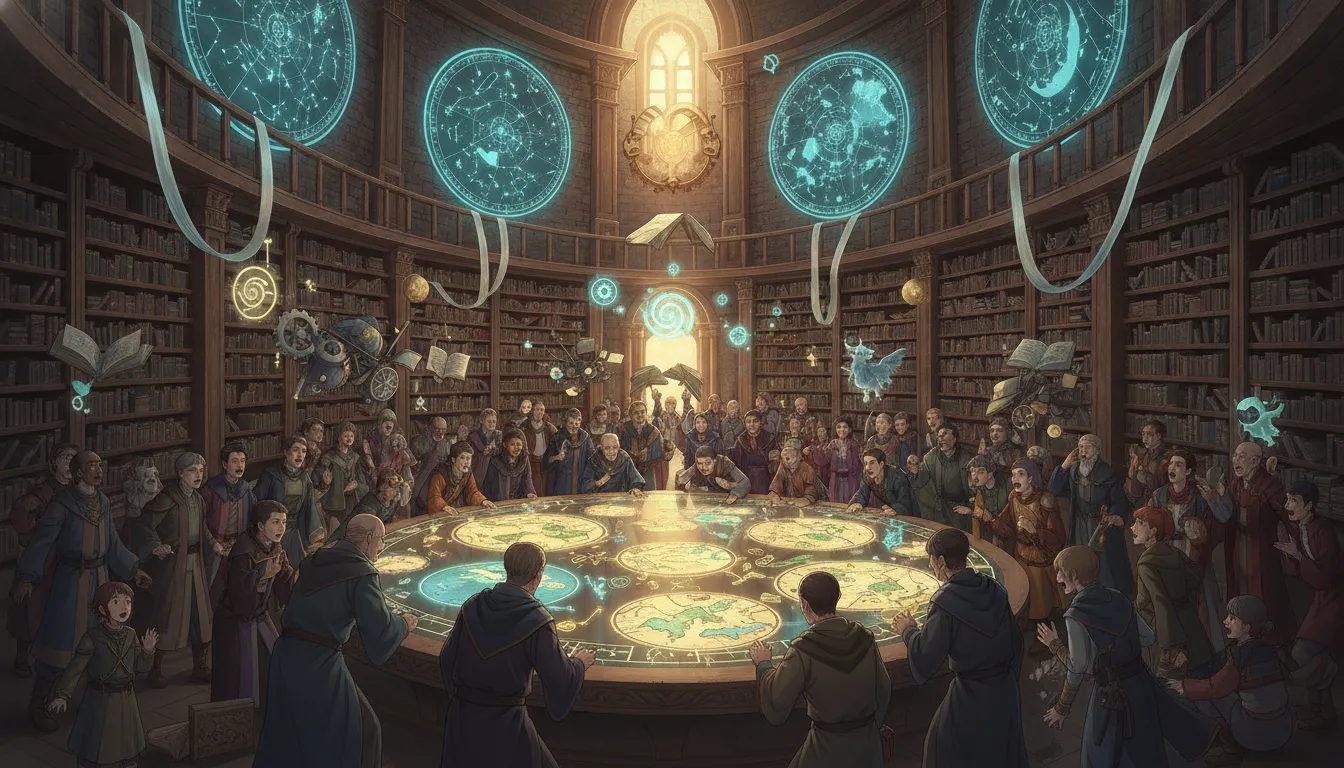
Imagine believing that the world sat on the back of a giant turtle, that bad smells caused plague, or that staring at the moon for too long would drive you irreversibly insane. Sound absurd? These weren’t fringe conspiracy theories whispered in dark corners — they were mainstream, accepted, scientific, and religious truths held by some of the most brilliant minds in human history. The gap between “what we know” and “what we think we know” has always been enormous, and the history of human belief is one long, delightfully humbling journey from the deeply weird to the slightly less weird.
What makes this topic so endlessly fascinating — especially for fans of anime, science fiction, and speculative fiction — is how often great storytelling has played with these ancient misconceptions. Shows like Dr. Stone (where a teenage genius rebuilds civilization from scratch using real science) or Fullmetal Alchemist: Brotherhood (which treats alchemy as a legitimate proto-science) tap directly into the history of humanity’s stranger beliefs. When you understand what people actually believed in the past, fictional worlds that seem fantastical suddenly feel grounded in something real and deeply human.
So buckle up. We’re about to take a tour through some of the wildest, most earnest, most confidently wrong beliefs that humanity ever held — and we’re going to have a great time doing it.
The Earth Is Flat, Hollow, and Sitting on a Turtle: Ancient Cosmologies Were Wild
Before we laugh too hard, let’s acknowledge something important: ancient cosmologies were sophisticated attempts to explain an enormously complex universe with limited tools. That said, some of the explanations were spectacularly strange by modern standards.
The flat Earth belief is perhaps the most famous, but it’s actually more nuanced than most people think. While many ancient cultures did conceive of a flat Earth, ancient Greek thinkers like Pythagoras and later Aristotle had already argued for a spherical Earth by around the 4th century BCE. Eratosthenes even calculated the Earth’s circumference with remarkable accuracy around 240 BCE. So flat-Earth thinking wasn’t universal even in the ancient world.
Far weirder was the Hollow Earth theory, which persisted well into the 18th and 19th centuries. Edmund Halley — yes, the same Halley of the famous comet — proposed in 1692 that the Earth consisted of several nested hollow spheres, possibly inhabited. This wasn’t fringe: Halley was a respected astronomer. The idea influenced literature for centuries, feeding directly into Jules Verne’s Journey to the Center of the Earth (1864) and countless stories after it.
And then there are the turtle cosmologies. Several cultures, including certain Native American traditions and ancient Hindu cosmology, described the Earth as resting on the back of a cosmic turtle (or supported by elephants standing on a turtle). These weren’t meant as literal physics — they were mythological frameworks — but they reflect how deeply humanity has always needed an answer to the question: what holds everything up?
Miasma: When Bad Smells Were Literally Killing You (According to Doctors)
For over two thousand years, the dominant medical theory about disease transmission was miasma theory — the idea that illness was caused by “bad air” rising from rotting organic matter, swamps, and filth. The very word “malaria” comes from the Italian mala aria, meaning “bad air.”
This theory wasn’t just folk medicine. It was the official position of physicians from ancient Greece through the mid-19th century. When the Black Death devastated Europe in the 14th century, killing roughly a third of the continent’s population, the medical response was largely focused on avoiding bad smells — burning herbs, carrying flowers, wearing masks filled with aromatic substances.
The miasma theory wasn’t completely wrong in its observations — disease did cluster around filthy, damp environments — it was just catastrophically wrong about the mechanism. It wasn’t the smell making people sick; it was the bacteria and parasites thriving in those same conditions.
Miasma theory held on stubbornly until figures like John Snow (during London’s 1854 cholera outbreak) and Louis Pasteur (with germ theory, solidified through the 1860s and 1870s) finally turned the scientific tide. The lesson? Sometimes you can observe a real pattern and still build an entirely wrong model around it. This is actually explored beautifully in fiction — The Surprising Truth Behind Objects You Use Every Day explores similar “hidden mechanisms” that we take for granted today.
Bloodletting, Balance, and the Four Humors: Medicine’s Longest-Running Mistake
If miasma theory is bad, the theory of the four humors might be humanity’s most medically devastating long-running belief. Originating with ancient Greek physicians and formalized by Galen in the 2nd century CE, this theory held that the human body was governed by four fluids — blood, yellow bile, black bile, and phlegm — and that illness resulted from these being out of balance.
The prescribed solution was often bloodletting: draining the patient’s blood to restore balance. This practice persisted in mainstream Western medicine for roughly two thousand years and almost certainly killed more people than it saved — including, possibly, George Washington, who received aggressive bloodletting treatments during his final illness in 1799.
The four humors theory is a brilliant example of a belief that was internally logical, socially reinforced, and culturally prestigious while being fundamentally and dangerously wrong. It also tells us something important: authority and longevity are not proof of truth.
The Moon, Madness, and Mysterious Celestial Powers
The belief that the moon could affect human behavior and mental health has roots in virtually every culture on Earth. The word “lunacy” itself comes from luna, the Latin word for moon. Medieval physicians genuinely believed that sleeping in moonlight, or prolonged exposure to a full moon, could induce madness.
This belief was so widespread that legal systems took it seriously. English common law once recognized “lunacy” as a condition tied to lunar cycles. Nurses and doctors in the 18th and 19th centuries often expected more chaotic wards during full moons.
Modern science has largely debunked a direct lunar-madness connection, though the cultural resonance has never died — and anime loves it. Werewolf and lunar transformation myths are everywhere in the medium, from InuYasha‘s Inuyasha losing his power on the night of the new moon to the moon’s role in Sailor Moon‘s entire mythology. These stories are more fun knowing they grew from something humans genuinely, earnestly feared.
A Quick Hit List: Other Beliefs That Will Make You Feel Better About 2026
Need a rapid-fire tour of humanity’s greatest hits? Here you go:
- Spontaneous generation: People believed maggots, mice, and other creatures could spontaneously generate from non-living matter (rotting meat, mud, old grain). Francesco Redi challenged it in 1668, and Louis Pasteur definitively disproved it in 1859.
- The geocentric model: The Earth at the center of the universe, with the sun and stars revolving around it. Copernicus proposed heliocentrism in 1543, and the fight to accept it lasted over a century.
- Phrenology: The “science” of reading personality and intelligence from the shape of a person’s skull. It was popular through the 19th century and used to justify horrific racial pseudoscience.
- Trepanation as a cure: Drilling holes in human skulls to release evil spirits or cure headaches, practiced across multiple ancient cultures.
- Quicksilver as medicine: Mercury (called quicksilver) was used as a treatment for syphilis and other ailments for centuries. It was devastatingly toxic.
- Tobacco as healthy: European physicians once praised tobacco as a medicinal cure-all following its introduction in the 16th century.
What Anime Teaches Us About Human Belief Systems
Anime has a genuinely underappreciated gift for exploring epistemology — the study of how we know what we know. Dr. Stone presents a world where Senku Ishigami rebuilds civilization by methodically questioning assumptions and rebuilding knowledge from evidence. Fullmetal Alchemist: Brotherhood deconstructs the beautiful, dangerous human desire to believe in systems of secret knowledge that promise control over the world.
Even isekai stories — those beloved tales of characters transported to another world — often work precisely because they show modern knowledge colliding with medieval belief systems. If you haven’t explored that genre yet, What Is Isekai Anime and Why Can’t Anyone Stop Watching It? is a great place to start.
The deeper message across all these stories is the same one history teaches us: confidence in a belief is not evidence for it. Every generation has its blind spots. The people who believed in miasma, hollow Earth, and skull-reading weren’t stupid — they were human, working with what they had.
The Humbling Truth About What We Might Be Getting Wrong Right Now
Here’s the thought that should keep you up at night (in the best way): if our ancestors were so confidently, systematically wrong about so many things, what are we getting wrong right now? This isn’t a call to distrust science — the scientific method exists precisely to catch and correct these errors over time. It’s a call to hold knowledge with appropriate humility.
History is not a parade of idiots finally reaching us, the smart ones. It’s a long, unbroken chain of curious, earnest people doing their best. The weirdest thing humanity has ever believed might just be that we’ve finally figured everything out.
Stay curious. Stay humble. And maybe don’t drink any mercury.
