

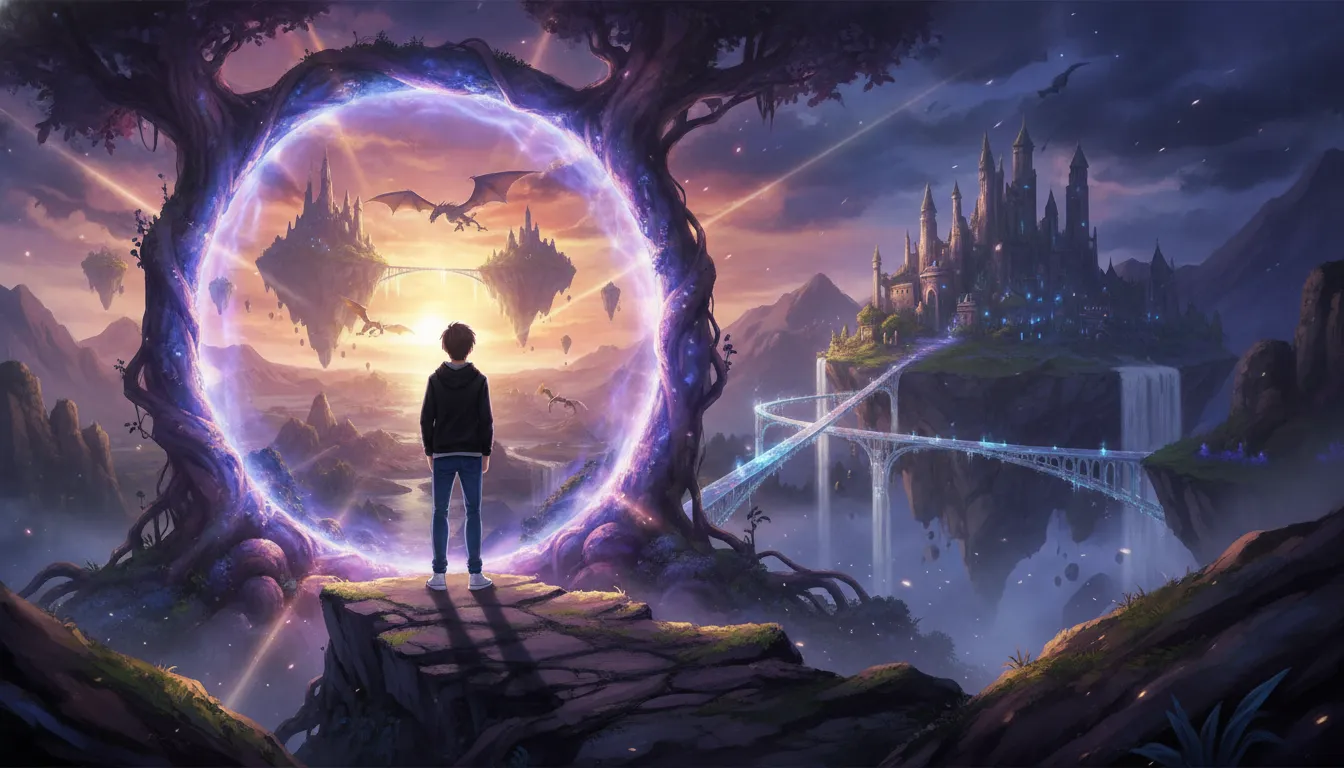
Imagine waking up tomorrow and discovering you’ve been transported to a fantasy kingdom where magic is real, monsters roam the wilderness, and — plot twist — you’re somehow the most powerful being in the entire realm. No more Monday meetings, no more stressful commutes, just swords, spells, and an adventure that never ends. That’s the basic promise of isekai anime, and it’s a promise tens of millions of fans worldwide apparently cannot resist. The genre has exploded from a niche light-novel curiosity into one of the dominant forces in modern anime, flooding streaming platforms every season with new worlds, new heroes, and new reasons to cancel your plans and binge until 3 a.m.
The word isekai (異世界) literally means “different world” in Japanese, and that two-word concept has spawned an entire cultural phenomenon. Whether it’s a teenager dying in a traffic accident and waking up as a slime, a gamer getting sucked into his favorite RPG, or a salaryman discovering he’s been reincarnated as a spider, the core fantasy is surprisingly universal: escape, reinvention, and a second chance at life in a place where the rules are different — and usually more exciting. It sounds simple, but there’s a reason creators and fans keep returning to this well over and over again.
So what exactly is isekai, where did it come from, why does it dominate seasonal anime charts, and what makes it so irresistible even to people who know, on some level, they’re watching something deeply, gloriously ridiculous? Let’s break it all down.
The Core DNA of Isekai: What Every Entry Has in Common
At its most basic, isekai follows a protagonist — almost always from modern-day Japan or a recognizable contemporary setting — who is transported, reincarnated, or summoned into another world. That world is typically a fantasy realm, though sci-fi and historical variants exist. From there, the story usually involves the protagonist navigating this new reality with some form of advantage: special powers, modern knowledge, a unique class, or just sheer luck.
A few defining traits tend to show up repeatedly:
- The transportation trigger: death and reincarnation, summoning by another world’s inhabitants, falling through a portal, or getting trapped in a video game
- The power fantasy element: the protagonist is usually exceptional in some way — chosen, overpowered, or uniquely clever
- RPG-style world-building: stat systems, character classes, skill trees, and level-ups are extremely common
- A found family dynamic: the hero assembles a party or companions who become surrogate family
- Social or emotional wish fulfillment: characters who were overlooked, bullied, or bored in their old lives find purpose, respect, and community in the new world
These aren’t criticisms — they’re the genre’s recipe. Isekai knows exactly what it’s doing, and audiences love it for precisely that reason.
A Brief History: From Classic Roots to the Modern Explosion
Isekai isn’t as new as it might seem. The concept of traveling to another world has ancient literary roots, from Lewis Carroll’s Alice’s Adventures in Wonderland (1865) to L. Frank Baum’s The Wonderful Wizard of Oz (1900). In Japanese anime specifically, early examples include The Vision of Escaflowne (1996) and the beloved Magic Knight Rayearth (1994), both of which sent young protagonists into fantastical alternate dimensions.
The real boom, however, came in the 2010s, fueled largely by the rise of light novels and web novels published on platforms like Shōsetsuka ni Narō (roughly “Let’s Become a Novelist”). That site became a breeding ground for isekai stories written by and for people who loved RPGs and fantasy gaming, and many of the genre’s biggest titles — including That Time I Got Reincarnated as a Slime and Overlord — originated there.
Sword Art Online, which began airing in 2012, is widely credited with mainstreaming the “trapped in a video game” subgenre for a global audience. Whatever debates fans have about its quality, its cultural impact is undeniable. By the mid-2010s, the isekai wave was fully underway, and by the early 2020s, it was rare to see an anime season without at least three or four new isekai entries competing for attention.
The Genre’s Biggest Heavy Hitters
Some isekai series have transcended the genre entirely, becoming genuine cultural landmarks. If you’re new to isekai and want a starting point, these are the titles that define the modern era:
| Title | Year | Hook |
|---|---|---|
| Sword Art Online | 2012 | Players trapped inside a deadly virtual MMO |
| No Game No Life | 2014 | Genius gamer siblings rule a world decided by games |
| Re:Zero − Starting Life in Another World | 2016 | Protagonist can return from death, but at enormous psychological cost |
| Overlord | 2015 | A player is stuck as his powerful skeleton villain character |
| That Time I Got Reincarnated as a Slime | 2018 | A man reborn as a slime builds a monster nation |
| Mushoku Tensei: Jobless Reincarnation | 2021 | Widely praised for its complex, mature take on the genre |
| Frieren: Beyond Journey’s End | 2023 | A post-quest elven mage reflects on time and loss |
Frieren: Beyond Journey’s End deserves special mention — while technically more of a fantasy reflection on the isekai/RPG-quest formula than a pure isekai, it took the anime world by storm in 2023 and 2024, winning widespread critical acclaim and proving that the genre’s adjacent ideas still have enormous room to grow.
Why the “Overpowered Protagonist” Formula Works So Well
One of the most common criticisms leveled at isekai is that the main character is always absurdly overpowered (often abbreviated in fandom as “OP”). And it’s frequently true. So why does it work?
The answer lies in catharsis and escapism. Many isekai stories tap into the feeling of being underestimated, overlooked, or trapped — experiences that resonate deeply with their core audience of students, young professionals, and passionate gamers. Watching a character who was nobody become someone extraordinary in a world that actually appreciates them is genuinely satisfying on a psychological level.
The best entries in the genre use that power fantasy as a foundation while adding complexity — Re:Zero, for example, deliberately subverts the power fantasy by placing its protagonist in constant, traumatic suffering. Done With Jujutsu Kaisen? Watch These Next — because if you can handle Gojo and Yuji’s world, several isekai series will scratch the same action-and-stakes itch beautifully.
The Studios and Production Ecosystem Behind Isekai
Isekai’s dominance isn’t accidental — it’s the result of a well-oiled production pipeline. Light novels and web novels provide source material at scale, reducing the risk for anime producers. Studios like Madhouse, J.C.Staff, and Eight Bit have all produced major isekai titles, and the genre’s consistent viewership makes it commercially attractive season after season.
The relationship between source material, manga adaptations, and eventual anime is a whole ecosystem worth understanding. For a deeper look at how the studios behind your favorite shows actually operate, The Anime Studios Shaping Every Show You Love is a great companion read.
Is There Such a Thing as Too Much Isekai?
Honestly? The market has asked this question out loud. At peak saturation, fans and critics began joking about the sheer volume of isekai entries each season, many of which blurred together into a pile of nearly identical premises. Terms like “isekai fatigue” entered the fan vocabulary around the early 2020s, and parody isekai series — including KonoSuba: God’s Blessing on This Wonderful World! (which lovingly mocks every trope) — became their own beloved subgenre.
Yet the genre kept evolving. Titles like Mushoku Tensei and Frieren demonstrated that thoughtful writing, strong characters, and genuine emotional depth could elevate the formula into something exceptional. The genre isn’t dying — it’s maturing, splintering into subgenres, and finding new ways to surprise audiences who thought they’d seen everything.
Why Isekai Isn’t Going Anywhere
Here’s the simplest truth about isekai: it sells a feeling that never gets old. The fantasy of starting over, of being seen, of walking into a world where your particular skills finally matter — that’s not a niche desire. It’s deeply human. As long as people feel overlooked, overscheduled, or hungry for adventure they can’t find in their daily lives, there will be an audience for a story about someone just like them stepping through a door and becoming something extraordinary.
Whether you’re a longtime fan with a ranked tier list of your favorite protagonists or someone who just stumbled onto the genre last week, isekai anime has something to offer. And if a story about a guy reincarnated as a slime can make you genuinely emotional by episode ten, then maybe the genre is doing something far more interesting than it first appears.
