


Imagine watching Tengen Toppa Gurren Lagann for the first time — a mecha anime where the heroes literally drill through the fabric of reality, piloting a robot the size of a galaxy to punch out a villain who throws galaxies like shuriken. You finish the last episode, sit back, and think, “Well, that’s the most insane thing I’ll ever encounter.” Then you open a physics textbook. Spoiler: the universe has been doing wilder things than that for about 13.8 billion years, and it didn’t even need a hype soundtrack.
From quantum particles that behave differently when you look at them, to black holes that evaporate over time and potentially encode every piece of information that ever fell into them, to the mind-bending possibility that our entire reality is a kind of holographic projection — real cosmology and physics read less like a science class and more like the script notes for an isekai that got rejected for being “too unrealistic.” The laws of nature don’t care about narrative consistency or the laws of physics as we casually understand them. They just are, and they are spectacularly weird.
This article is your guided tour through some of the most brain-melting truths about our universe, mapped against the anime concepts they most resemble. Whether you’re a seasoned fan of Neon Genesis Evangelion‘s existential horror or a newcomer who just finished Fullmetal Alchemist: Brotherhood, buckle up — because reality is about to make your favorite series look tame.
Quantum Mechanics: The Universe’s Ultimate Plot Twist
If you’ve watched Steins;Gate, you already have an emotional relationship with quantum theory. The series, produced by White Fox and first broadcast in 2011, centers on the many-worlds interpretation of quantum mechanics and the terrifying consequences of altering timelines. It’s brilliant science fiction — but actual quantum mechanics is arguably stranger than anything Rintaro Okabe ever faced.
The double-slit experiment is the universe’s way of trolling scientists. Fire electrons through two slits without measuring which slit they use, and they behave like waves, creating an interference pattern. Start measuring which slit each electron uses, and the interference pattern disappears — as if the electrons know they’re being watched and decide to behave like particles instead. The act of observation literally changes the outcome. That’s not metaphor. That’s peer-reviewed, repeatedly confirmed experimental reality.
Then there’s quantum entanglement, which Albert Einstein famously (and dismissively) called “spooky action at a distance.” Two particles can be entangled so that measuring the state of one instantly affects the state of the other, no matter how far apart they are. In 2022, the Nobel Prize in Physics was awarded to Alain Aspect, John Clauser, and Anton Zeilinger for experiments confirming that this effect is real and not just a gap in our understanding. In anime terms, imagine if Goku powering up in one universe instantly changed Vegeta’s power level in another — and that was just how physics worked.
Black Holes: Villains That Break Every Rule
In Dragon Ball, Beerus the Destroyer is introduced as a god capable of erasing entire planets with a flick of his fingers. It’s meant to establish a new ceiling of power. Black holes didn’t get the memo that there was a ceiling.
A stellar-mass black hole compresses the mass of several suns into a point of infinite density. At its center is a singularity — a place where our current equations for physics simply break down and produce nonsense. Time itself, as measured by someone falling toward a black hole, slows to a crawl relative to an outside observer. This is called gravitational time dilation, and it is the literal premise of the devastating beach scene in Interstellar — one hour on the water planet equals seven years on Earth.
But here’s the twist that would make even Fullmetal Alchemist‘s equivalent exchange principle nervous: Stephen Hawking theorized in 1974 that black holes actually slowly radiate energy and eventually evaporate. This created what physicists call the black hole information paradox — if a black hole evaporates, what happens to all the information (the quantum states) of everything that fell in? Does information simply get destroyed? Most physicists believe the universe doesn’t allow that. The argument is still active, still heated, and still unresolved as of 2026.
The Multiverse: Not Just an Anime Trope
Long before Re:Zero sent Subaru Natsuki dying and respawning across branching timelines, physicists were seriously discussing the many-worlds interpretation of quantum mechanics, first proposed by Hugh Everett III in 1957. The idea: every quantum event that could go multiple ways does go multiple ways, each outcome spawning a separate branch of reality.
There are actually several distinct multiverse theories in modern cosmology:
- Many-worlds interpretation — every quantum decision creates branching universes
- Eternal inflation — our Big Bang may be one of countless “bubble universes” formed in an ever-expanding inflationary field
- String theory landscape — the equations of string theory permit an enormous number of possible universes, each with different physical constants
- Simulation hypothesis — the possibility, discussed seriously by physicists and philosophers, that our universe is computed inside a more fundamental reality
None of these are confirmed. All of them are taken seriously by credentialed scientists. If that doesn’t sound like the setup for an isekai light novel, nothing does.
The Scale of the Universe: Making Gurren Lagann Look Small
Tengen Toppa Gurren Lagann‘s final mecha form is roughly the size of the observable universe in-series — a narrative flex intended to represent the absolute limit of “big.” Real cosmology is less polite about limits.
The observable universe stretches roughly 93 billion light-years in diameter, and it contains an estimated 2 trillion galaxies, a number revised sharply upward from earlier estimates following more precise analysis of Hubble Space Telescope data published in 2016. Each galaxy contains hundreds of billions of stars. Our Sun is so average it’s almost philosophically humbling.
And yet the observable universe is just the portion we can see — the region from which light has had time to reach us since the Big Bang. The total universe could be vastly larger. Some inflationary models suggest it is effectively infinite. The 10 Mind-Blowing Facts That Will Change How You See the World barely scratch the surface of how profoundly the scale of existence defies intuition.
Dark Matter and Dark Energy: The Invisible Antagonists
Every great anime has a hidden antagonist pulling strings behind the scenes — think the Homunculi in Fullmetal Alchemist: Brotherhood or the Instrumentality Committee in Neon Genesis Evangelion. In our universe, those hidden forces are called dark matter and dark energy, and together they make up roughly 95% of everything that exists.
We cannot see dark matter. We cannot directly detect it. We know it’s there because galaxies rotate at speeds that would fling them apart without additional gravitational mass holding them together — mass we can’t account for with visible matter. Dark energy is even more baffling: it’s the name we give to whatever is causing the expansion of the universe to accelerate, a discovery that won the 2011 Nobel Prize in Physics.
In other words, science has mapped, with extraordinary precision, that 95% of the universe is made of stuff we don’t understand at all. The matter that makes up every star, planet, and anime fan on Earth is essentially the universe’s footnote.
The Anthropic Fine-Tuning Problem: Why Does Any of This Exist?
Here’s the question that keeps physicists, philosophers, and the occasional Evangelion fan awake at night: why are the fundamental constants of physics exactly the values needed for matter, stars, planets, and life to exist?
The strength of gravity, the mass of electrons, the cosmological constant — tweak any of these even slightly, and you get a universe of undifferentiated gas, or one that collapses back on itself in seconds, or one where atoms never form. The universe appears, to a remarkable degree, calibrated for complexity to exist. This is known as the fine-tuning problem, and proposed explanations range from the multiverse (if infinite universes exist, at least one will have the right values by chance) to deeper physical principles we haven’t discovered yet.
It’s the kind of question that Beyond Gods: The Strongest Anime Characters of All Time gestures at when those characters literally reshape reality — because the real mystery isn’t finding something powerful enough to break the rules. It’s understanding why the rules are what they are in the first place.
Conclusion: Reality Doesn’t Need Special Effects
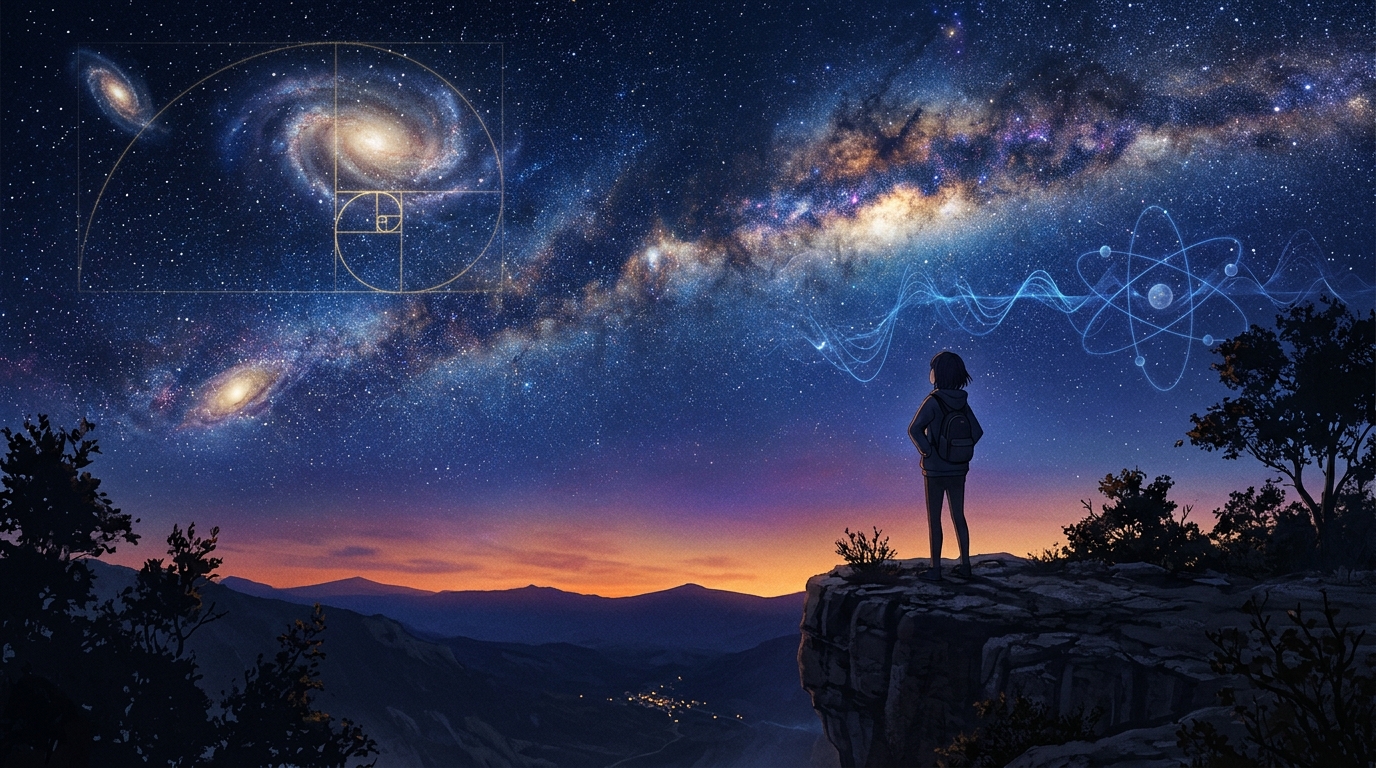
Anime has always been at its best when it takes wild, impossible ideas seriously — when it asks “what if?” and follows the answer all the way to its emotional, logical, and cosmic conclusion. What’s remarkable is that real physics has been doing exactly that for centuries, and the answers it keeps finding are consistently more surreal, more humbling, and more genuinely mind-bending than anything a storyboard artist has sketched.
The universe is not waiting for us to figure it out. It is 13.8 billion years old, mostly invisible, probably much larger than we can observe, and operating according to rules that dissolve under scrutiny. The next time an anime breaks its own logic for the sake of a dramatic power-up, remember: the universe already did that. It just didn’t give us a soundtrack.
