

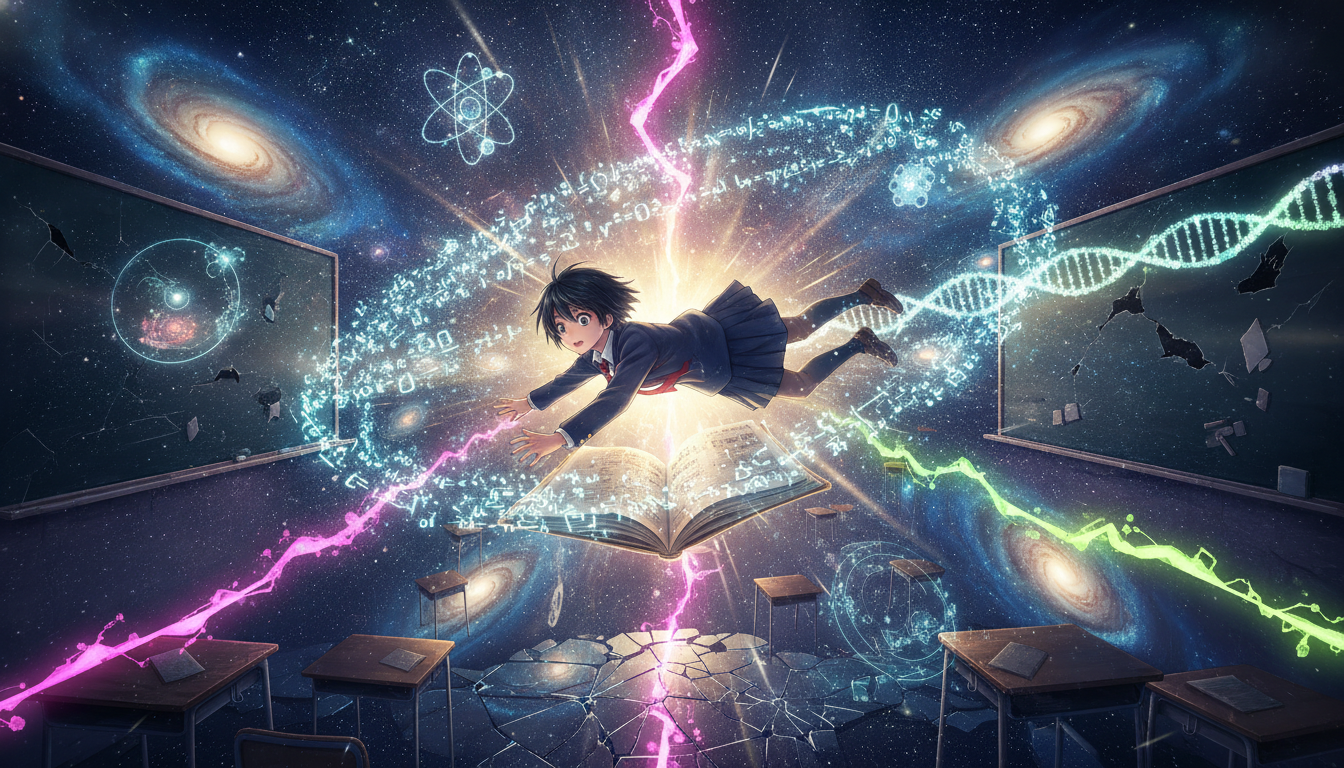
You think you know how reality works? You wake up, gravity keeps you on the ground, time ticks forward at a steady pace, and the chair you’re sitting on feels solid. Congratulations — almost all of that is either incomplete, misleading, or quietly hiding something that would make your brain short-circuit if you stared at it long enough. Science class handed us a tidy, comfortable version of the universe. The real version? It reads more like the plot of Neon Genesis Evangelion than a textbook chapter.
Here’s the thing about school science: it’s designed to be digestible. Teachers needed you to pass a test, not spiral into an existential crisis about whether the table in front of you is mostly empty space (it is, by the way). But in 2026, with information more accessible than ever, there’s no excuse not to dig into the genuinely jaw-dropping truths that the curriculum quietly skipped. Whether you’re a hardcore sci-fi fan who’s noticed how often anime gets surprisingly close to real physics, or just someone who wants dinner-party ammunition that will absolutely derail the conversation — this one’s for you.
The Solid Ground Beneath You Is Almost Entirely Nothing
Let’s start with the chair. Or the floor. Or your own hand. Matter — all matter — is composed of atoms, and atoms are almost entirely empty space. The nucleus of an atom is fantastically small compared to the atom’s overall size. If you scaled a hydrogen atom up to the size of a football stadium, the nucleus would be roughly the size of a marble sitting at the center. The electrons exist as probability clouds — not tiny solid balls orbiting like a miniature solar system, but smeared-out quantum possibilities.
The reason you don’t fall through your chair isn’t that the atoms are packed tightly. It’s because of electromagnetic repulsion between electrons. The sensation of “solid” is really just force pushing back against force. You have never actually touched anything in your life. That handshake you gave someone this morning? Technically, your electron clouds repelled each other at a quantum level. Romantic? Debatable. Reality-breaking? Absolutely.
Time Is Not a River — It’s More Like a Landscape
School taught us that time flows forward, like water in a river, and that’s just how it is. Einstein’s theory of relativity, which has been experimentally confirmed countless times, tells a very different story. Time is not a universal constant. It bends, stretches, and slows depending on two things: velocity and gravity.
The faster you move, the slower time passes for you relative to a stationary observer. This isn’t science fiction — GPS satellites in orbit experience time passing slightly faster than it does on Earth’s surface (because they’re farther from Earth’s gravitational field), and their onboard clocks have to be corrected to account for this. Without that correction, GPS systems would drift by kilometers every day. Your phone’s navigation app is, in a very literal sense, proof that Einstein was right and that time is malleable.
This concept — called time dilation — is explored beautifully in anime like Interstellar‘s cinematic cousin, or more directly in series like Stein’s;Gate, where the characters grapple with the consequences of tampering with time at a quantum level. The show’s portrayal of how changing one event creates cascading, unpredictable effects actually parallels real theoretical discussions in physics.
Your Brain Fabricates Reality in Real Time
Here’s a haunting one. Your eyes don’t work like a camera. They send raw, incomplete data to your brain, which then fills in the gaps, corrects errors, and renders a complete “picture” of the world — all in milliseconds. But here’s the kicker: that rendering is always slightly in the past. There is a lag between something happening in the world and you consciously perceiving it.
Your brain also has a blind spot — a literal gap in your visual field where the optic nerve connects to the retina. There are no photoreceptors there. You cannot see anything in that region. And yet you never notice a hole in your vision because your brain quietly invents whatever it thinks should be there based on surrounding information. You are living inside a simulation — one your own mind is generating. No VR headset required.
The Quantum World Plays by Completely Different Rules
At the subatomic scale, particles behave in ways that flatly contradict everyday logic:
- Superposition: A particle can exist in multiple states simultaneously until it is observed or measured. The act of measuring it collapses it into one state. This is not metaphor — it is experimentally verified.
- Quantum entanglement: Two particles can become “entangled” so that measuring one instantly affects the other, regardless of the distance between them. Einstein famously called this “spooky action at a distance” and hated it. Experiments, including landmark tests run in the 2010s and 2020s, have confirmed it is real.
- The observer effect: The very act of observing a quantum system changes it. Reality, at its most fundamental level, is participatory.
- Tunneling: Particles can pass through barriers they classically shouldn’t be able to cross. This is not just theoretical — it’s the mechanism behind nuclear fusion in stars and the operation of certain electronic components.
If this sounds like the kind of rule-breaking that makes Dorohedoro feel almost grounded by comparison, you’re not entirely wrong. Speaking of rule-breaking fictional worlds, check out the Dorohedoro Season 2 Recap: What You Can’t Afford to Miss for a story where reality is equally bizarre.
The Universe Is Mostly Stuff We Cannot See or Detect
Of all the humbling facts in cosmology, this one deserves a moment of silence. Everything that has ever been observed — every star, planet, galaxy, nebula, black hole, and human being — accounts for approximately 5% of the total content of the universe. The remaining 95% is divided between dark matter (roughly 27%) and dark energy (roughly 68%).
Dark matter doesn’t emit, absorb, or reflect light. We infer its existence from its gravitational effects on visible matter — galaxies rotate in ways that make no sense unless there’s a massive invisible component holding them together. Dark energy is even stranger: it’s the name we’ve given to whatever is causing the expansion of the universe to accelerate. We don’t know what it is. We just know it’s there, and it’s winning.
Stars You See in the Night Sky May No Longer Exist
Light travels fast — roughly 299,792 kilometers per second — but space is almost incomprehensibly vast. When you look at a star, you’re not seeing it as it is right now. You’re seeing it as it was when the light left it. For nearby stars, that lag is years. For distant galaxies, we’re looking back billions of years into the past.
The night sky is a time machine. Some stars visible to the naked eye could have already gone supernova — exploded in spectacular, violent death — and we won’t receive that information for centuries. You might be admiring the ghost light of something that no longer exists. Astronomy is, in one sense, always archaeology.
Evolution Is Still Happening — Including to Us
A common misconception is that evolution is something that happened to our ancestors and is now finished. It isn’t. Evolution is an ongoing process driven by natural selection, genetic drift, and mutation. Human populations today still show measurable genetic change over generations in response to environment and selective pressure. The prevalence of lactose tolerance in populations with long histories of dairy farming is a well-documented example of relatively recent human evolution.
Our technology now evolves faster than our biology, which creates its own fascinating tensions — but the biology hasn’t stopped. And if you want more facts that feel genuinely wild, these animal facts are so wild they feel like sci-fi and belong in the same conversation.
Reality Was Always Stranger Than the Curriculum Admitted
The universe is not a calm, clockwork machine ticking along predictably. It is deeply weird, probabilistic, mostly invisible, temporally flexible, and built on a foundation of electromagnetic illusion that tricks you into thinking your coffee cup is solid. School gave you a sketch; the actual painting is far more chaotic and far more beautiful.
The good news? You don’t need a PhD to appreciate any of this. Curiosity is the only prerequisite. So the next time someone tells you that science is boring, remind them that reality is held together by quantum repulsion, that time literally bends, and that the stars they’re looking at might already be dead. That should be enough to start a very interesting conversation.
