

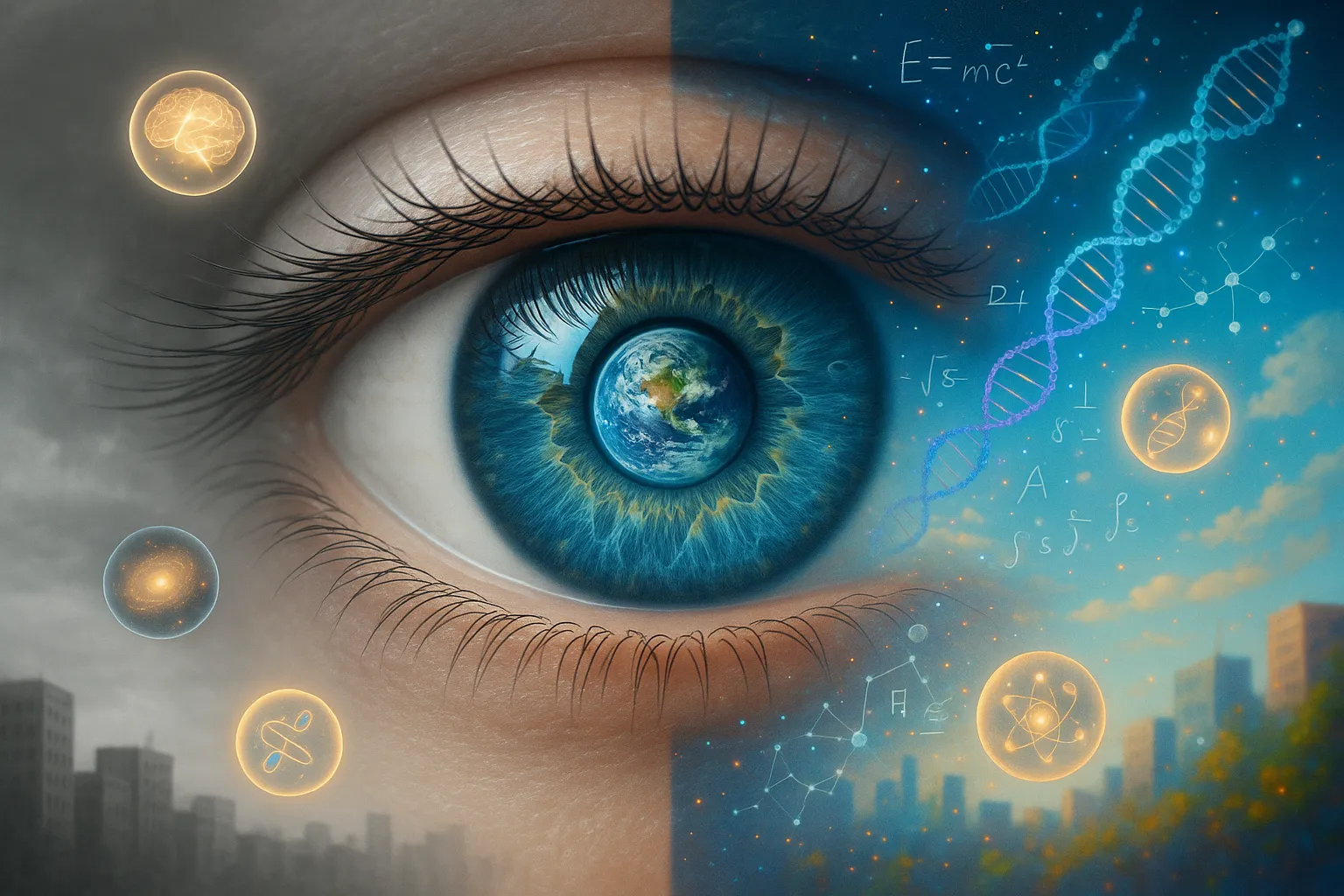
# 10 Mind-Blowing Facts That Will Change How You See the World
The world is full of extraordinary phenomena, surprising truths, and fascinating details that often go unnoticed in our daily lives. While we navigate through our routines, countless remarkable realities exist beneath the surface of what we perceive as ordinary. These mind-blowing facts have the power to shift our perspective, challenge our assumptions, and inspire a deeper appreciation for the complexity of our universe. From the microscopic to the cosmic, from ancient history to cutting-edge technology, the following revelations will fundamentally alter how you view reality itself.
1. Your Body is More Bacterial Than Human
One of the most astonishing revelations about human biology is that we are, in essence, walking ecosystems. For years, scientists believed that bacterial cells in our body outnumbered human cells by a ratio of 10:1. Recent research has revised this estimate to a more conservative 1:1 ratio, but the implications remain staggering. Your body contains approximately 37 trillion human cells, but it also hosts a similar number of bacterial cells, primarily residing in your gut.
These microorganisms aren’t just passive passengers—they’re active participants in your health. Your gut microbiome influences everything from digestion and immune function to mental health and mood regulation. The bacteria in your intestines produce neurotransmitters like serotonin and dopamine, which directly affect your emotional state. This biological reality challenges our notion of individuality and suggests we’re more like collaborative superorganisms than singular beings. Understanding this relationship has become increasingly important in fields like artificial intelligence and biotechnology, as explored in AI Rising Sun: How Japan is Shaping the Future of Artificial Intelligence, where researchers examine biological systems to improve technological innovations.
2. Trees Communicate Through Underground Networks
Forests aren’t simply collections of individual trees competing for resources—they’re sophisticated communities that communicate and support each other through vast underground networks. Dubbed the “Wood Wide Web” by scientists, these networks consist of mycorrhizal fungi that connect tree roots, enabling the exchange of nutrients, water, and chemical signals across vast distances.
Mother trees, typically the oldest and largest in a forest, act as hubs in these networks, nurturing younger saplings by sharing resources through fungal connections. When a tree is attacked by insects, it can send warning signals through this network, prompting neighboring trees to boost their defensive compounds. Trees can even recognize their own kin and preferentially share resources with their offspring. This revelation transforms our understanding of plant intelligence and cooperation in nature, demonstrating that ecosystems operate on principles of mutual support rather than pure competition. Similar interconnected systems appear in various aspects of culture and society, as discussed in Discovering the Enigmatic World of Japanese Culture, where communal harmony plays a central role.
3. Time Passes Differently Depending on Where You Are
Einstein’s theory of relativity isn’t just abstract physics—it has measurable, real-world consequences that affect us daily. Time literally passes at different rates depending on your position in a gravitational field and your velocity. This means that time moves slightly faster for someone standing on a mountain than for someone at sea level, though the difference is minuscule.
GPS satellites must account for relativistic time dilation to function accurately. Because they orbit at high speeds and experience weaker gravity than objects on Earth’s surface, their onboard clocks tick faster than clocks on the ground—by about 38 microseconds per day. Without corrections for these relativistic effects, GPS navigation would accumulate errors of several kilometers within a single day. This mind-bending reality demonstrates that time isn’t the universal constant we intuitively believe it to be, but rather a flexible dimension influenced by gravity and motion.
4. Your Brain Rewires Itself Throughout Your Entire Life
For decades, neuroscientists believed that brain development was essentially fixed after childhood, but research has thoroughly demolished this myth. Neuroplasticity—the brain’s ability to reorganize itself by forming new neural connections—continues throughout your entire lifespan. Every experience you have, every skill you learn, and every memory you form physically reshapes your brain’s structure.
London taxi drivers, who must memorize the city’s complex street network, have been shown to have enlarged hippocampi—the brain region associated with spatial navigation. When people lose their sight, their visual cortex gets recruited for processing auditory and tactile information. Musicians who play string instruments have larger representations of their left hand fingers in their brain’s motor cortex. This remarkable adaptability means that change is always possible, regardless of age. Your thoughts and behaviors literally shape the physical structure of your brain, giving profound meaning to the concept of personal growth and transformation.
5. Most of the Universe is Invisible
Everything we can see—from planets and stars to galaxies spanning billions of light-years—constitutes only about 5% of the universe’s total mass and energy. The remaining 95% consists of dark matter and dark energy, substances that don’t emit, absorb, or reflect light, making them completely invisible to our instruments.
Dark matter, comprising approximately 27% of the universe, reveals its presence only through gravitational effects on visible matter. It acts as the scaffolding upon which galaxies form and holds galaxy clusters together. Dark energy, making up about 68% of the universe, is even more mysterious—it’s the force driving the accelerating expansion of the universe itself. The humbling reality is that we live in a cosmos where the vast majority of existence remains fundamentally mysterious, reminding us that our understanding of reality is far from complete.
6. You’re Literally Made of Stardust
This poetic-sounding statement is scientifically accurate. Every atom in your body heavier than hydrogen and helium was forged in the nuclear furnaces of stars billions of years ago. The carbon in your DNA, the calcium in your bones, the iron in your blood—all these elements were created through nuclear fusion in the cores of massive stars or during their explosive deaths as supernovae.
When these ancient stars exhausted their fuel and exploded, they scattered these elements across space, where they eventually coalesced into new stars, planets, and ultimately, living beings. You are composed of matter that has existed since shortly after the Big Bang, recycled through multiple generations of stars over billions of years. This cosmic connection means you’re not separate from the universe—you’re an intrinsic part of its ongoing evolution, a way for the cosmos to experience itself. This interconnectedness between the cosmic and the personal resonates with themes found in creative media, as examined in Anime Adventure: Exploring Virtual Reality Worlds, where creators explore the relationship between individuals and vast, complex systems.
7. Octopuses Have Nine Brains
The octopus represents one of nature’s most alien intelligences, possessing a neurological architecture radically different from vertebrates. While they have one central brain, each of their eight arms contains its own mini-brain, called a ganglion, which can control arm movement independently. This means that two-thirds of an octopus’s neurons are located in its arms rather than its head.
This distributed intelligence allows each arm to explore, manipulate objects, and even taste without direct input from the central brain. An octopus arm can continue performing complex tasks even after being severed from the body. These creatures can solve puzzles, use tools, recognize individual humans, and even display personality traits and playfulness. Their intelligence evolved completely independently from vertebrate intelligence, providing a fascinating glimpse into how consciousness and problem-solving abilities can emerge through entirely different evolutionary pathways. The creative representation of unique creatures and intelligence systems has long fascinated artists, particularly in animation studios as detailed in Top Anime Studios You Need to Know.
8. Ancient Civilizations Had Technology We Can’t Fully Explain
Our ancestors possessed remarkable engineering capabilities that sometimes challenge modern understanding. The precision of ancient Egyptian stonework, particularly in structures like the Great Pyramid of Giza, remains astonishing. Some granite blocks were cut and placed with tolerances tighter than a human hair, achieved without power tools or modern measuring instruments.
The Antikythera mechanism, discovered in a shipwreck off the Greek island of Antikythera, is an ancient Greek analog computer from around 100 BCE that predicted astronomical positions and eclipses decades in advance. Nothing approaching its mechanical complexity appeared again in historical records for more than a millennium. Roman concrete, particularly that used in structures like the Pantheon, has proven more durable than many modern formulations, and we’re only now beginning to understand the chemical processes that give it such longevity. These examples remind us that technological progress isn’t always linear and that past civilizations achieved remarkable feats that deserve our respect and continued study.
9. Your Memories Are Reconstructed Every Time You Remember Them
Contrary to popular belief, memories aren’t fixed recordings stored in your brain like files on a hard drive. Instead, each time you recall a memory, your brain reconstructs it from scattered fragments of stored information. This reconstruction process makes memories malleable and susceptible to distortion.
Every time you remember an event, you slightly change that memory. External suggestions, your current emotional state, and subsequent experiences can all influence how you reconstruct a memory, potentially introducing inaccuracies you genuinely believe to be true. This is why eyewitness testimony, once considered the gold standard of evidence, is now understood to be surprisingly unreliable. It’s also why family members can have genuinely different recollections of the same event—each person’s brain has been reconstructing and modifying the memory independently over time. This fluid nature of memory has profound implications for personal identity, justice systems, and our understanding of truth itself. The reconstruction and reinterpretation of past content has become increasingly relevant in entertainment, as explored in Retro Anime Revival: Classic Shows Making a Comeback.
10. Bananas Are Radioactive
This surprising fact provides an accessible way to understand natural radiation exposure. Bananas contain relatively high levels of potassium, and a small percentage of naturally occurring potassium is the radioactive isotope potassium-40. Each banana contains about 450 mg of potassium, making it slightly radioactive.
Scientists even use “banana equivalent dose” as an informal unit of radiation exposure to help the public understand radiation risks. Eating one banana exposes you to approximately 0.1 microsieverts of radiation—a completely harmless amount. You would need to eat about 10 million bananas at once to receive a fatal radiation dose, and even then, the radiation would be the least of your problems. Many everyday items are naturally radioactive to small degrees—Brazil nuts, potatoes, and even your own body all emit low levels of radiation. This fact serves as a reminder that “radioactive” doesn’t automatically mean “dangerous” and that understanding the scale of phenomena is crucial for assessing actual risk.
Conclusion
These ten mind-blowing facts represent just a fraction of the extraordinary realities that exist beyond our everyday perception. From the bacterial colonies within us to the invisible matter dominating the cosmos, from the fluid nature of memory to the hidden intelligence of forests, our world operates according to principles that are simultaneously stranger and more wonderful than we typically imagine.
Understanding these facts doesn’t diminish the magic of existence—it enhances it. Each revelation opens new questions and deeper mysteries. The trees communicating through fungal networks, the octopuses thinking with their arms, and the ancient engineers achieving seemingly impossible precision all remind us that reality exceeds our assumptions and that curiosity remains our most valuable tool for understanding.
As we continue to explore through science, technology, and human ingenuity, we’ll undoubtedly discover countless more truths that challenge our worldview. The key is maintaining a sense of wonder and intellectual humility, recognizing that what we don’t know vastly exceeds what we do. These facts should inspire not just amazement but also a commitment to continued learning and exploration, ensuring that we remain open to the countless surprises our remarkable universe still has to reveal.
The world is far more interesting than it appears on the surface, and every day offers opportunities to discover something that might fundamentally change how we understand our place in the grand scheme of existence.
