

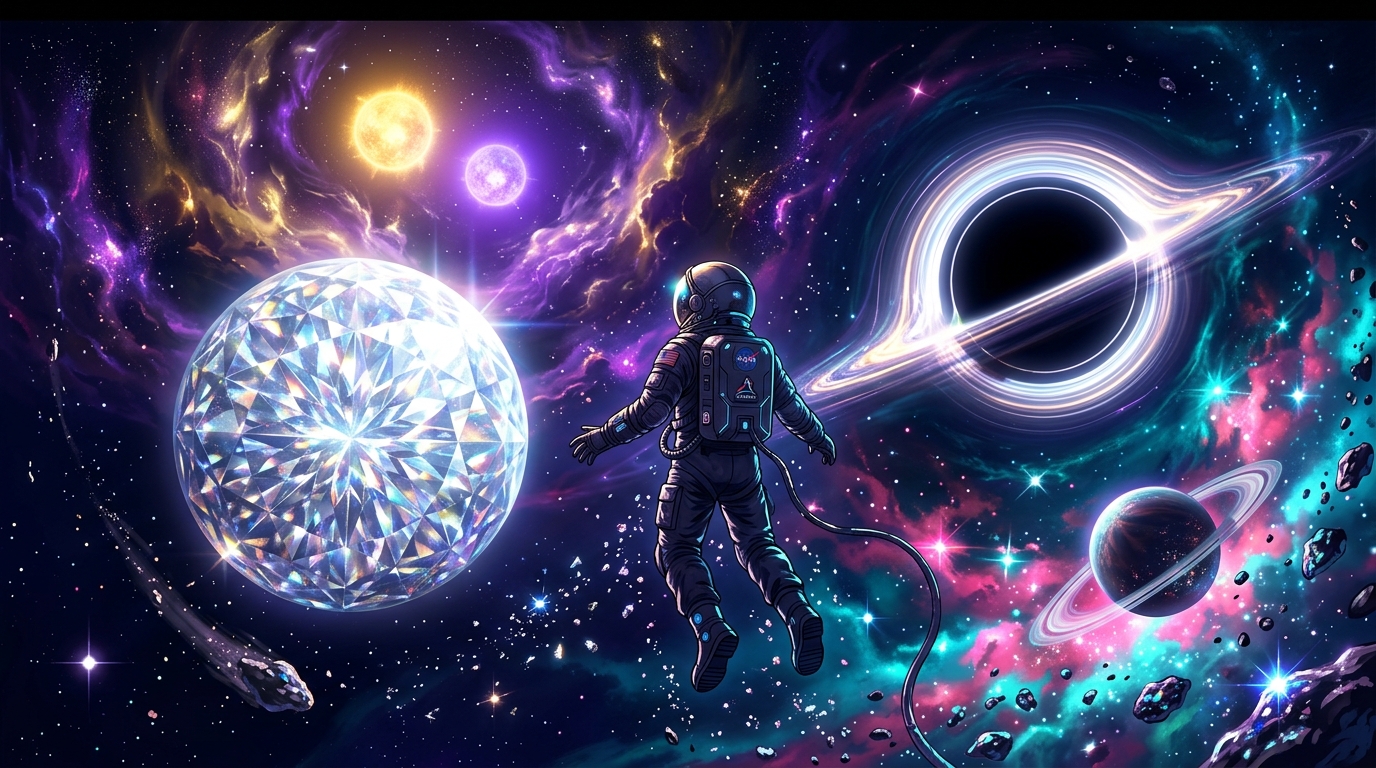
Anime has given us black holes that swallow galaxies, stars that explode with enough force to reshape reality, and space empires spanning thousands of light-years. Shows like Gurren Lagann literally throw galaxies at each other as weapons. Cowboy Bebop makes hyperspace travel feel as routine as catching a bus. And yet — brace yourself — the actual universe is sitting in the corner quietly doing things so bizarre, so fundamentally wrong-feeling, that even the most imaginative anime writers would probably second-guess themselves before putting them in a script. Real space doesn’t care about narrative logic. It doesn’t care about your suspension of disbelief. It just keeps existing in ways that make your brain quietly short-circuit.
That’s the beautiful, terrifying truth about our cosmos: fiction has to be plausible, but reality has no such obligation. From planets that rain liquid iron to stars so large they defy comprehension, the universe is a collection of phenomena that sound like they were written by a sleep-deprived mangaka on their fourth energy drink. And the best part? Scientists are still discovering new weirdness every year. As of 2026, space telescopes like the James Webb Space Telescope (launched in December 2021) are still sending back data that rewrites textbooks on a near-monthly basis. So buckle up, grab your favorite Space Dandy episode for moral support, and let’s take a tour of real space facts so strange that sci-fi anime couldn’t responsibly make them up.
A Planet Where It Rains Iron — And That’s Not Even the Weirdest Part
Let’s start with WASP-76b, a gas giant located about 640 light-years from Earth. On the dayside of this planet, temperatures soar high enough to vaporize iron — we’re talking above 2,400°C. That vaporized iron gets carried by ferocious winds to the night side, where it cools, condenses, and falls as liquid iron rain. Actual iron. Falling from the sky. In droplets.
In any anime, this would be treated as a dramatic moment — imagine a character in Vinland Saga staring slack-jawed at a planet through a viewport. But WASP-76b doesn’t stop there. Because it’s tidally locked (one side always faces its star, like how our Moon always shows us the same face), it has a permanent day side and a permanent night side with almost no transition. It is simultaneously a furnace and a metal storm. The Neon Genesis Evangelion writers famously pushed the boundaries of what felt “real,” but even Anno’s team might have dialed this one back for being too on the nose.
The Sound of Space — When Silence Lies
Everyone knows the famous rule: in space, no one can hear you scream. It’s a staple of sci-fi anime that space battles happen in near-silence (though plenty of shows, like Mobile Suit Gundam, keep the explosions loud for dramatic effect, which fans lovingly accept). Here’s the twist: space isn’t actually silent everywhere.
In 2022, NASA released an audio recording of the Perseus Galaxy Cluster — actual sound waves propagating through the hot gas of the cluster, translated into human-audible frequencies. The result is deeply unsettling, a low, eerie drone that sounds like something straight out of a horror anime. Sound can travel through plasma and gas on enormous scales; it just can’t travel through the vacuum between stars. The Perseus Cluster is essentially playing music on a scale so vast that a single “note” has a wavelength of roughly 30,000 light-years. No synthesizer in any anime soundtrack has ever matched that.
Stars That Shouldn’t Exist by the Rules We Made Up
Here are a few stellar facts that actively seem to violate narrative fairness:
- UY Scuti, a hypergiant star, has a radius roughly 1,700 times that of our Sun. If placed at the center of our solar system, its surface would extend beyond the orbit of Jupiter.
- Magnetars are neutron stars with magnetic fields so strong that, at a distance of 1,000 kilometers, they would tear the iron from your hemoglobin. The closest known magnetar is thousands of light-years away — thankfully.
- Zombie stars (a real astronomical term) are white dwarfs that partially explode in a supernova but survive, continuing to exist in a damaged state. They literally refuse to die. This is the Kaguya Otsutsuki of stellar objects.
- Thorne–Żytkow objects are theoretical (and possibly observed) hybrid stars — a red giant with a neutron star hidden inside it, like cosmic Russian nesting dolls.
- PSR J0952-0607, a pulsar observed in 2022, is estimated to be the heaviest neutron star ever recorded, pushing theoretical limits of what neutron stars can even be before collapsing into black holes.
If a writer pitched “a star that has another star inside it” in an anime writers’ room, someone would call it too derivative of Tengen Toppa Gurren Lagann. But nature filed no such objection.
Black Holes Don’t Just Destroy — They Sing, Burp, and Occasionally Create
Popular anime portrayals of black holes treat them as pure destruction engines. In Gurren Lagann, they’re ammunition. In Steins;Gate, a micro black hole is essentially a plot device wrapped in theoretical physics. Real black holes are weirder and, in a strange way, more creative.
Supermassive black holes at the centers of galaxies actively shape star formation around them. They release jets of energy thousands of light-years long. In 2019, the Event Horizon Telescope collaboration released the first real image of a black hole’s shadow — the one at the center of galaxy M87 — and in 2022, they imaged Sagittarius A*, the black hole at the center of our own Milky Way. It “wobbles” — its brightness fluctuates because hot plasma orbits it in unpredictable patterns. It is, in the most scientifically accurate sense possible, restless.
And if that’s not enough: the universe is weirder than any anime you’ve watched, and black holes are perhaps the strongest evidence for that argument. They evaporate over time through a process called Hawking radiation — meaning even the most powerful objects in the universe are, on a long enough timeline, temporary.
Time Itself Gets Weird Near Massive Objects
General relativity isn’t just a physics textbook entry — it’s a lived reality for anything near a massive object. Time literally passes more slowly in stronger gravitational fields. This isn’t anime-level exaggeration; it’s measurable with atomic clocks. GPS satellites have to account for relativistic time dilation to stay accurate.
The film Interstellar (2014) depicted this with the “one hour on the water planet equals seven years on Earth” scenario. That’s based on real math. But here’s the detail that even sci-fi rarely explores: you would not feel time passing differently. To you, everything feels normal. It’s only when you reunite with someone in a weaker gravitational field that you discover the gap. This is the kind of tragedy that would make an incredible anime arc — and honestly, the emotional template is already there in shows like Violet Evergarden, which explores time and loss with devastating precision. Someone just needs to apply it to relativistic physics.
The Universe Is Mostly Made of Stuff We Cannot See or Detect Directly
Here is perhaps the most humbling fact in all of cosmology: roughly 95% of the universe is made of dark matter and dark energy, and we have no direct detection of either. We know dark matter exists because of its gravitational effects on galaxies. We know dark energy exists because the universe’s expansion is accelerating. But we cannot see, touch, or directly measure either one with any instrument we currently possess.
To put that in anime terms: imagine watching Attack on Titan and being told that 95% of the characters and plot are happening just off-screen, influencing everything, and you will probably never see them directly. That’s our universe. The stuff we can see — stars, planets, gas clouds, everything that has ever appeared in a telescope — is the 5% footnote at the bottom of reality’s page.
For more perspective-shaking ideas like this, check out 10 mind-blowing facts that will change how you see the world.
The Cosmic Void That Might Be the Loneliest Place in Reality
The Boötes Void is a supervoid in space — a region approximately 330 million light-years in diameter that contains almost no galaxies. In a universe that is otherwise lumpy and clustered with galactic filaments and walls, the Boötes Void is an enormous, nearly empty bubble. If the Milky Way were located at its center, humans would not have discovered other galaxies until the 1990s because there would be essentially nothing close enough to see.
It is the cosmic equivalent of an ocean with no fish, no plankton, no currents — just water, in every direction, for farther than imagination allows. Some researchers call it “the Great Nothing.” No anime villain, no eldritch god from a dark fantasy series, has ever managed to be quite as quietly unnerving as an actual 330-million-light-year bubble of near-nothingness sitting in our cosmic neighborhood.
The Universe Wins, Every Time
Here’s what makes real space permanently more fascinating than any fictional depiction: it has no author, no editor, and no need to make sense to its audience. Anime — even the most visionary, boundary-pushing series — has to pass through human imagination, human logic, and human storytelling instinct. The universe skipped all of that and went straight to implementation. Iron rain, singing galaxy clusters, stars hiding inside other stars, and 95% of everything being fundamentally invisible — these aren’t creative choices. They’re just Tuesday in a cosmos that never got the memo about keeping things relatable.
So next time you’re watching Cowboy Bebop and marveling at how imaginative the future looks, remember: the real universe looked at all of that and quietly whispered, “Cute. But have you heard about magnetars?” Keep looking up. The facts are always stranger than the fiction — and honestly, that’s exactly the way we like it.
