


Time is a flat circle — or at least that’s what it feels like after you fall deep enough into the rabbit hole of historical coincidences, mind-bending timelines, and facts so strange they sound completely made up. What if we told you that Cleopatra lived closer in time to the Moon landing than to the construction of the Great Pyramid? Or that the fax machine was invented before the telephone? These aren’t riddles or tricks. They’re real, verifiable facts about history and time that have a way of completely rewiring how you see the world. And once you know them, you genuinely cannot un-know them.
For anime fans and geek-culture enthusiasts especially, there’s something deeply satisfying about having your mental model of reality flipped upside down. We love shows like Steins;Gate and Re:Zero precisely because they play with timelines, causality, and the terrifying weight of history. But here’s the kicker — you don’t need a time machine or a microwave phone to experience that brain-scrambling sensation. Reality has already done the work for you. The facts in this article are the kind that spread through Discord servers, manga fan forums, and trivia nights like wildfire, and for very good reason.
So buckle up, because we’re about to put your perception of history through the blender. By the end of this article, you’ll be staring at your calendar with the same existential dread that Okabe Rintaro feels every time the Divergence Meter ticks over. You’ve been warned.
Cleopatra and the Moon Landing Are Basically Neighbors in Time
Let’s start with the one that breaks nearly everyone immediately. Cleopatra VII, the famous Egyptian queen who ruled from around 51 BCE until her death in 30 BCE, is commonly associated in our minds with the pyramids of Giza. Ancient Egypt. Sand, pharaohs, hieroglyphs. The whole package.
Here’s the gut punch: the Great Pyramid of Giza was completed around 2560 BCE. That means roughly 2,500 years passed between the pyramid’s construction and Cleopatra’s reign. Meanwhile, the Apollo 11 Moon landing happened in 1969 CE — which is only about 2,000 years after Cleopatra’s death.
Cleopatra is closer to us landing on the Moon than she is to the pyramids her civilization is famous for. Let that settle in for a second. The ancient world we picture as one single block of antiquity was itself sprawling across millennia. It’s the kind of fact that makes you realize just how compressed and warped our mental map of “old stuff” really is.
The Fax Machine Is Older Than the Telephone (Yes, Really)
If someone told you the fax machine predates the telephone, you’d probably assume they were joking. But Alexander Bain, a Scottish inventor, patented a rudimentary fax machine concept — called an “electric printing telegraph” — in 1843. Alexander Graham Bell didn’t patent the telephone until 1876. That’s a 33-year gap.
Just think about the implications. People could theoretically transmit documents mechanically before they could speak to each other over a wire. Technology doesn’t always develop in the logical, linear order we assume. Kind of makes you think of the tech tree in civilization-building games like Civilization VI, where sometimes you unlock one technology that seems wildly out of sequence with everything else around it.
Nintendo Is Older Than You Think — Much, Much Older
This one hits especially hard for gamers and anime fans alike. Nintendo was founded in 1889. Eighteen eighty-nine. That’s not a typo.
To put that in context:
- Nintendo was founded before the Eiffel Tower was completed (also 1889, but later that year)
- Nintendo is older than commercial motion pictures (the Lumière brothers held their first public film screening in 1895)
- Nintendo started out making hanafuda playing cards, a traditional Japanese card game
By the time Nintendo released the original Famicom (NES) in 1983, the company was already 94 years old. A nearly century-old playing card company pivoted to become one of the defining forces in global entertainment. If that’s not a glow-up for the ages, nothing is.
Woolly Mammoths Were Still Alive During the Bronze Age
Here’s another fact that destroys the neat little boxes we build in our heads. When most people picture woolly mammoths, they think Ice Age — frozen tundra, cave paintings, prehistoric humans in furs. But a small population of woolly mammoths survived on Wrangel Island, in the Arctic Ocean, until approximately 1650 BCE.
1650 BCE is when the Egyptian New Kingdom was flourishing. The Minoans were sailing the Mediterranean. Stonehenge had already been standing for centuries. Humans were smelting bronze and building civilizations — and there were still mammoths alive on a remote Arctic island. They went extinct not because of some dramatic prehistoric apocalypse, but quietly, on an island, while history was already well underway somewhere else on the planet.
It’s the kind of fact that would fit perfectly into an isekai anime where the protagonist discovers that the fantasy world’s timeline doesn’t match what historians thought. Except this is just Earth.
A Quick Table of “Wait, WHAT?” Timeline Facts
Sometimes seeing the numbers side by side does more damage than any paragraph could. Here are a few more timeline comparisons that should come with a warning label:
| Fact | Time Gap |
|---|---|
| Pyramids built → Cleopatra’s reign | ~2,500 years |
| Cleopatra’s death → Moon Landing (1969) | ~2,000 years |
| Oxford University founded (~1096) → Aztec Empire founded (~1428) | Oxford is older by ~332 years |
| Last execution by guillotine in France (1977) → Star Wars release (1977) | Same year |
| Nintendo founded (1889) → NES release (1983) | 94 years |
| Fax machine concept (1843) → Telephone (1876) | 33 years |
The guillotine one tends to be the one that makes people put their phones down and just stare at the ceiling for a while. France carried out its last guillotine execution the same year Luke Skywalker blew up the Death Star. History is genuinely unhinged.
Why Our Brains Are Just Bad at Time
There’s a reason these facts feel so impossible even after we verify them. Human brains are notoriously poor at perceiving large spans of time intuitively. We’re wired for the immediate — the here and now, the last few years, maybe a generation or two back. Anything beyond that collapses into a vague, undifferentiated “the past.”
Psychologists and cognitive scientists refer to this as temporal compression — our tendency to mentally squish historical events together, especially as they recede further into the past. It’s the same reason that 2015 feels like “just a few years ago” when it’s actually over a decade behind us as of 2026. Our internal clocks are terrible at the macro scale.
Anime actually does a fascinating job of playing with this concept. The smartest anime character ever is not who you think — and part of what makes certain genius characters so compelling is precisely their ability to see time and causality in ways ordinary humans can’t process. Characters like Lelouch from Code Geass or Light Yagami from Death Note think in long arcs, anticipating chains of events across months and years. Watching them operate is almost therapeutic for a brain that’s bad at time.
Did You Know? A Bonus List of Smaller Mind-Melters
Before we wrap up, here’s a rapid-fire list of additional facts to round out your collection:
- Betty White (born 1922) was older than sliced bread, which was first sold commercially in 1928
- The University of Bologna, founded in 1088, is the oldest continuously operating university in the world — it was teaching students when the Crusades were just getting started
- Sharks are older than trees — sharks evolved roughly 450 million years ago, while trees appeared around 350 million years ago
- Cleopatra was born closer in time to the founding of Pizza Hut (1958) than to the construction of the pyramids
- Anne Frank and Martin Luther King Jr. were born in the same year: 1929
- The last known widow of an American Civil War veteran (through a late-life marriage) died in 2020
The World Is Weirder Than Your Timeline
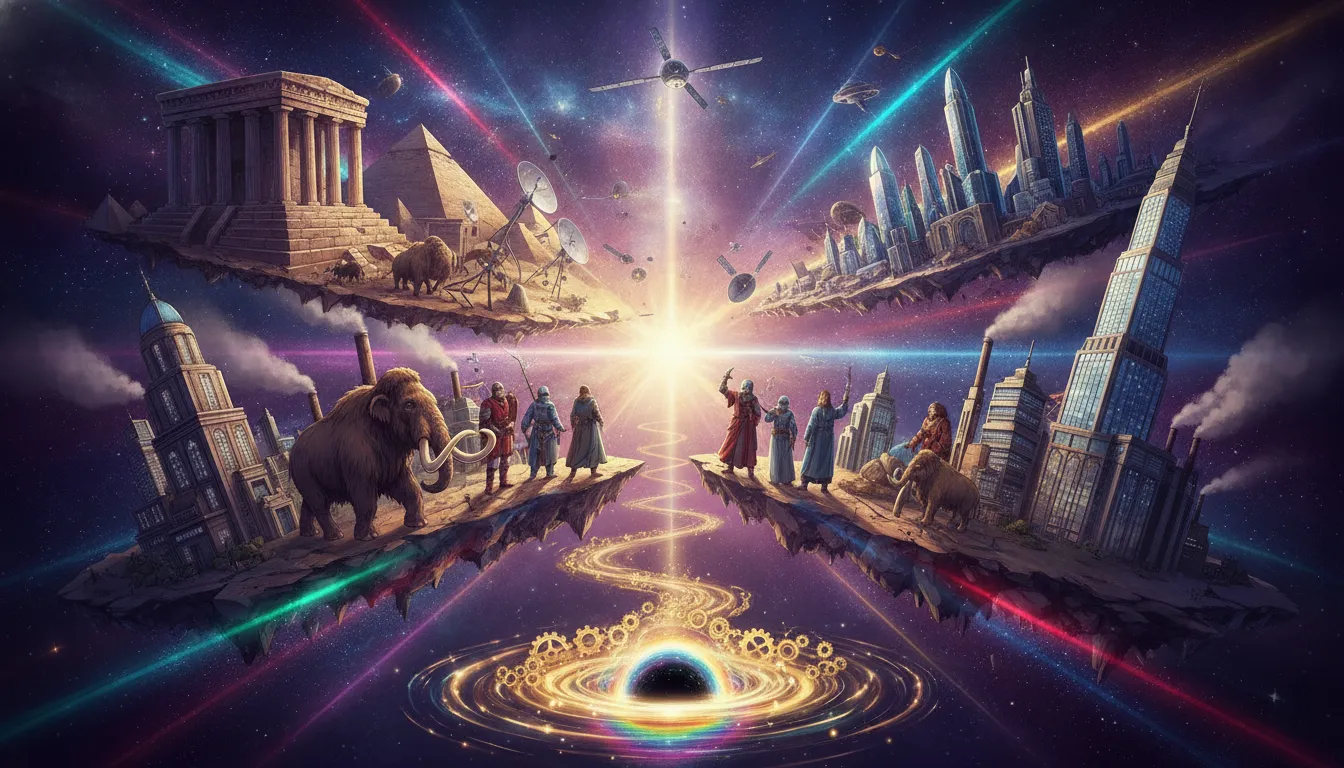
The real takeaway here isn’t just trivia bragging rights, although those are absolutely a bonus. It’s that the story of human civilization is far stranger, longer, and more layered than any textbook or mental shortcut can capture. History doesn’t move in clean chapters — it overlaps, loops back, and surprises you in ways that feel almost fictional.
If you love digging into the hidden layers of things — whether it’s anime lore, the hidden stories behind famous brand logos, or the weird forgotten corners of history — then you already understand the appeal. The world rewards the curious. Keep pulling at the threads. The more you learn, the stranger and more magnificent everything becomes. And hey, at least our timeline doesn’t involve a microwave that sends texts to the past. Probably.
