

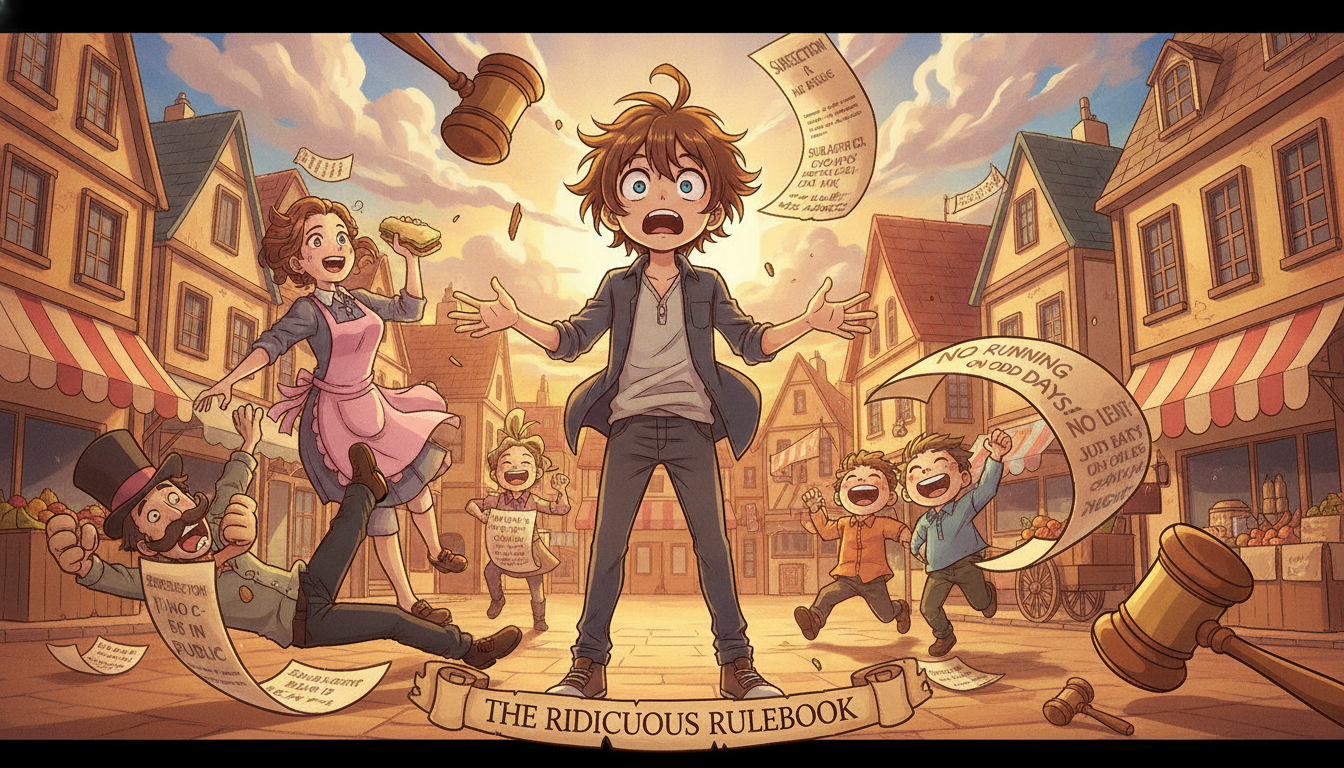
Imagine getting arrested for dying your margarine yellow, or being slapped with a fine because your chicken crossed the road without a permit. Sounds like the plot of a surreal isekai anime where the protagonist wakes up in a bureaucratic nightmare world — except the nightmare is very much real life, happening right now in 2026, in countries you probably thought were perfectly normal. The world is stuffed full of laws so strange, so wildly outdated, and so utterly baffling that even the most convoluted anime lore starts to look reasonable by comparison. Nobody warned you. Nobody put up a sign. And yet, break one of these rules and you could find yourself in genuine legal trouble.
The wild thing is, these aren’t urban legends or internet rumors. Many of these laws have been on the books for decades — some even centuries — and governments simply never got around to repealing them. They sit quietly in legal code like forgotten side characters who were never given a proper send-off. You know that feeling when an anime series just… ends without resolving a subplot? That’s essentially what happened here. Lawmakers introduced these rules, moved on to other things, and left the rest of us to accidentally stumble into criminality. Consider this your official, overdue warning.
If you enjoy discovering that the world is stranger than any fictional universe, you’re in the right place. Think of this as a geek’s guide to surviving reality — because as we’ve seen from shows like Re:Zero, sometimes the most dangerous worlds are the ones with the most absurd rules. Let’s break down the weirdest laws still on the books in 2026, so you can at least say someone finally told you.
Laws So Bizarre They Sound Like Anime Filler Episodes
Filler episodes in long-running anime like Naruto or One Piece are famous for introducing completely random rules and situations that feel disconnected from reality. Real-world legislation has been doing the same thing for centuries, and honestly, it shows no signs of stopping. Some of these laws were logical once — born out of very specific historical contexts — but in 2026, they read like the work of a writer who had a deadline and no ideas.
Take the United Kingdom, for example. Under the Salmon Act of 1986, it is technically illegal to handle a salmon “in suspicious circumstances.” The law was designed to combat illegal fishing, but the wording is delightfully vague. What counts as suspicious? Nobody truly knows. In the same country, the Metropolitan Streets Act of 1867 makes it illegal to drive cattle through the streets of London during daytime hours, though you can do it between midnight and 7 a.m. if you have a permit. Peak London behavior.
The United States: A Treasure Chest of Legal Chaos
America is a federal system, which means every state gets to contribute its own flavor of legislative bewilderment. The results are spectacular.
Some highlights from across the fifty states:
- In Alabama, it is illegal to wear a fake mustache in church if it causes laughter.
- In Alaska, it is illegal to wake a sleeping bear for the purpose of taking a photograph.
- In California, a law once prohibited women from driving vehicles while wearing housecoats, though enforcement has effectively disappeared.
- In Florida, if an elephant is tied to a parking meter, the parking fee must be paid just as it would be for a vehicle.
- In Ohio, it is illegal to get a fish drunk — yes, this is a real statute.
- In Tennessee, it is illegal to share your Netflix login. Okay, that one is newer, but it counts.
The sheer variety here tells you something important: American legal history is a patchwork quilt stitched together in very different rooms by very different people. Some of these laws were created to address genuine problems of their era. Others appear to have been created by someone who lost a bet.
Europe’s Ancient Laws That Refuse to Die
Europe has had a lot more time to accumulate legislative weirdness, and the continent has made full use of every century available. In Switzerland, it is illegal to flush a toilet after 10 p.m. in an apartment building — a noise ordinance with unexpectedly intimate consequences. In Germany, there is technically a law that makes it illegal to run out of fuel on the Autobahn, since stopping unnecessarily on the highway is considered a traffic violation. Running on empty is therefore not just inadvisable; it is criminal.
Italy offers a particularly surreal one: in the city of Milan, citizens are legally required to smile in public at all times, except during funerals or hospital visits. Whether this is actively enforced is a separate matter entirely, but the law exists. France, not to be outdone, passed a law in 2004 prohibiting the naming of a pig “Napoléon” — a protection for the dignity of the French emperor that Napoleon himself, one suspects, would have found both flattering and confusing.
Asia and Beyond: Weird Laws With Intercontinental Reach
The legal strangeness is not limited to Western nations. Across Asia and beyond, lawmakers have left their own unique marks on the historical record.
In Singapore, chewing gum has been effectively banned since 1992, with limited medical exceptions introduced in 2004. The country is famously tidy, and the law reflects that cultural priority — but it still surprises tourists expecting to pop a stick of Juicy Fruit before their flight. In Japan, there are strict laws around the mixing of alcohol with other substances in certain contexts, and regional regulations on bicycle behavior that would make a bureaucrat weep with joy.
Australia — a country that once lost a war against emus — does not disappoint. In Victoria, it is illegal to wear pink hot pants after midday on a Sunday. The origin of this law is genuinely unclear, which makes it all the more legendary. In Queensland, you cannot own a pet rabbit unless you are a magician. Seriously. The law is connected to concerns about feral rabbit populations, but the magician exception is chef’s kiss.
For more jaw-dropping examples of strange things people accepted without question, check out How Did People Ever Believe These Unhinged Past Myths? — because sometimes history is the weirdest fiction of all.
Why These Laws Are Never Repealed
Here is the real mystery: why do these laws still exist in 2026? The answer is frustratingly mundane. Repealing a law requires political will, legislative time, and someone who actually cares enough to put it on the agenda. In a world where lawmakers are busy with budgets, international crises, and endless debates, the “no fish-getting-drunk” statute in Ohio simply does not make the priority list.
There is also something called legal inertia — the tendency of established systems to maintain the status quo unless actively disrupted. In many jurisdictions, old laws remain technically valid until they are explicitly removed. They do not expire. They do not fade. They just sit there, quietly, waiting. Like a villain in a shonen anime who has been sealed away but never definitively defeated.
Additionally, some governments are genuinely afraid to repeal old laws without comprehensive review, worried they might accidentally remove a protection or precedent that is still needed. The result is a legal ecosystem full of fossils.
If you want to go even deeper into what’s technically still on the books, Still Illegal in 2026: Weirdest Laws You Won’t Believe Exist is your next stop.
What These Laws Tell Us About Human Nature
Stripped of their humor, these laws are actually fascinating anthropological artifacts. Each one reflects a genuine concern of its time — public order, sanitation, animal welfare, cultural identity. The margarine law? Dairy lobbying. The salmon handling law? Poaching. The pig naming law? National pride and political sensitivity.
In a way, these laws are like the lore documents of civilization: dense, occasionally contradictory, and absolutely essential for understanding the world that produced them. Geeks know this feeling well — it is the same satisfaction you get from diving deep into the lore of a fictional universe and realizing that every strange detail has a reason, even if that reason is now centuries old.
The Takeaway: The Real World Has Terrible Game Design

If reality were an RPG, the legal system would be its most poorly documented mechanic. The rules are numerous, often contradictory, rarely explained, and occasionally invented by someone who was probably having a very specific kind of bad day. The next time you think anime worldbuilding gets too weird or the rules of a fictional magic system are too convoluted, remember: the real world lets you get legally in trouble for handling a fish suspiciously or failing to smile in Milan.
Nobody warned you. Now, at least, somebody has.
