

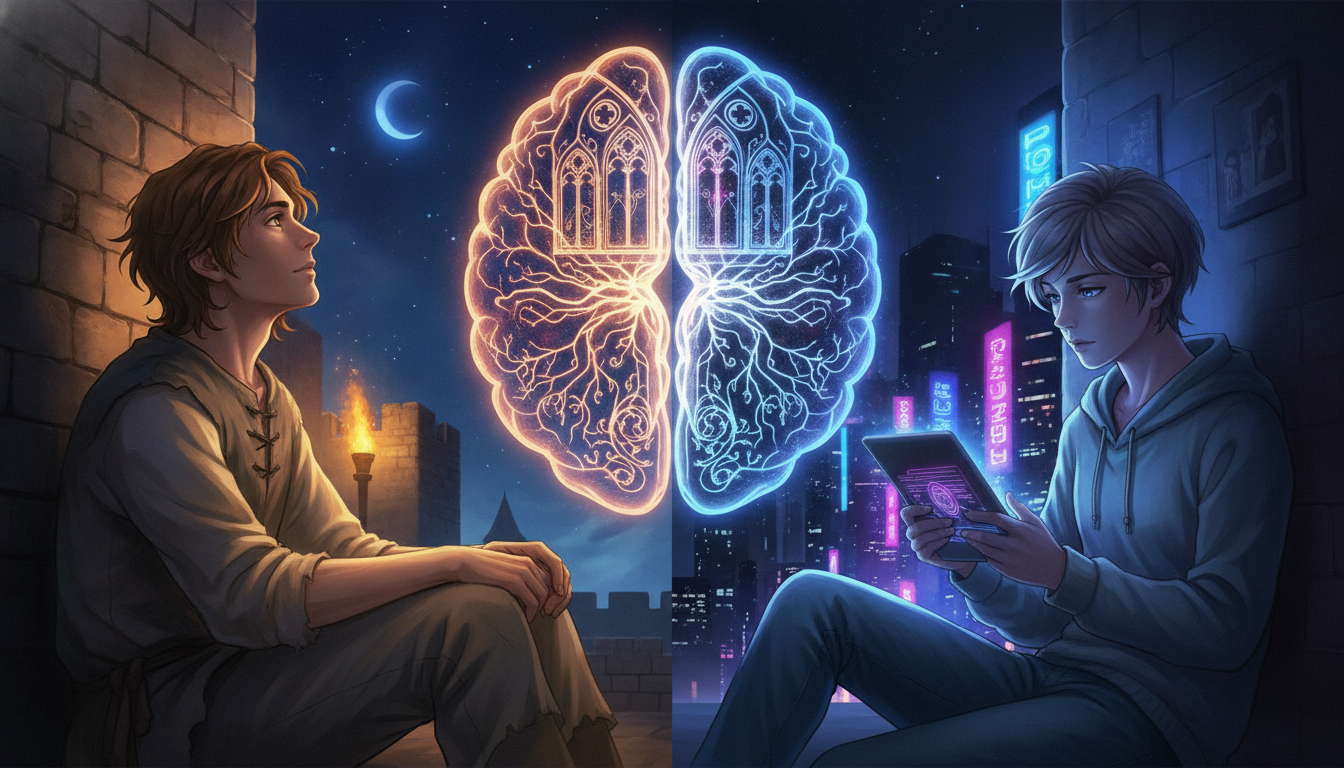
Imagine waking up tomorrow with no concept of germs, no idea why the sun rises, and a genuine, unironic belief that your neighbor’s cow died because a witch looked at it funny. No Google. No WebMD spiral at 2 a.m. No anime to explain the mysteries of the universe through a conveniently timed flashback. That was Tuesday for your average medieval European. And yet — here’s the wild part — these people were not stupid. Their brains were working just as hard as ours. They were just running on completely different software, shaped by a world so alien to us that understanding it almost feels like studying a fantasy setting. Because in many ways, it was one.
The medieval period, roughly spanning from the 5th to the late 15th century, produced cathedral architecture that still baffles engineers, philosophical texts that shaped universities for centuries, and a legal system complex enough to make modern lawyers nervous. These people solved real problems with real ingenuity. But their perception of reality — what counted as evidence, what was sacred, what was dangerous — operated on frameworks so different from ours that comparing worldviews is genuinely mind-bending. If you’ve ever watched a show like Vinland Saga or Berserk and thought, “there is no way anyone actually lived like this,” buckle up. Because reality was often stranger than the fiction.
This isn’t a history lecture. This is a deep dive into the fascinating, occasionally horrifying, and weirdly relatable ways medieval people experienced the world — and why understanding the gap between their minds and ours might just make you appreciate your own era a little more. Or panic about it. Honestly, both are valid.
The Information Diet: When Everything You Knew Could Fit in a Church
For most medieval people, the church was not just a place of worship — it was the internet, the library, the news broadcast, and the school all rolled into one stone building. Literacy rates in early medieval Europe were extremely low among the general population, with access to written texts largely limited to clergy and nobility. This meant that the overwhelming majority of people received information aurally — through sermons, storytelling, and communal oral tradition.
This creates a wildly different cognitive landscape. When your entire understanding of history, science, medicine, and morality comes through the spoken word filtered by religious authority, your mental model of the world is fundamentally different from someone who can fact-check anything in thirty seconds. It’s not that medieval people were incapable of critical thought — they absolutely were. It’s that the inputs were radically constrained. Think of it like playing a video game with a broken controller. The player isn’t less skilled; they’re just working with limited and sometimes misleading data.
Time Was Not What You Think It Was
Here’s a concept that will genuinely rewire your brain: medieval people did not experience time the way we do. The mechanical clock, as we understand it, didn’t become widespread until the late 13th and 14th centuries in Europe, and even then, only in cities. Before that, time was measured by church bells, the position of the sun, and liturgical cycles — the rhythm of prayers repeated across the day.
This means “be there at 3 p.m.” was not a thing anyone said. Life was organized around events, not hours. You woke up when it got light. You worked until it got dark. The idea of “wasting time” had almost no conceptual meaning when time wasn’t yet a resource you could measure and spend. Historians and cognitive scientists have noted that this fundamentally altered how people planned, remembered, and narrated events. Deadlines, as we understand them, were largely a post-industrial invention.
Death Was Everywhere and Nobody Pretended Otherwise
In an era before modern medicine, vaccines, or even basic antiseptic practice, death was a constant and intimate companion. The average life expectancy in medieval Europe was significantly lower than today, heavily skewed by catastrophic infant and child mortality rates. The Black Death of the 14th century alone is estimated to have killed between 30 and 60 percent of Europe’s population over a roughly seven-year period.
Living under that kind of statistical shadow changes you. Medieval culture developed an entire artistic and philosophical tradition around death called Ars Moriendi (the Art of Dying) and the Danse Macabre (the Dance of Death), in which Death was personified as a figure who came for everyone regardless of rank or wealth. It wasn’t morbid edginess — it was coping. It was a society trying to make sense of massive, unavoidable loss. If you’ve ever cried watching a beloved anime character die and thought about how the show sits with grief in an unflinching way — Vinland Saga and Berserk are notable for this — medieval people would probably nod along. They understood that particular emotional language deeply.
Magic Was Not Metaphorical
When a medieval peasant said they were worried about witches or evil spirits, they were not speaking poetically. The supernatural was real to them in the same way that traffic or inflation is real to us — an ever-present, practical concern that shaped daily decisions. People carried amulets, performed folk rituals, avoided certain roads at night, and consulted local healers (sometimes called “cunning folk”) as serious problem-solving strategies.
This wasn’t a failure of intelligence — it was a rational response to a world where causality was genuinely mysterious. Without germ theory, disease seemed like it must have an intentional cause. Without meteorology, a bad storm required explanation. The frameworks people used to explain the unexplainable were the best tools available. Just like how Japanese superstitions that actually explain anime logic reveal that cultural belief systems shape storytelling in deep and logical ways, medieval supernatural belief was internally consistent and meaningful to the people who held it.
Did You Know? Medieval Brain Facts That Sound Made Up But Aren’t
- Medieval scholars genuinely debated whether women had fewer teeth than men, a claim famously attributed (though debated by historians) as an example of accepted “knowledge” that no one bothered to verify by simply counting.
- The concept of “childhood” as a distinct developmental phase was not fully recognized in the modern sense; children were often depicted in art as small adults and integrated into adult labor early.
- Medieval Europeans had no concept of PTSD by name, but chronicles and texts describe knights and soldiers returning from battle with symptoms that read strikingly like modern trauma responses.
- The color blue was relatively rare and expensive in European medieval art until the wider availability of ultramarine pigment; prior to this, blue was not culturally emphasized the way it is today.
- Medieval hospitals — among the earliest formal ones in Europe — were primarily run by religious orders and focused on spiritual care as much as physical treatment.
- The idea of romantic love as a basis for marriage was largely a concept of the nobility and troubadour tradition; most marriages among common people were economic arrangements.
Perception, Memory, and the Oral Mind
Scholars like Walter Ong and later research in cognitive history have explored how oral cultures develop different memory strategies than literate ones. Without writing as an external memory storage device, oral societies develop mnemonic techniques — rhythm, repetition, story structure, formula — that encode information into forms easier for human brains to retain without external reference.
This is part of why so much medieval knowledge came wrapped in narrative, parable, and religious allegory. It wasn’t just style. It was function. The story was the storage format. This cognitive architecture also explains why medieval people could recite hours of spoken text from memory — a skill modern audiences might associate more with theatrical performance than everyday life.
What This All Means for Us in 2026
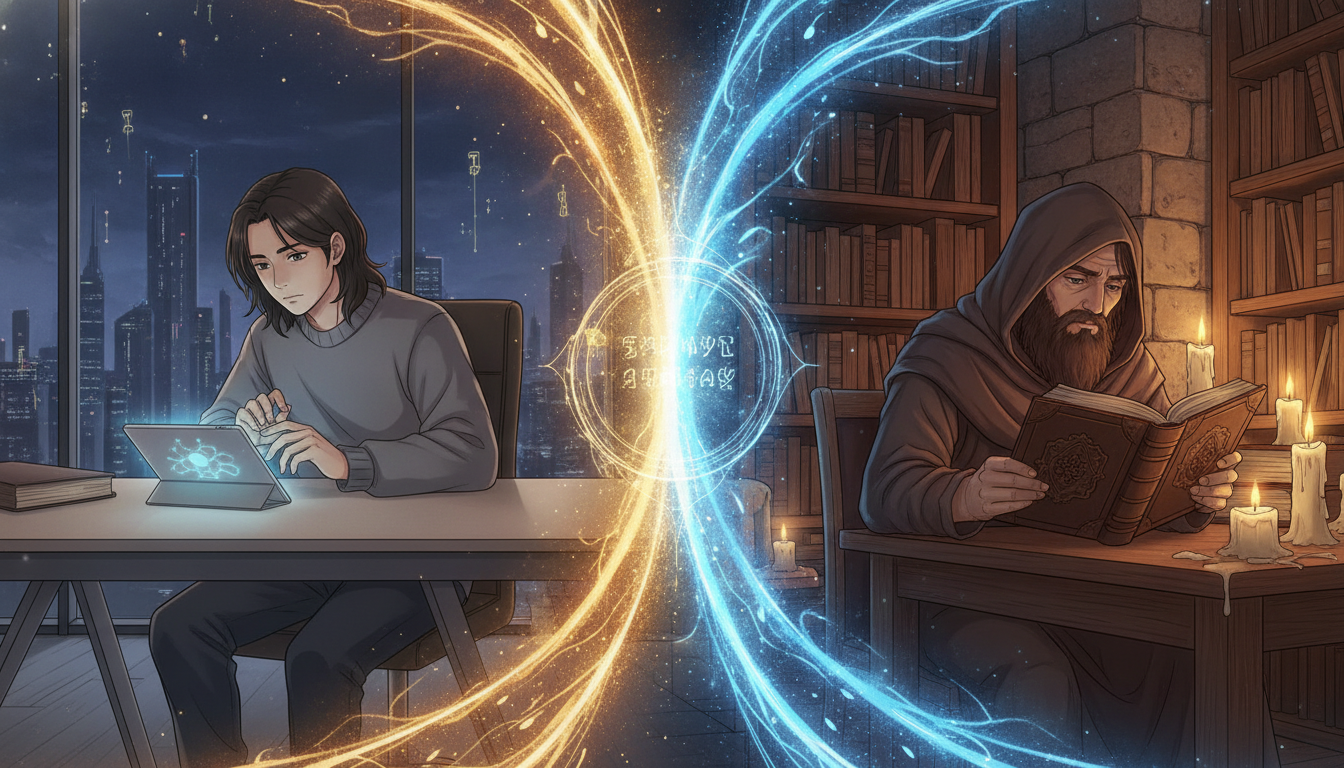
Understanding medieval cognition is genuinely useful beyond historical curiosity. It reminds us that the way we perceive reality right now — the frameworks, assumptions, and invisible rules we use to navigate the world — are products of our specific historical moment, not timeless truths. In an era where AI, geopolitical instability, and information overload are reshaping what we even consider “real,” that humility matters. It’s the same kind of cultural self-awareness that makes us look at something like Still Illegal in 2026: The Weirdest Laws on Earth and realize that every era has its blind spots hiding in plain sight.
Medieval brains weren’t broken. They weren’t primitive. They were finely tuned instruments operating under completely different conditions. And if someone from 1350 could see us arguing about whether something “counts” if an AI made it, or staring at glowing rectangles for twelve hours a day, they would probably think we were the ones running strange software. They wouldn’t be entirely wrong.
