

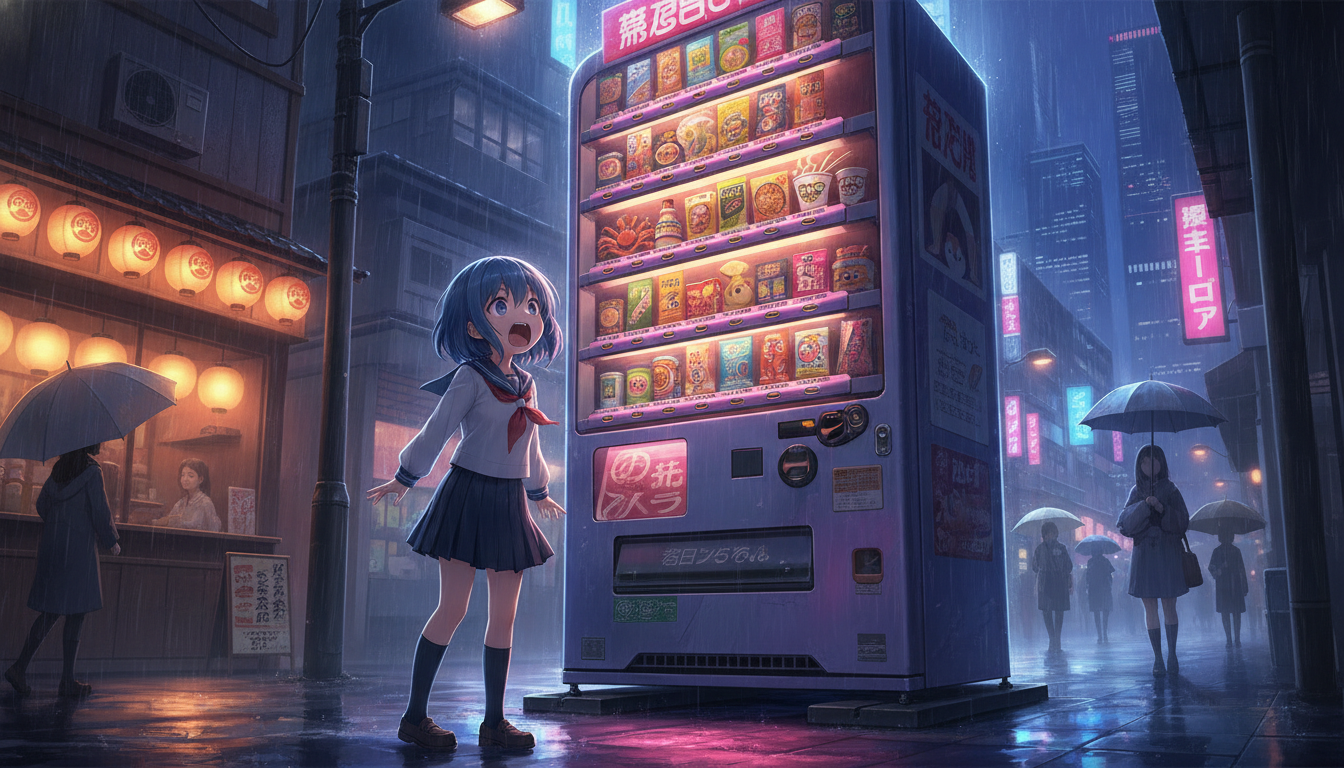
Imagine stepping off a train in Tokyo, mildly jet-lagged and craving something — anything — to eat, and being confronted by a glowing wall of machines that offers you hot ramen, a fresh banana, a bottle of sake, rhinestone-encrusted phone cases, and a small potted cactus. No human in sight. Just you, the hum of fluorescent lights, and what can only be described as a retail fever dream made of steel and buttons. That is the everyday reality of vending machines in Japan, and honestly? It slaps. Hard.
Japan is home to one of the densest vending machine networks on the planet. Estimates have long placed the number of machines across the country in the millions, and even accounting for some contraction in recent years, they remain an absolutely omnipresent fixture of Japanese life — tucked into train station corridors, nestled between shrines, bolted to the sides of mountain hiking trails, and standing proudly in the middle of rice paddies with seemingly zero explanation. They are not a novelty. They are infrastructure. And once you start digging into what these machines actually sell, things get wonderfully, irreversibly weird.
The Baseline Is Already Bonkers
Before we even get to the unhinged stuff, let’s acknowledge that the normal Japanese vending machine is already operating at a level most countries can only dream of. The standard drink machine — the kind you’ll find on literally every other street corner — doesn’t just offer cold beverages. It offers hot and cold options in the same machine, simultaneously. You can grab an ice-cold green tea or a piping hot can of corn soup from the same slot, depending on the season. The machine knows the season. The machine is prepared for the season. You are not.
Hot canned coffee, popularized in Japan and sold under brands like Georgia (a Coca-Cola product hugely popular in Japan), is practically a cultural institution. Salarymen — Japan’s term for white-collar office workers — have been fueling long commutes with these little warm cans for decades. It’s comfort in aluminum form, and a vending machine hands it to you without judgment at 6 a.m.
Things You Can Actually Buy From Japanese Vending Machines
Here is where we stop easing you in and just let the list speak for itself. These are all real product categories that have been sold, at various points, through Japanese vending machines:
- Hot ramen and udon — full noodle soups, dispensed hot and ready to eat
- Fresh eggs — farm-direct, sometimes with the hen’s name printed on the carton
- Bananas — yes, individual bananas, sold by at least one famous machine outside Shibuya
- Sake and beer — alcohol vending was common for decades, though age-verification systems and social pressure have reduced their prevalence significantly
- Bread and pastries — sometimes baked fresh, with machines restocked daily
- Umbrellas — practical, unglamorous, and weirdly moving when you need them
- Batteries, disposable cameras, and basic electronics — sold in tourist-heavy and station areas
- Live rhinoceros beetles — yes. Alive. In a machine. For children.
- Mystery items — entire vending machines dedicated to selling random, unknown items at a fixed price, purely for the thrill
- Ties and dress shirts — because a business traveler’s emergency is someone’s vending machine opportunity
- Fresh flowers — stocked in refrigerated machines, especially near cemeteries for grave offerings
The live beetle one deserves a moment of silence. Japan has a deeply rooted culture of children collecting and raising insects, particularly kabuto-mushi (rhinoceros beetles) and kuwagata (stag beetles). They appear in anime, manga, and video games constantly — Pokémon alone has multiple beetle-inspired creatures. The beetles have trading value. The beetles have fans. So naturally, someone built a machine for them.
The Cultural Logic Behind the Madness
None of this happened by accident. Japanese vending machine culture is rooted in a few deeply practical and cultural realities. For one, Japan has an exceptionally low crime rate in public spaces, which means leaving an unattended machine full of goods and cash is a viable business model rather than a liability nightmare. The machines aren’t constantly vandalized or robbed, so operators can afford to experiment.
There’s also a deeply ingrained cultural value around convenience and service — the Japanese concept of omotenashi, or wholehearted hospitality, extends even into automated retail. A vending machine that stocks exactly what someone might need, in exactly the right condition, at any hour of the day, is an expression of that philosophy at scale. It’s not chaos. It’s hyper-optimization wearing a chaos costume.
This connects to a broader thread in Japanese culture worth exploring — the way everyday infrastructure reflects values and beliefs that might seem invisible to outsiders. If you enjoy that kind of cultural archaeology, Japanese Superstitions That Actually Explain Anime Logic digs into similar territory in a really satisfying way.
Vending Machines in Anime and Pop Culture
Of course, as a geek culture outlet, we would be doing you a disservice if we didn’t connect this back to anime. Vending machines appear in Japanese animation with a frequency that reflects how embedded they are in daily life. They’re atmospheric shorthand — a character buying a can of coffee from a machine at night signals a certain loneliness, a pause, a thinking moment. It’s visual storytelling that only works because the audience knows that machine.
In Steins;Gate, the cluttered, gadget-filled Akihabara setting includes the casual presence of convenience machines as part of its texture. In countless slice-of-life series, the vending machine is a meeting point, a place of small decisions and quiet scenes. Even in cyberpunk settings — and if you want to see how Japan imagines its own tech-saturated future, the upcoming Ghost in the Shell 2026 Remake Finally Has a Release Date is required reading — vending machines appear as persistent, almost eternal fixtures of the urban landscape. They will apparently survive everything, including dystopia.
The Gacha Machine: Vending Culture’s Chaotic Cousin
No conversation about Japanese vending is complete without addressing gashapon (sometimes called gacha) machines — the capsule toy dispensers that have colonized every mall, arcade, and tourist spot in Japan and increasingly the rest of the world. You put in coins, you turn a knob, and you receive a small plastic capsule containing a random miniature figure, toy, or accessory.
The gashapon industry is enormous. Bandai alone produces thousands of gashapon series, covering everything from Dragon Ball and One Piece characters to hyper-realistic miniature sushi, tiny office supply sets, and surprisingly anatomically accurate cat paw charms. The randomness is the point. The not-knowing is the experience. The mild devastation of getting a duplicate is a shared cultural bond.
Gashapon culture also directly influenced the “loot box” mechanics in modern video games — a lineage that’s become one of gaming’s most controversial features. The machine that gave you a tiny Vegeta figure is, in a very real sense, the ancestor of every blind box mechanic you’ve ever raged at.
Why This Would Never Work Everywhere (And Why That’s Fine)

Part of what makes Japanese vending culture so singular is that it’s a product of very specific conditions — social trust, urban density, a service-oriented culture, and decades of iterative retail experimentation. Attempts to replicate it in other countries have met with… variable results. Machines get vandalized. Supply chains for hot ramen in a box are harder to justify when the machine gets broken into monthly. The magic is contextual.
That doesn’t mean other countries can’t have interesting vending machines — they absolutely do, and the global spread of gashapon culture proves that some elements travel beautifully. But the ecosystem of Japanese vending, the sheer density and diversity and casual normalcy of it all, remains something you really have to experience to fully believe.
Japanese vending machines aren’t just a quirky tourist attraction or a list of fun facts for a Reddit thread. They’re a window into a society that takes convenience, service, and — let’s be honest — delightful retail weirdness extremely seriously. Whether you’re buying a hot corn soup at midnight or gambling a coin on a mystery capsule containing either a masterpiece figurine or a tiny plastic radish, you’re participating in something genuinely unique. And honestly? We could all use a little more of that energy in our lives.
