

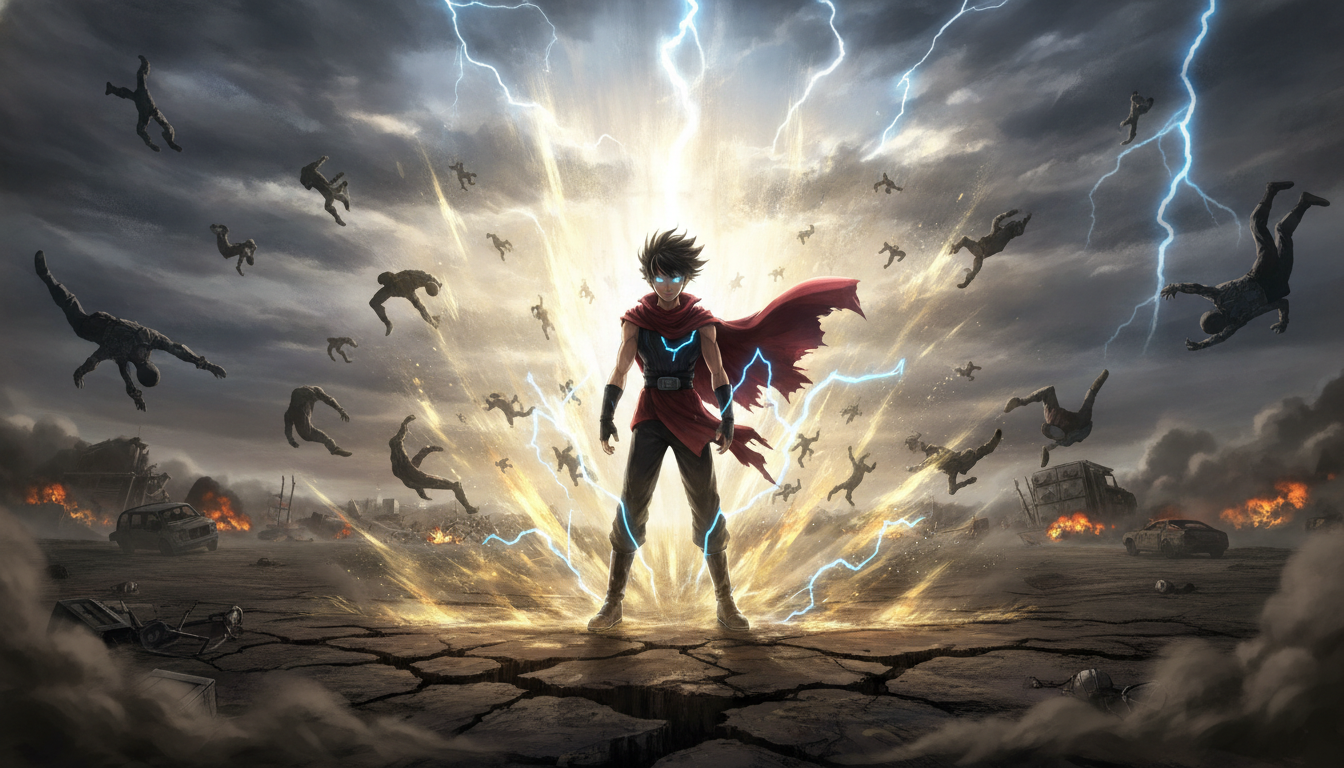
There is something almost chemically satisfying about watching an anime protagonist walk into a room and instantly outclass every single person in it. No struggle, no dramatic power-up music, no sweating through a training montage — just pure, effortless dominance. It sounds like it should be boring. Conventional storytelling wisdom says conflict drives narrative, and if the hero can solve every problem with one finger (literally, in some cases), where is the conflict? Yet here we are in 2026, and the overpowered main character — affectionately known in fandom as the “OP MC” — remains one of the most watched, most memed, and most beloved tropes in anime. Streaming queues worldwide are still packed with titles built around this exact premise.
The secret, it turns out, is that the fantasy these shows sell is not really about power. It is about recognition. Audiences, many of whom grew up feeling unseen or underestimated, get to watch a character who is quietly, impossibly exceptional navigate a world that keeps failing to grasp what it is dealing with. That slow reveal — the moment when the world finally gets it — is endlessly rewatchable. Add in sharp writing, memorable side characters, and the occasional moment of genuine emotional depth, and you have a genre formula that keeps reinventing itself no matter how many entries pile up.
The Origins of the OP MC: How the Trope Took Shape
Overpowered protagonists are not a modern invention. Goku from Dragon Ball, which began airing in 1986, was already pushing the boundaries of what a hero could reasonably accomplish. But the modern OP MC archetype as fans recognize it today solidified around the early 2010s, riding the wave of the isekai boom (stories where a character is transported to another world) and light novel adaptations flooding seasonal anime schedules.
Sword Art Online, which premiered in 2012, is one of the clearest early flashpoints. Kirito’s ability to outperform virtually every other player in a death-game virtual reality world drew both passionate fans and equally passionate critics, and that debate essentially wrote the playbook for every OP MC conversation that followed. Around the same time, One Punch Man — Yusuke Murata’s manga adaptation of ONE’s webcomic — was building its audience and would arrive as an anime in 2015, reframing the entire concept as deliberate satire.
One Punch Man and the Art of Deconstructing Power Fantasy
It is impossible to discuss overpowered protagonists without spending real time on Saitama, the hero of One Punch Man. The entire premise is a punchline: a man who trained so hard he went bald and can now defeat any enemy with a single punch. That joke sustains a genuinely moving meditation on purposelessness, depression, and the hollow feeling of achieving a goal that no longer challenges you.
Madhouse’s 2015 anime adaptation brought Saitama to a massive global audience, and The Greatest Anime Movies of All Time Finally Ranked has explored how certain anime works achieve cultural landmark status — One Punch Man did that for television anime in under a season. J.C. Staff handled Season 2 in 2019, and as of 2026 the franchise remains one of the most recognized anime properties worldwide. What makes it remarkable is that it both celebrates and critiques the OP MC fantasy simultaneously, trusting the audience to hold both reactions at once.
Isekai and the Rise of Cheat-Skill Protagonists
The isekai subgenre — and specifically its “cheat skill” variant, where heroes arrive in fantasy worlds with game-breaking abilities — became the dominant vehicle for OP MC storytelling through the mid-to-late 2010s and into the 2020s. The formula proved irresistible to publishers and studios alike.
Some standout entries that shaped the subgenre:
- That Time I Got Reincarnated as a Slime (2018): Rimuru Tempest begins as literally the weakest monster type imaginable and systematically absorbs every power he encounters, building an empire along the way.
- Overlord (2015): Ainz Ooal Gown is a max-level undead sorcerer who is genuinely confused why the new world he inhabits cannot present him with a meaningful challenge.
- The Rising of the Shield Hero (2019): A more emotionally grounded take, where Naofumi’s OP status arrives slowly and is earned against a backdrop of social hostility and betrayal.
- Mushoku Tensei: Jobless Reincarnation (2021): Widely praised for its worldbuilding depth and treating its protagonist’s growth with genuine narrative seriousness.
- Frieren: Beyond Journey’s End (2023): Technically not isekai, but Frieren herself is an ancient elf mage of virtually unmeasurable power whose strength is used to explore grief and time rather than spectacle.
The variety within these titles alone explains why the formula does not feel exhausted. Each series asks a slightly different question about what extraordinary power actually means for the person carrying it.
Why Viewers Keep Coming Back: The Psychology Behind the Fantasy
Psychologists and media researchers have explored wish fulfillment in fiction for decades, and OP MC anime slots neatly into that conversation. But there is something more specific at work than simple escapism.
Part of the appeal is the inversion of social anxiety. Many OP protagonists — Saitama, Rimuru, Ainz, even Kirito — are socially awkward, isolated, or misunderstood before and after their power is established. Their strength does not automatically translate into belonging. Viewers who have felt like outsiders recognize that gap between capability and acceptance immediately. The power is the fantasy; the social navigation is the reality check that keeps it emotionally honest.
There is also the spectacle factor. When animation studios bring an OP character’s abilities to life — Ufotable’s visual language in Demon Slayer, the kinetic choreography Madhouse delivered in One Punch Man Season 1, or the spell sequences in Mushoku Tensei — the visual payoff is simply enormous. Even viewers who might tire of “hero wins again” narratively are rarely tired of watching those victories rendered in beautiful animation.
The Difference Between Boring and Brilliant OP Writing
Not every overpowered protagonist lands equally, and fandom is quick to identify the difference. The criticism usually comes down to stakes. If a hero faces no meaningful consequence, internal or external, the story can feel inert no matter how impressive the fight scenes are.
The titles that endure tend to do at least one of the following:
- Give the protagonist something power cannot solve — loneliness, guilt, grief, identity.
- **Make the journey the point** rather than the destination — Rimuru building a nation, Frieren processing centuries of loss.
- Use the OP character as a lens for supporting cast development — Saitama’s world is populated with heroes who have genuine arcs precisely because they cannot rely on his abilities.
- Play with genre awareness — the best isekai and OP shows increasingly acknowledge their own tropes, winking at the audience without breaking the emotional spell.
Much like how accidents accidentally invented the modern world, some of the most beloved OP protagonists emerged from creative decisions that were almost accidental in their brilliance — ONE writing Saitama as a gag character who somehow became a philosophical icon being the clearest example.
Where the Genre Stands in 2026
As of 2026, the OP MC pipeline shows no signs of slowing. Each anime season brings new light novel adaptations positioning their heroes with world-breaking abilities, and audiences continue to sample them in enormous numbers. The genre has also pushed further into nuance — recent titles are more willing to examine trauma, moral ambiguity, and the political consequences of having one impossibly powerful individual in a complex world.
The conversation has matured alongside the audience. Fans who grew up watching Kirito in 2012 are now adult viewers who want emotional complexity alongside their spectacle. The genre is listening. Frieren’s enormous critical and commercial success in 2023 and 2024 demonstrated that an OP protagonist story can also be a quiet, achingly melancholic examination of what it means to outlive everyone you love.
Final Thoughts: Power Is Just the Hook
The OP MC trope endures because it was never really about power. It is about the dream of being enough — more than enough — while still wrestling with the deeply human problems that strength cannot touch. Every era of anime finds new ways to dress that fantasy up, filter it through different genres, different art styles, and different emotional registers. As long as that core feeling resonates, which it will as long as people feel unseen or underestimated, someone will be writing a new protagonist who can level mountains and still cannot figure out how to make a friend. And we will watch every episode.
