

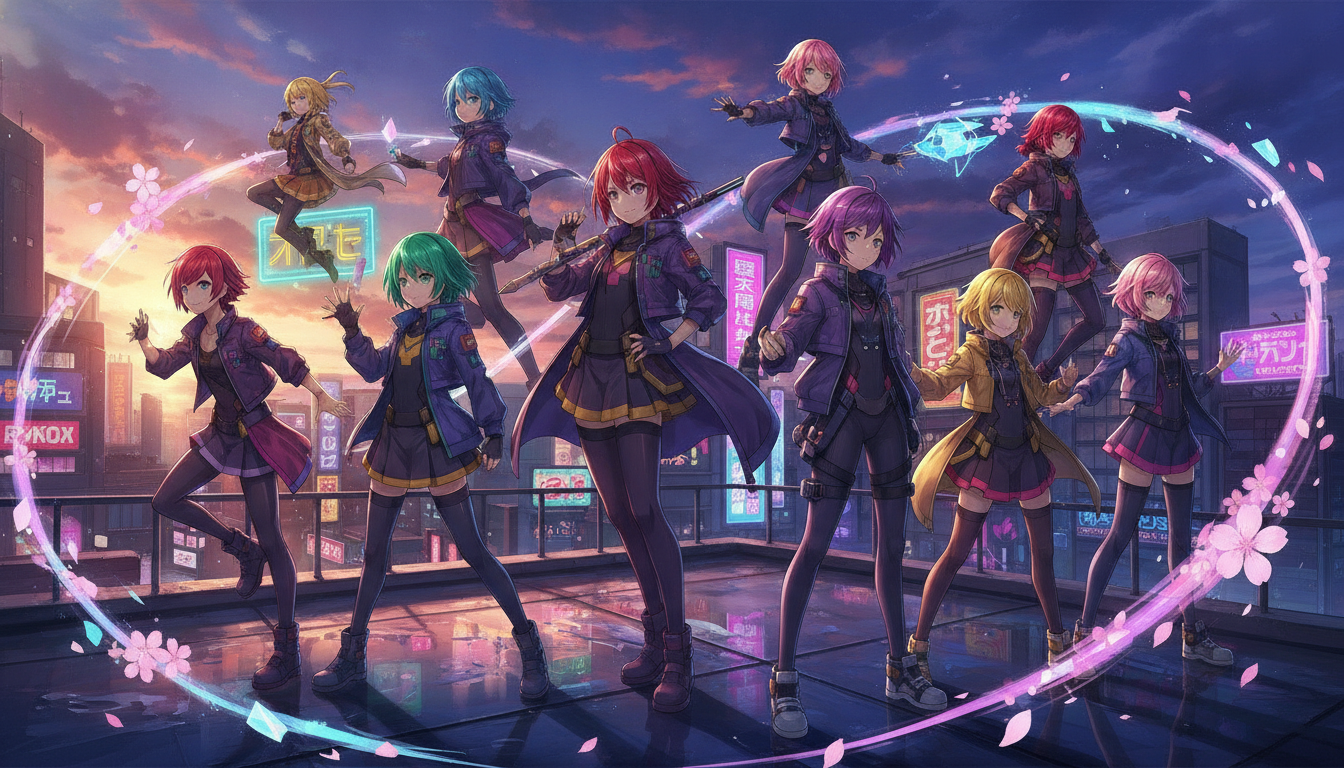
Imagine sitting down on a lazy Saturday morning, clicking on what you think is “just a cartoon,” and then suddenly realizing three hours have vanished, your snacks are gone, and you are emotionally invested in the survival of a teenage boy who turns into a giant naked giant to fight other giants. That is the anime experience in a nutshell — and it happens to millions of people every single day across every continent on Earth. Anime is no longer a niche hobby whispered about in school hallways or confined to late-night cable slots. It is a full-blown global cultural force that shapes fashion, music, philosophy, and the way an entire generation tells stories.
But how did it get here? Japan has been producing animation since the early 20th century, yet it was not until the late 1990s and early 2000s that titles like Dragon Ball Z, Sailor Moon, and Pokémon began cracking open Western markets in a serious way. Then streaming arrived, social media amplified everything, and suddenly a subtitled episode of Attack on Titan was being dissected in Reddit threads from Brazil to Nigeria to South Korea. The rise of anime to global dominance is not an accident — it is the result of a very specific, almost mathematical combination of storytelling craft, cultural timing, technological shifts, and a deeply passionate fanbase that refuses to let anything stay underground for long.
Understanding that formula is the key to understanding why anime is not just popular, but obsession-inducing in a way that few other entertainment formats can match. So let us break it down, piece by piece.
The Storytelling Engine: Why Anime Narratives Hit Differently
The single most powerful ingredient in the anime formula is long-form, consequence-driven storytelling. Western animation, with some notable exceptions, has historically leaned toward episodic formats where characters reset at the end of every episode — think classic Saturday morning cartoons where nothing truly changes. Anime, by contrast, inherited a tradition from manga (Japanese comics) of continuous, evolving narratives where characters grow, relationships shift, and people actually die and stay dead.
This creates genuine emotional stakes. When Maes Hughes is killed in Fullmetal Alchemist: Brotherhood, or when a major character falls in Demon Slayer: Kimetsu no Yaiba, fans feel it because they have watched dozens of episodes of buildup. The storytelling respects the audience’s memory and emotional investment. You cannot skip episodes. You cannot dip in and out casually. The story demands your full attention — and that demand is precisely what creates obsession.
Anime also tackles themes that mainstream animation has often avoided: grief, political corruption, moral ambiguity, existential dread, the horror of war. Neon Genesis Evangelion is ostensibly about giant robots fighting monsters, but it is really a dense exploration of depression, trauma, and identity. Vinland Saga is a Viking epic that becomes a meditation on pacifism. These are not themes you expect from “cartoons,” and the cognitive dissonance of finding them there is part of what hooks viewers so deeply.
The Visual Language: A Style That Became Its Own Grammar
Anime has developed a visual vocabulary so distinct and so widely recognized that it functions almost like a universal language. The exaggerated facial expressions, the “sweat drop” of embarrassment, the dramatic power-up sequences, the iconic character archetypes — the stoic loner, the loud-mouthed hero, the secretly powerful quiet girl — these are immediately readable signals that communicate enormous amounts of information quickly and efficiently.
Studios like Toei Animation, Madhouse, Wit Studio, MAPPA, and ufotable have each pushed the visual ceiling of what animation can achieve. ufotable’s work on the Demon Slayer movie Mugen Train (released in 2020) became the highest-grossing anime film of all time and one of the highest-grossing films in Japanese box office history, demonstrating that the visual ambition of anime can compete with any Hollywood production on a global stage.
The art style is also endlessly adaptable. Anime covers everything from the soft, watercolor aesthetic of a Studio Ghibli film to the hyper-kinetic, almost violent fluidity of a Jujutsu Kaisen battle sequence. That range means anime is not one thing — it is an entire spectrum of visual experiences, and there is an entry point for almost every aesthetic taste.
The Streaming Revolution: How Netflix, Crunchyroll, and the Algorithm Helped
For decades, accessing anime outside Japan meant hunting down VHS tapes, navigating early internet forums, or waiting for a regional broadcaster to pick up a license. Fan-subtitle groups (fansubbers) kept the culture alive through the 1990s and 2000s, building passionate underground communities that would prove crucial later. Then legal streaming changed everything.
Crunchyroll, which launched in 2006 and grew into the world’s largest dedicated anime streaming platform, made simulcasting — releasing subtitled episodes in multiple countries the same day they aired in Japan — the industry standard. This eliminated the lag that had previously kept international fans perpetually behind. Suddenly, the global conversation about an episode could happen simultaneously.
Netflix then began investing heavily in original anime productions and licensing major titles, bringing series like Castlevania (an American-produced anime-style series) and Aggretsuko to mainstream audiences who might never have sought out anime on their own. The algorithm did the rest. One click on a trending title could send a casual viewer down a rabbit hole that ends three seasons later.
The Fandom Effect: A Community That Amplifies Everything
No discussion of anime’s global rise is complete without acknowledging the fandom itself as an active ingredient in the formula. Anime fans are not passive consumers — they are creators, translators, theorizers, cosplayers, and evangelists. Fan art floods social media platforms within hours of a new episode dropping. Theory videos on YouTube accumulate millions of views. Cosplay at conventions like Anime Expo in Los Angeles or Comiket in Tokyo transforms viewers into living, breathing embodiments of the culture.
This participatory dimension means that the content of any given anime is only the beginning of the experience. The conversation around anime — the debates, the fan theories, the shipping wars, the “who would win” discussions (and if you want a truly epic example of that, check out Goku vs Saitama: Only One Can Walk Away Undefeated) — extends the emotional engagement far beyond the runtime of any episode.
Did You Know? Fast Facts About Anime’s Global Reach
Here are some key facts that illustrate just how far anime has traveled:
- Dragon Ball has been in continuous production in some form since the original manga began in 1984
- One Piece, which began its manga run in 1997, remains one of the best-selling manga series in history
- The Pokémon franchise, which includes anime, games, and merchandise, is considered the highest-grossing media franchise of all time
- Spirited Away (2001), directed by Hayao Miyazaki, won the Academy Award for Best Animated Feature, making it the first anime film to win an Oscar
- MAPPA produced both the final season of Attack on Titan and Jujutsu Kaisen simultaneously, a workload that sparked major industry discussions about animator working conditions in Japan
- Anime conventions now take place on every inhabited continent
The Cultural Export Machine: Japan’s Soft Power Play
Japan’s government and cultural institutions have not ignored anime’s global reach. The concept of “Cool Japan” — a soft power initiative promoting Japanese culture abroad — has embraced anime, manga, and gaming as official cultural ambassadors. This is a remarkable shift from earlier decades when anime was considered low-brow entertainment even within Japan.
The cultural specificity of anime is, paradoxically, part of its universal appeal. The food, the school settings, the seasonal festivals, the social dynamics — all of these deeply Japanese elements feel exotic and fascinating to international viewers in a way that fuels curiosity about Japanese culture more broadly. In the same way that Japanese culture produces uniquely fascinating everyday experiences, anime gives the world a window into a cultural imagination that is genuinely different from Hollywood’s — and audiences are hungry for that difference.
What Comes Next: Anime in 2026 and Beyond
As of 2026, the industry shows no signs of slowing down. New adaptation announcements generate headline news. AI-assisted production tools are entering early discussion — and early controversy — within studios. The question of animator pay and sustainable working conditions remains one of the most important ethical conversations in the industry.
Original streaming productions, international co-productions, and the ongoing global hunger for manga adaptations mean the pipeline of content is longer than ever. The challenge now is not discovery — anyone with a streaming subscription can find anime in minutes — but depth: will the industry be able to maintain the quality and creative ambition that created the obsession in the first place?
The secret formula was never really one secret at all. It was great storytelling, distinctive visual craft, a technology shift that opened borders, and a passionate fanbase that turned every new series into a shared cultural event. Anime conquered the world not through a single viral moment but through decades of earned devotion — one emotionally devastating plot twist at a time. And if you are only now falling down the rabbit hole? Welcome. Your weekends are about to get very complicated.

2 Comments
Pingback: The Only Fate Watch Order Guide You'll Ever Need - ICL Geek Curiosities
Pingback: The Obsessive Japanese System That Makes Trains Never Late - ICL Geek Curiosities