

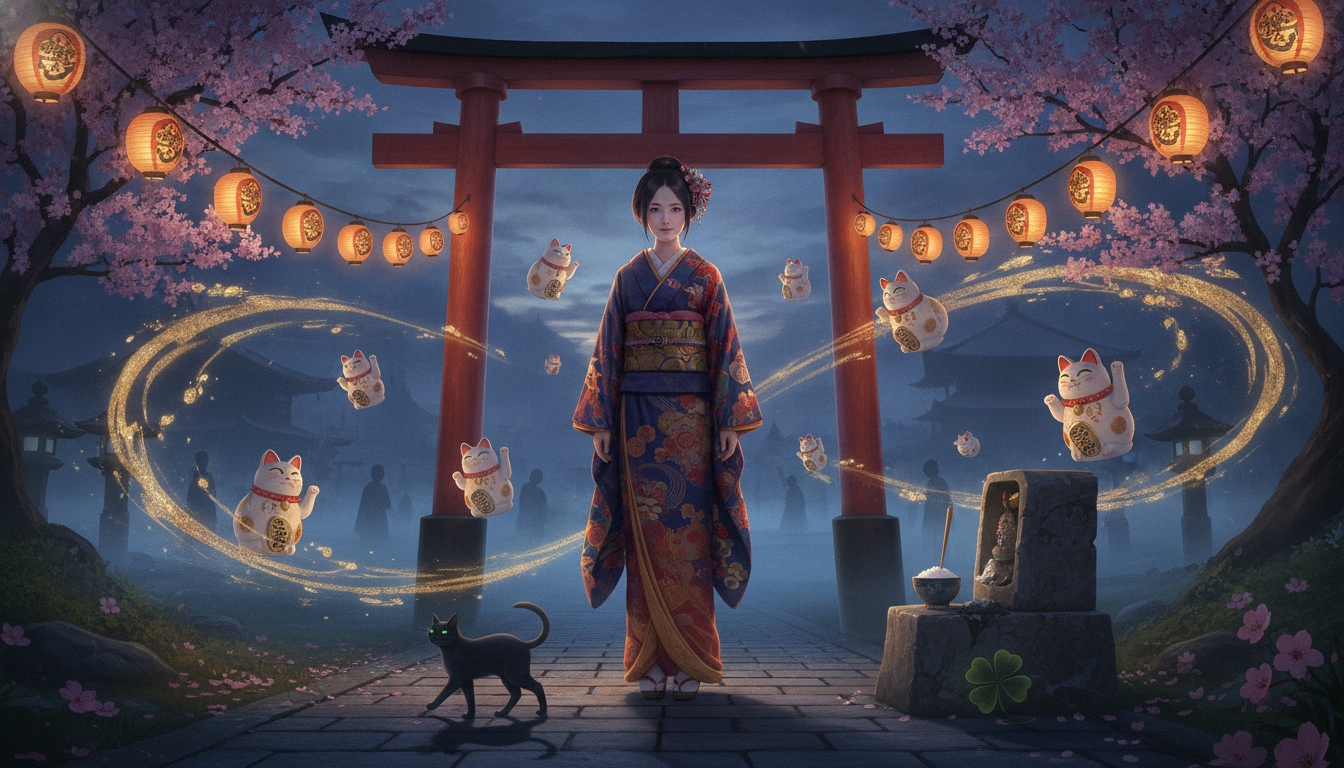
If you have ever watched a horror anime and wondered why the characters are suddenly terrified of a haircut at night, or why someone is desperately avoiding the number four, congratulations — you have just stumbled into the fascinating world of Japanese superstitions. These beliefs are not just quirky background details; they are woven deep into the cultural fabric of Japan, showing up in everything from hospital room numbering to the way people celebrate New Year’s. And for anime fans, recognizing these superstitions transforms a casual viewing experience into something far richer — suddenly, scenes that seemed random reveal layers of cultural meaning that most Western audiences completely miss.
Japan has one of the world’s most intricate webs of folk belief, shaped by centuries of Shinto tradition, Buddhist influence, and a uniquely Japanese sensitivity to the spirit world. Some of these superstitions are ancient, tracing back to the Heian period (794–1185 CE), while others evolved more recently through popular culture and urban legend. What makes them especially compelling is that they are not treated as embarrassing relics of the past — many are still actively observed today, in 2026, by ordinary people who would describe themselves as perfectly rational. That tension between modernity and ancient belief is part of what makes Japan endlessly fascinating, and it is absolutely everywhere in anime, manga, and Japanese storytelling. For more on how old beliefs shape pop culture, check out 9 Insane Things People Actually Believed in the Past.
The Number Four and Why Japanese Buildings Skip It
One of the most visible superstitions in Japan is tetraphobia — the fear of the number four. In Japanese, the number four can be read as shi (四), which is the same pronunciation as the word for death (死). Because of this phonetic overlap, the number four is considered deeply unlucky, and you will find it quietly erased from everyday life in ways that can genuinely surprise visitors.
Many hospitals in Japan do not have a fourth floor or a room numbered four. Elevators sometimes jump straight from three to five. Even some product lines avoid pricing or packaging in sets of four. The same logic extends to the number nine (ku), which shares its sound with the word for suffering or pain (苦). Together, four and nine are sometimes called shiku, and gifting someone a set of four or nine items — especially in a medical or funeral context — is considered seriously bad form.
In anime, you can spot this sensitivity in shows like Fullmetal Alchemist: Brotherhood, where themes of death and taboo are handled with a reverence that clearly draws from this cultural discomfort around mortality markers. The number four is not just an anime trope — it is a living, breathing part of daily Japanese life.
Cutting Nails at Night Invites Bad Luck
If you have ever seen a Japanese character in anime panic because someone grabbed a pair of nail clippers after dark, here is the explanation: cutting your nails at night is widely believed to shorten your life or invite evil spirits. The superstition has practical roots — in the days before electric lighting, cutting nails in the dark was genuinely dangerous and could result in injury. Over time, the practical warning transformed into a supernatural one.
A related belief says that cutting nails at night means you will not be present at your parents’ deathbed. This version of the superstition is particularly emotionally loaded in Japanese culture, where family duty and filial piety carry enormous weight. It is the kind of detail that a thoughtful anime writer will drop into a scene to instantly signal a character’s traditional upbringing or their family’s deep-rooted beliefs.
Whistling at Night and the Spirits It Summons
Whistling at night is another widely known Japanese superstition, and this one is particularly atmospheric. The belief holds that whistling after dark attracts snakes — or, in more supernatural interpretations, summons evil spirits or even the tengu (mythical mountain beings). Some versions of the superstition say it can attract thieves, while others connect it to the idea that certain frequencies or sounds at night disturb the boundary between the living world and the spirit world.
This fits neatly into the broader Shinto worldview, where the natural world is inhabited by spirits (kami) and the line between the human realm and the supernatural is porous, especially at liminal times like night, dusk, or the transitional seasons. Anime like Natsume’s Book of Friends (Natsume Yuujinchou) masterfully portrays this sense of the world being full of invisible presences that ordinary people can accidentally disturb — whistling at night is exactly the kind of careless act that would get a character into trouble in that universe.
The Fox, the Cat, and the Power of Animal Omens
Japan has a rich tradition of animal-based superstitions, many of which feed directly into anime mythology:
- White snakes are considered messengers of the god Benzaiten and symbols of good luck and financial fortune.
- Black cats crossing your path are considered bad luck in Japan (unlike in some UK traditions where they are lucky).
- Crows (karasu) are often seen as omens of bad news or death — but they are also sacred to some Shinto shrines, associated with the divine crow Yatagarasu.
- Foxes (kitsune) are both tricksters and divine messengers of Inari, the Shinto deity of rice, agriculture, and prosperity. A fox can be your greatest ally or your worst enemy depending on how you treat it.
- Cats (neko) with a raised paw (maneki-neko) bring good luck to businesses — the iconic beckoning cat figure you see in shops is rooted in genuine folk belief.
The kitsune in particular has become one of anime’s most beloved archetypes, appearing in everything from Naruto (the Nine-Tails is a fox spirit sealed within the main character) to Kamisama Kiss and The Ancient Magus’ Bride. The supernatural weight these creatures carry in actual Japanese belief makes them far more than cute character designs — they are loaded with centuries of cultural meaning.
Superstitions Around Death and Funerals
Japanese funeral customs come with their own dense set of rules and superstitions, many of which cross over into daily life:
- Never pass food chopstick to chopstick — this mimics a funeral ritual where bones of the cremated deceased are passed between family members.
- Never stick chopsticks upright in rice — this resembles incense sticks offered to the dead and is considered deeply disrespectful.
- Cover mirrors during mourning — mirrors are believed to trap the soul of the deceased, and covering them protects the grieving family.
- Do not sleep with your head pointing north — this is the position in which the dead are laid out, and sleeping that way is believed to invite death.
These customs are so embedded in Japanese daily life that breaking them — even accidentally — can cause genuine discomfort in social settings. Anime series set in realistic Japanese households, like March Comes in Like a Lion (3-gatsu no Lion), reflect these unspoken rules in the texture of everyday scenes.
Lucky Charms and the Positive Side of Superstition
Not every Japanese superstition is about avoiding disaster. Japan also has a rich tradition of actively attracting good fortune through specific actions and objects. Omamori (protective charms sold at Shinto shrines and Buddhist temples) are carried by millions of people for everything from traffic safety to academic success. New Year’s (Oshogatsu) is essentially a national ritual of superstitious good-luck seeking — from the first sunrise (hatsuhinode) to the first shrine visit (hatsumode) to the lucky bags (fukubukuro) sold by shops.
Lucky numbers like seven and eight (hachi, because the kanji 八 widens at the bottom, symbolizing expanding fortune) are actively sought out. In Japanese culture, superstition is not purely about fear — it is equally about cultivating good energy and maintaining harmony with the invisible forces around you. This balance is beautifully explored in anime that take spirituality seriously, as we discussed in our look at Witch Hat Atelier Anime Review: Magic Done Right.
Why These Superstitions Still Matter in 2026
It might be tempting to dismiss these beliefs as quaint folklore, but that would be a mistake. Japanese superstitions are alive because they carry genuine cultural memory — the practical wisdom of pre-industrial life, the emotional logic of communities shaped by Buddhism and Shinto, and the very human need to feel some control over an uncertain world. They persist in hospital architecture, dinner table etiquette, gift-giving customs, and the stories Japan tells itself through anime, manga, and film.
For fans, understanding these superstitions is like getting a secret key to Japanese storytelling. The next time a character in an anime refuses to whistle at night, or a horror series leans into the terror of a north-facing bed, you will not just see a spooky scene — you will feel the deep cultural weight behind it. And that, honestly, is one of the best things about being a geek: the knowledge that transforms entertainment into genuine understanding.

2 Comments
Pingback: Why Does Reality Work Like This? School Lied to You - ICL Geek Curiosities
Pingback: 12 Anime Soundtracks So Epic They Give You Chills - ICL Geek Curiosities