

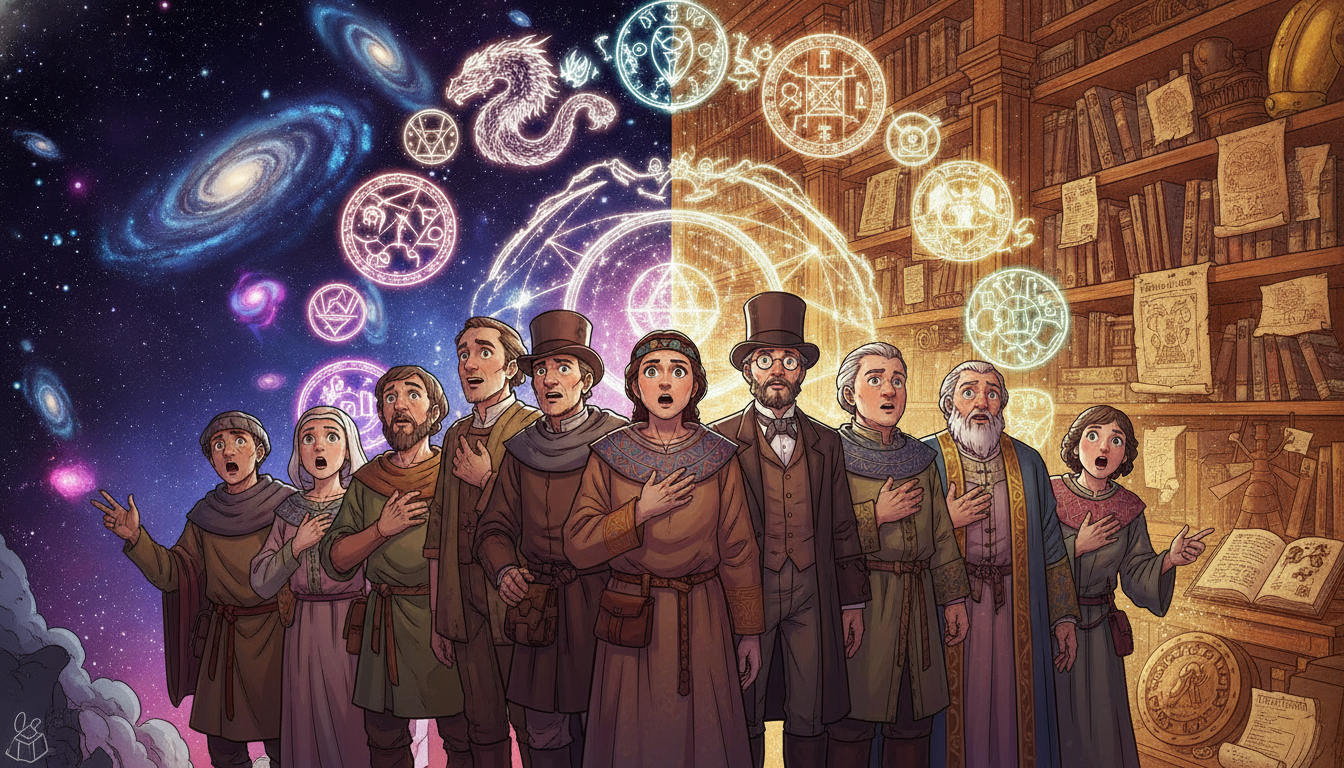
Humans are fascinating creatures — brilliant enough to split the atom, land rovers on Mars, and animate 24 frames per second into tearjerking masterpieces, yet somehow capable of believing the most wildly incorrect things for centuries. History is absolutely packed with confident, often highly educated people who were completely, spectacularly wrong about the world around them. And the wildest part? They weren’t just guessing. They were sure. They had arguments, treatises, entire philosophical schools dedicated to ideas that make modern people laugh out loud.
From flat Earth cosmologies to the “fact” that you could cure disease by pointing a magnet at someone, the past is a treasure chest of spectacular intellectual failures. Some of these beliefs shaped laws, wars, medicine, and art. Some of them were held by the smartest people of their era. And a few of them are so absurd that they sound like the plot of a bad isekai anime — which, honestly, makes them even more entertaining. So buckle up, because we’re about to take a wild tour through history’s greatest hall of “wait, people actually believed that?”
Whether you’re a history buff, a science nerd, or just someone who enjoys feeling smarter than Aristotle for once in your life, this list is for you. These aren’t fringe, tinfoil-hat theories, either — these were mainstream, academically respected beliefs held by entire civilizations. Let’s dig in.
1. The Earth Was the Absolute Center of the Universe
Geocentrism: When Humans Put Themselves in the Middle of Everything
For roughly two thousand years, the dominant scientific and religious consensus was that Earth sat perfectly still at the center of the cosmos, with the Sun, Moon, planets, and stars all orbiting around us. This wasn’t just casual belief — it was codified by the Greek astronomer Claudius Ptolemy in the 2nd century CE into a detailed mathematical model called the Ptolemaic system, complete with elaborate “epicycles” to explain why planets sometimes seemed to move backward in the sky.
The system was so mathematically intricate and so well-defended by the Catholic Church that challenging it was genuinely dangerous. When Nicolaus Copernicus published his heliocentric model in 1543, and when Galileo Galilei championed it in the early 1600s, the backlash was severe — Galileo was placed under house arrest for the rest of his life. It took generations before humanity collectively accepted that Earth is, in cosmic terms, remarkably unremarkable.
2. The Human Body Runs on Four Magic Liquids
Humorism: The Medical Theory That Refused to Die
Imagine going to a doctor with a fever and being told your blood is “too hot” and needs to be drained out. That was legitimate, respected medicine for over two millennia. The theory of the four humors — blood, phlegm, yellow bile, and black bile — was developed by ancient Greek physicians including Hippocrates and later expanded by Galen in the 2nd century CE.
According to humorism, personality, health, and disease were all determined by the balance of these four liquids in your body. Too much black bile? You were melancholic. Too much yellow bile? Choleric and angry. The treatments were accordingly wild:
- Bloodletting — cutting open veins or applying leeches to drain “excess” blood
- Purging — forcing vomiting or bowel movements to expel bad humors
- Cauterization — burning tissue to rebalance the body
- Dietary restriction based on which humor was supposedly dominant
Humorism wasn’t fully abandoned by mainstream Western medicine until the mid-1800s, when germ theory finally replaced it. Two thousand years of draining people’s blood because a Greek philosopher had a theory.
3. Spontaneous Generation: Life Just… Appears From Nowhere
How People Explained Maggots Before Microbiology
Before microscopes and germ theory, one of the most widely accepted scientific “facts” was spontaneous generation — the idea that living creatures could simply spring into existence from non-living matter. Rotting meat produced maggots. Mud produced frogs. Grain left in a barn produced mice. The explanation? Those organisms just generated themselves from the surrounding material.
Aristotle championed this idea, and it remained credible through the medieval period and into the Renaissance. The Belgian physician Jan Baptist van Helmont even published a specific recipe in the 1600s for generating mice: leave some wheat and a dirty shirt in an open container for 21 days. The sweat from the shirt would allegedly interact with the wheat to create living mice.
It wasn’t until Louis Pasteur’s famous swan-neck flask experiments in 1859 that spontaneous generation was definitively disproven, paving the way for modern microbiology.
4. Bloodletting Could Cure Basically Everything
The Medical Practice That Killed More Patients Than It Saved
Linked to humorism but deserving its own spotlight, bloodletting was considered a universal cure-all for an almost comical range of conditions — fevers, infections, pneumonia, and even mental illness. Physicians would open a vein with a lancet or apply medicinal leeches to remove what they believed was corrupt or excessive blood.
The practice was so embedded in medicine that it likely contributed to the death of George Washington in December 1799. Already ill with a throat infection, Washington was subjected to multiple bloodletting sessions in a single day, with physicians removing an estimated 40% of his blood volume. He died hours later. Despite this, bloodletting remained in practice well into the 19th century.
5. The Brain Was Just There to Cool the Blood
Ancient Greeks Thought Your Heart Did All the Thinking
Aristotle — who shows up a lot on this list — believed that the heart was the seat of intelligence, emotion, and consciousness. The brain, in his view, was a cooling mechanism for the blood, functioning something like a radiator. He based this partly on the observation that the heart is warm and active, while brain tissue feels relatively cool to the touch.
This idea seems laughably wrong now, but it was held with genuine conviction by one of the greatest minds of the ancient world. It’s the kind of thing that might make even the smartest anime character ever pause for a moment of humble reflection.
6. Lead Was Totally Fine to Eat and Drink
The Roman Empire’s Slow-Motion Poisoning
The ancient Romans loved lead. They used it in their plumbing (the Latin word for lead, plumbum, is literally the root of the word “plumbing”), in their cookware, in cosmetics, and most remarkably, in their food. Roman cooks would reduce grape juice in lead-lined pots to produce a sweet syrup called sapa, which was used as a sweetener and food preservative. The lead leaching into the syrup gave it an extra sweetness due to lead acetate, sometimes called “sugar of lead.”
Lead exposure causes neurological damage, cognitive impairment, and behavioral changes — symptoms that weren’t understood or connected to lead consumption for centuries. Some historians have argued that widespread lead poisoning may have contributed to cognitive and behavioral problems among Roman elites, though the full extent of its societal impact is still debated among scholars.
7. The Shape of Your Skull Revealed Your Personality
Phrenology: 19th-Century Pseudoscience With Real-World Consequences
Phrenology was the belief, popular throughout much of the 1800s, that the shape and bumps of a person’s skull directly reflected the development of specific brain regions underneath — and that by feeling those bumps, a trained “phrenologist” could determine someone’s intelligence, moral character, and personality traits.
Developed by Franz Joseph Gall in the late 18th century, phrenology gained enormous mainstream credibility and was used in hiring decisions, criminal sentencing, and even to justify racist pseudoscience about different ethnic groups. It was taught in universities. Respected journals published phrenological research. People paid for skull readings the way we might pay for personality assessments today.
The consequences were far from harmless. Phrenological “evidence” was used to argue that certain races were intellectually inferior, contributing to the ideological scaffolding of slavery and colonialism. It’s a stark reminder that scientific-sounding language can dress up truly dangerous ideas — which is exactly why critical thinking matters, whether you’re navigating the daemons of shadow realms or evaluating a real-world claim.
Why This All Matters in 2026

History’s bad ideas aren’t just funny — they’re instructive. Every single one of these beliefs was held confidently by intelligent, educated, socially respected people. They had logic. They had evidence (even if that evidence was wrong). They had institutional support. The lesson isn’t that past people were stupid. The lesson is that confidence and consensus are not the same as correctness.
The best weapon against believing the next generation of spectacular nonsense is the same one that dismantled geocentrism, humorism, and phrenology: curiosity, humility, and a willingness to question what everyone around you assumes to be obviously true. History didn’t run out of wrong ideas in the 19th century. It never does. Stay curious, stay skeptical — and maybe don’t let anyone feel the bumps on your skull.

1 Comment
Pingback: Japanese Superstitions Explained: What Each One Really Means - ICL Geek Curiosities