

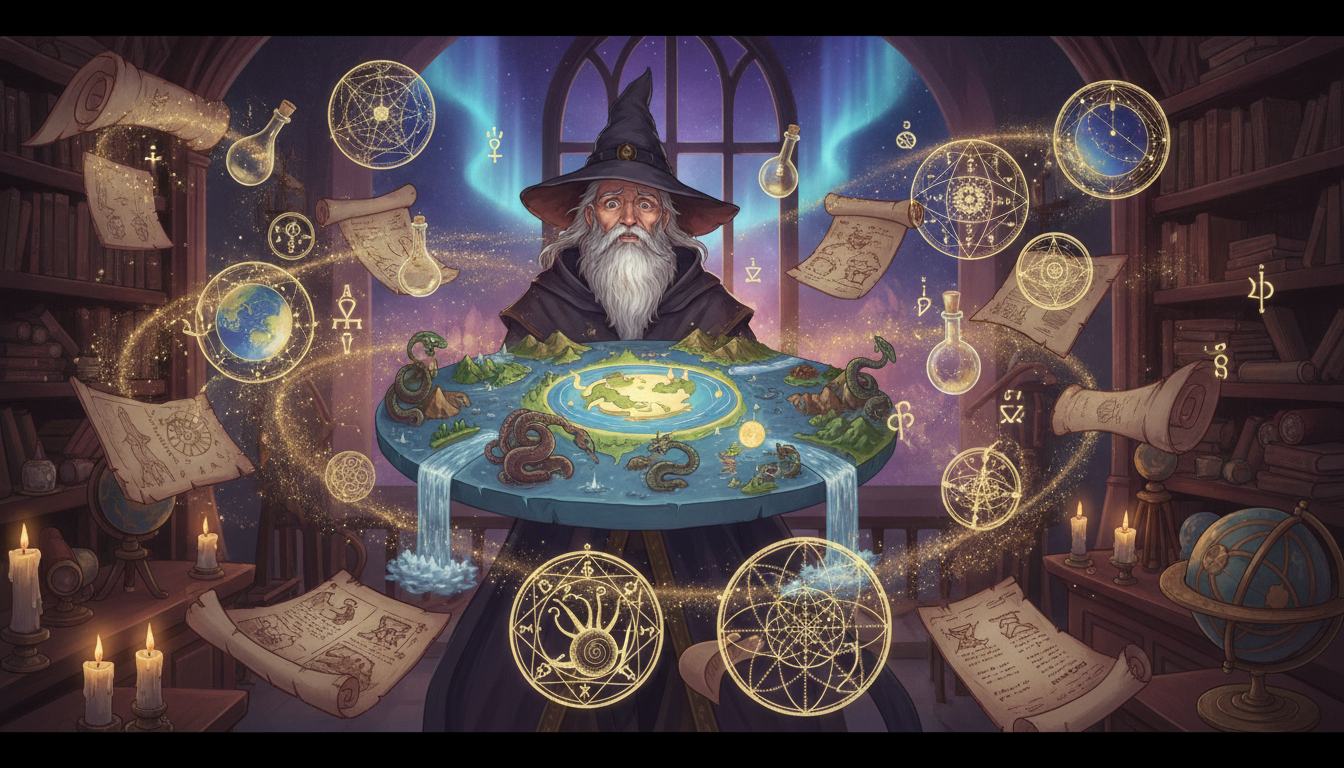
Imagine believing that the sun orbited the Earth, that bad smells caused disease, or that you could cure a headache by drilling a hole in your skull. Sounds like something out of a dark fantasy anime, right? But these weren’t the ravings of fictional villains — they were mainstream, educated, official human beliefs held for centuries. History is absolutely packed with ideas that were once considered scientific fact, divine truth, or just plain common sense, only to be completely obliterated by better thinking later on. And honestly? Some of them are so bizarre that if an anime writer pitched them today, they’d probably be told to tone it down.
What makes this topic so fascinating — and so humbling — is the realization that brilliant people, entire civilizations, and respected institutions once built their entire worldview on things that turned out to be spectacularly wrong. From ancient medicine to flat-earth cosmology, from spontaneous generation to the existence of a mysterious fire element called phlogiston, humanity’s intellectual history reads less like a textbook and more like a greatest-hits album of confident mistakes. And if you love anime and geek culture, you already know that some of the most compelling stories are built around the moment a character discovers that everything they believed was a lie — think Attack on Titan‘s wall reveal or Fullmetal Alchemist: Brotherhood‘s exposure of the Homunculi conspiracy. Real history hits the same way.
So buckle up, because we’re diving deep into the weirdest, most confidently wrong things humanity ever believed — and why understanding them makes us sharper thinkers today.
The Earth Is the Center of Everything (Obviously)
For most of recorded human history, the geocentric model — the idea that the Earth sat perfectly still at the center of the universe while everything else spun around it — was not a fringe theory. It was the theory. Ancient Greek philosophers including Aristotle and Ptolemy developed detailed mathematical systems to support it. The Catholic Church officially endorsed it. Astronomers built careers around it. It was the scientific consensus for well over a thousand years.
When Nicolaus Copernicus quietly published his heliocentric model in 1543 (suggesting the Earth actually orbits the Sun), he was so worried about the backlash that the book was reportedly only published as he lay dying. Galileo Galilei later championed heliocentrism with telescopic evidence and was placed under house arrest by the Inquisition for his trouble. It took decades — and the work of Johannes Kepler and Isaac Newton — before the scientific community fully shifted.
The lesson here? Even the smartest people, armed with the best tools available to them, can be completely wrong when they start from a flawed assumption. It’s a plot twist the real world keeps recycling.
Bad Smells Cause Disease: The Miasma Theory
Before germ theory became established science in the 19th century, the dominant medical explanation for disease was the miasma theory — the belief that illness spread through “bad air” emanating from rotting organic matter, swamps, and filth. The very word “malaria” literally means “bad air” in Italian (mala aria).
This wasn’t just folk belief. Respected physicians across Europe and Asia operated under miasmatic principles for centuries. Cities tried to combat disease by burning aromatic herbs, carrying flowers, or simply avoiding foul-smelling areas. Ironically, some of these efforts accidentally worked — clearing garbage and improving sanitation reduced disease not because the smell was gone, but because the actual disease vectors (bacteria, parasites, mosquitoes) lost their breeding grounds.
It wasn’t until scientists like Louis Pasteur and Robert Koch demonstrated in the 1860s–1880s that specific microorganisms caused specific diseases that miasma theory finally collapsed. One wild idea replaced by an even wilder (but true) one: invisible living creatures are literally everywhere, and some of them want to destroy you.
Fire Is an Element, and It Lives Inside Everything
Long before chemistry became a real discipline, European scientists in the 17th and 18th centuries were deeply invested in phlogiston theory — the belief that all flammable materials contained a fire-like element called phlogiston, which was released during combustion. When something burned, it was releasing its phlogiston into the air.
This theory was taken seriously by major scientists and even helped organize some legitimate observations about oxidation and combustion. The problem? It was completely backwards. When Antoine Lavoisier demonstrated in the 1770s–1780s that burning actually involves absorbing oxygen rather than releasing a mystery substance, phlogiston theory crumbled. Lavoisier is now often called the father of modern chemistry.
Phlogiston sounds like something out of a Fullmetal Alchemist textbook — and that’s exactly the point. Real historical alchemy and proto-chemistry were full of concepts just as dramatic and just as fictional as anything Ed and Al Elric ever encountered.
Weird Things Humanity Believed: A Quick-Fire List
Because history is generous with its absurdities, here’s a rapid rundown of other spectacular human misconceptions:
- Spontaneous generation: People believed life could arise from non-living matter — maggots from meat, mice from grain, eels from river mud. This persisted until Pasteur’s famous sealed-flask experiments in the 1850s–1860s disproved it.
- Trepanation as medicine: Drilling holes in living people’s skulls to release evil spirits or “bad pressure” was practiced across multiple ancient cultures. Healed skull bones prove many patients actually survived.
- The humors: Ancient Greek and Roman medicine held that human health depended on the balance of four bodily fluids — blood, phlegm, yellow bile, and black bile. Feeling angry? Too much yellow bile. Sad? Excess black bile (melancholia).
- Bloodletting: Flowing naturally from humor theory, physicians bled patients — sometimes to death — to rebalance their humors. George Washington likely died in 1799 partly due to aggressive bloodletting by his doctors.
- The flat Earth: While ancient Greek scholars actually knew the Earth was spherical, flat-Earth beliefs persisted in various cultures and, embarrassingly, have seen a bizarre modern revival fueled by social media.
- Ether filled all of space: 19th-century physicists were certain that light waves must travel through some invisible medium called the “luminiferous ether.” The Michelson-Morley experiment of 1887 found no evidence of it whatsoever.
If any of these feel surreal, check out these fun facts sound made up but are absolutely real — real history is genuinely stranger than fiction.
When Anime Gets the “Everything Was a Lie” Moment Right
One of anime’s most powerful recurring storytelling devices is the paradigm-shattering revelation — the moment a character (and by extension the audience) realizes the entire world they thought they understood was built on a false foundation. This mirrors real scientific history almost perfectly.
In Attack on Titan, humanity spends generations believing they are the last survivors of a monster apocalypse, huddled behind enormous walls. The truth is exponentially more complicated and horrifying. In Fullmetal Alchemist: Brotherhood, the entire system of alchemy that characters built their lives around turns out to be manipulated by an ancient, sinister force. In Neon Genesis Evangelion, nearly every “fact” the audience accepts in the early episodes gets recontextualized by the finale.
These stories resonate so deeply because real human history is full of these same moments — the collective realization that a confident, centuries-old belief was catastrophically wrong. Art reflects life, and in this case, life is extremely dramatic.
Why We Keep Getting Things Wrong (And Why That’s Okay)
It would be easy to mock our ancestors for believing in miasma or phlogiston — but that’s not really fair. Every one of those theories was someone’s genuine attempt to explain the observable world with the tools and information available at the time. The geocentric model wasn’t stupid; it was a rational interpretation of what the naked eye could observe before telescopes existed. Miasma theory wasn’t lazy; it was a logical connection between filthy environments and sick people.
What makes science powerful isn’t that it never gets things wrong. It’s that it has a built-in mechanism for correcting mistakes when new evidence arrives. The history of human belief is really the history of humans slowly, painfully, sometimes heroically updating their understanding of reality. That process is ongoing. Right now, in 2026, there are things we believe confidently that future generations will look back on with the same amused disbelief we feel reading about phlogiston.
Conclusion: Stay Curious, Stay Humble
The weirdest thing humanity ever believed might not be any single theory on this list. It might be the recurring belief — across every era — that this time we’ve finally figured everything out. History punishes that kind of certainty repeatedly and spectacularly. The smarter move, whether you’re a scientist, an anime fan, or just a curious human being alive in 2026, is to stay genuinely open to being wrong. Question the consensus. Demand evidence. And never stop finding the universe stranger and more wonderful than you expected. After all, that’s what the best stories — real or animated — are always about.
