

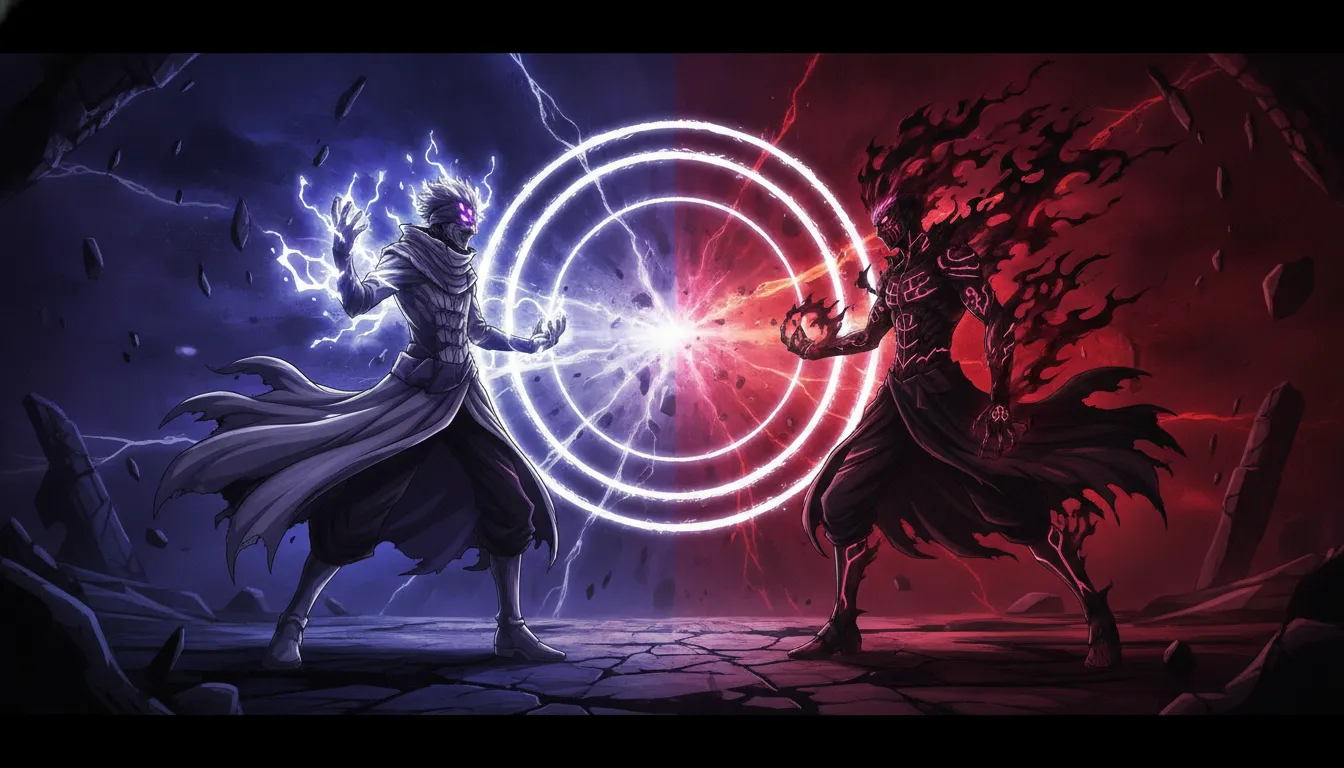
Few rivalries in modern anime history have sparked as much debate, fan art, theory-crafting, and outright screaming into the void of social media as Satoru Gojo versus Ryomen Sukuna from Jujutsu Kaisen. These two titans occupy the same fictional universe — one a blindfolded, silver-haired sorcerer with an ego the size of a small planet, the other a millennia-old King of Curses with more fingers than most people care to count — and yet for years, fans refused to accept that the question of who would win in a straight fight could ever truly be answered. Then manga creator Gege Akutami went ahead and answered it anyway, and the internet has not been the same since. Whether you’re a longtime JJK devotee or someone who just started watching the anime and stumbled into this debate, buckle up — because this one goes deep.
The rivalry between Gojo and Sukuna is more than just a clash of power levels. It represents two fundamentally different philosophies: Gojo embodies the belief that one extraordinary individual can change the entire system, while Sukuna represents the ancient, predatory truth that power exists for its own sake, beholden to nothing and no one. That philosophical contrast made their long-anticipated showdown one of the most emotionally loaded events in recent manga history — not just a fight, but a statement about what Jujutsu Kaisen is ultimately trying to say. And when the dust settled, there was a winner, a loser, and an avalanche of fan grief that crashed Twitter (now X) servers in multiple regions.
Who Are These Two Characters, Anyway?
For the newcomers in the room, a quick primer. Satoru Gojo is introduced in Jujutsu Kaisen as the most powerful jujutsu sorcerer of the modern era, a teacher at Tokyo Jujutsu High who possesses the rare Limitless cursed technique combined with the Six Eyes — a genetic gift so potent it’s said to appear only once a generation. His signature move, Infinity, creates an invisible barrier around him that renders virtually every attack mathematically unable to reach him. He is, in short, the guy everyone in-universe agrees is unbeatable. Or was.
Ryomen Sukuna, on the other hand, is a cursed spirit — technically, the King of Curses — who existed over a thousand years ago as a human sorcerer so terrifyingly powerful that, even after death, his power lived on in twenty cursed finger-relics. The central plot of Jujutsu Kaisen begins when teenager Yuji Itadori swallows one of those fingers, becoming Sukuna’s reluctant host. Sukuna’s techniques include Dismantle (a slashing attack) and Cleave (an adaptive cutting technique that scales to the target), and his mastery of Reverse Cursed Technique gives him extraordinary healing abilities. He is ancient, ruthless, and finds genuine joy in destruction.
The Long Road to Their Showdown
Fans waited years for Gojo and Sukuna to actually throw hands. For much of the early story, Gojo was sealed away inside the Prison Realm — an artifact used against him by the villainous organization Kenjaku — which conveniently removed him from the board. When Gojo was finally unsealed in the manga during the Culling Game arc, anticipation exploded. Akutami had been building toward this confrontation for hundreds of chapters, layering in power-scaling debates, feats of strength, and philosophical confrontations that kept both characters’ ceilings frustratingly ambiguous.
The actual battle, which played out in the manga during 2023, became a cultural event. Panels were dissected, translated, and reposted across every corner of anime social media within hours of release. The fight itself spanned multiple chapters and delivered exactly the kind of high-concept, reality-bending spectacle JJK is known for — complete with domain expansions, technique clashes, and moments that made readers question whether conventional power logic even applied.
What Actually Happened: Breaking Down the Fight
Here’s where it gets genuinely painful for Gojo fans. Sukuna won. After an exhausting, breathtaking battle that pushed both fighters to their absolute limits, Sukuna killed Satoru Gojo. The manner of Gojo’s death — cut in half by Sukuna’s techniques after his Infinity was finally breached — was simultaneously brutal and, in the context of the story, poetic. Gojo died smiling, acknowledging that he had finally faced someone who truly challenged him.
Key moments that turned the tide include:
- Sukuna’s use of Mahoraga, a shikigami (a kind of summoned spirit used in jujutsu) capable of adapting to and eventually neutralizing any technique, including Gojo’s Infinity
- Sukuna’s absorption of Megumi Fushiguro’s Ten Shadows Technique, which gave him access to Mahoraga and other shikigami he would not otherwise possess
- Sukuna’s mastery of Reverse Cursed Technique allowing him to sustain damage that would have ended nearly any other fighter
- Gojo’s own acknowledgment in his final moments that the fight had been the greatest of his life
This wasn’t a lazy writing decision. Akutami constructed Mahoraga’s adaptation ability across many earlier chapters specifically so that Sukuna’s victory had internal logic. It wasn’t plot armor — it was plot architecture.
Why This Outcome Was Controversial (and Why It Shouldn’t Be)
The fan backlash was immediate and volcanic. Gojo had been positioned as the series’ ultimate benchmark of power for so long that many readers genuinely could not accept his death. Accusations of bad writing flew freely. Some fans argued that Sukuna only won because of circumstances — borrowing Megumi’s techniques, fighting a version of Gojo weakened from being sealed — and that in a “fair” fight, Gojo would dominate.
This is an understandable reaction, but it misses something important. In Jujutsu Kaisen, there is no such thing as a “fair” fight — the entire universe operates on the principle that sorcerers use every available resource, technique, and advantage. Sukuna winning by leveraging stolen techniques and adaptive shikigami is entirely consistent with who Sukuna is. He doesn’t fight fair. He wins. That’s the character.
If you enjoy passionate debates like this one, you’ll absolutely want to check out our breakdown of Luffy vs Naruto: Only One Can Be the True Goat for more cross-series power-scaling chaos.
A Side-by-Side Look at Their Capabilities
| Attribute | Satoru Gojo | Ryomen Sukuna |
|---|---|---|
| Core Technique | Limitless (Infinity) | Dismantle / Cleave |
| Special Ability | Six Eyes | Ten Shadows Technique (via Megumi) |
| Healing | Limited | Full Reverse Cursed Technique |
| Domain Expansion | Unlimited Void | Malevolent Shrine |
| Fatal Weakness | Mahoraga adaptation | Arguably none shown |
| Outcome | Deceased (manga, 2023) | Currently active |
What Gojo’s Death Means for Jujutsu Kaisen
Narrative deaths of supposedly invincible characters are rare precisely because writers fear fan backlash. Akutami leaned into that fear and pulled the trigger anyway. Gojo’s death fundamentally changes the world of Jujutsu Kaisen — without the strongest sorcerer alive acting as a deterrent, the balance of power shifts catastrophically. The remaining characters, particularly Yuji, are left to face Sukuna without their greatest weapon.
This is exceptional storytelling. By removing Gojo, Akutami forces every surviving character — and every reader — to confront a world without a safety net. The question is no longer “when will Gojo fix this?” It becomes “can anyone fix this at all?” That shift in stakes is what separates genuinely ambitious shonen from the comfortable, formulaic variety.
The Legacy of the Debate Itself
Regardless of canon outcome, the Gojo vs. Sukuna debate produced some of the most creative and passionate fan engagement in recent anime history. Fan theories about technique interactions, power ceilings, and potential outcomes filled entire YouTube channels, Reddit threads, and Discord servers for years. That kind of sustained intellectual investment — fans essentially doing literary analysis on a manga — speaks to the quality of Akutami’s world-building.
The debate also highlighted something fascinating about how modern audiences engage with anime and manga: we don’t just watch, we analyze hidden details and construct arguments. Gojo vs. Sukuna was never just about who wins. It was a lens through which fans explored themes of legacy, inevitability, and what it means to be the strongest.
The Verdict
The debate is settled by the text itself: Sukuna is stronger than Gojo, at least in the conditions under which they actually fought. Gojo remains the greatest sorcerer of his era, a character of immense power and even greater narrative importance — but Sukuna is something else entirely, a force of nature that predates modern jujutsu society by over a millennium. Gojo reached his ceiling in that fight. Sukuna shattered it.
Does that make the outcome satisfying? That depends on what you wanted from Jujutsu Kaisen. If you wanted comfort, probably not. If you wanted consequence — real, irreversible, heartbreaking consequence — then Gege Akutami delivered something genuinely rare. In a genre full of heroes who always find a way, Gojo lost. And somehow, that makes Jujutsu Kaisen more worth watching than ever.
