

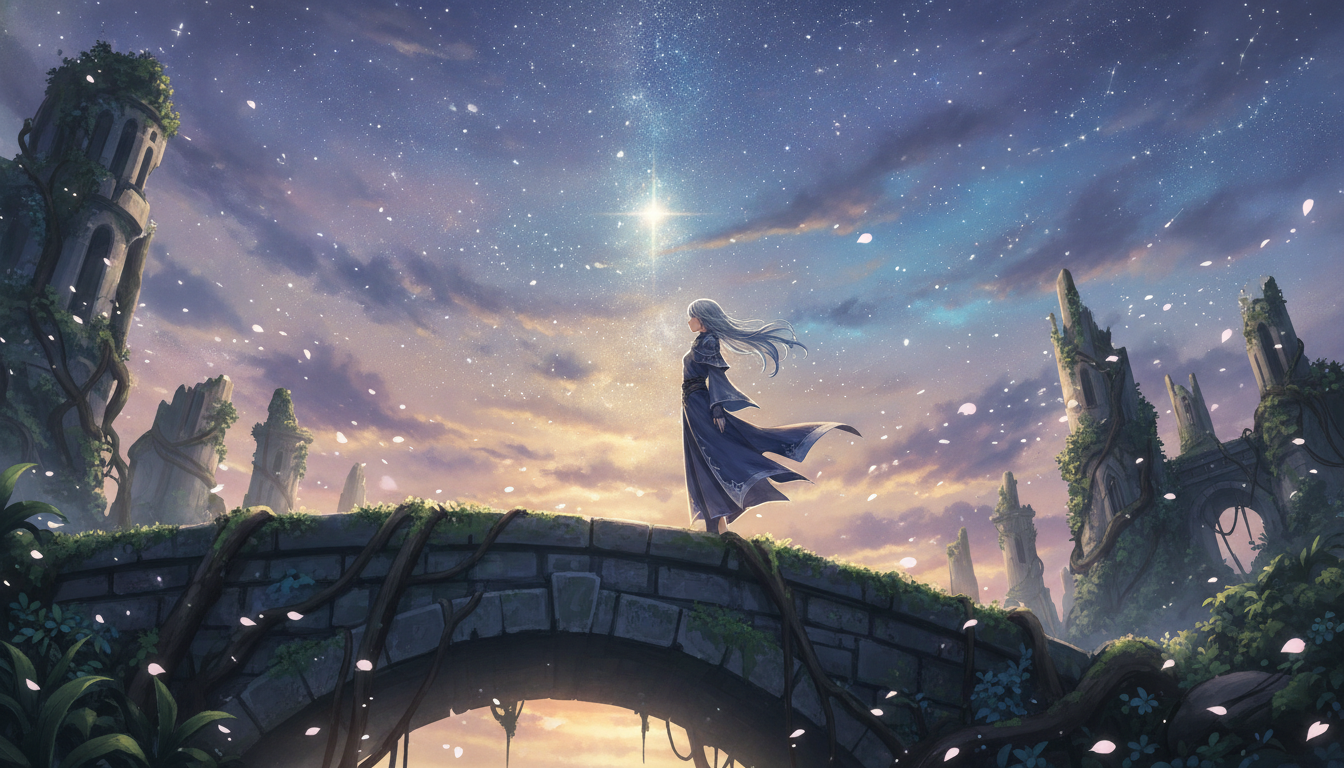
Frieren: Beyond Journey’s End crept up on the anime community like a quiet snowfall — and then absolutely buried everyone alive. When the series premiered in September 2023, adapted from the manga by Kanehito Yamada and Tsukasa Abe, few expected a story about an elf mage slowly processing grief across centuries to become one of the most emotionally devastating anime in recent memory. No explosive power-ups, no tournament arcs, no screaming protagonist. Just a silver-haired mage wandering through a world where her human companions keep dying of old age while she barely blinks — and somehow that hits harder than any battle shonen ever could.
What makes Frieren so special, and so painful, is its obsession with time as a weapon. Every quiet moment carries weight because you know the characters don’t have equal amounts of it. Frieren watched her closest friend Himmel die of old age and only then realized she never truly knew him. That’s the gut punch the show delivers in its opening episodes, and it never really lets up. The show asks a devastating question: What does it mean to love someone when you’ll outlive them by centuries? If that question wrecked you — and statistically, it did — then you are exactly the kind of viewer this list was made for.
Below are anime that operate in that same emotional register: slow burns, quiet devastation, characters defined by loss and time, and stories that linger in your chest long after the credits roll. Consider this your grief support group, with better animation.
A Silent Voice — One Conversation Can Change Everything
If Frieren made you cry during quiet scenes of introspection, A Silent Voice (Koe no Katachi, 2016, Kyoto Animation) will finish the job. This film follows Shoya Ishida, a former bully who tormented a Deaf classmate named Shoko Nishimiya in elementary school, and his years-long journey toward redemption and connection. Director Naoko Yamada crafts something that refuses to let anyone off the hook — not the protagonist, not the side characters, not even the viewer who’s expected to sit with genuine discomfort.
The parallels to Frieren run deeper than surface sadness. Both works are fundamentally about the cost of failing to truly see someone until it’s almost too late. Shoya missed years of genuine connection because of cruelty and cowardice. Frieren missed decades because she simply assumed she had infinite time. The emotional payoff in both cases is earned through restraint — neither story manipulates you cheaply. Check out these anime deaths that still make fans ugly cry years later if you want to fall further down that particular emotional rabbit hole.
Violet Evergarden — Learning to Feel After Everything Is Gone
If Frieren is about an immortal learning to grieve, Violet Evergarden (Kyoto Animation, 2018) is about a soldier learning to feel. Violet is a young woman who spent her entire childhood as a weapon on a battlefield, and now, in a world finally at peace, she works as an Auto Memory Doll — essentially a ghostwriter who helps people put their deepest feelings into letters. She does this in part to understand the last words a beloved major said to her before disappearing: “I love you.”
This show destroys people. Not all at once — it builds slowly, episode by episode, teaching you to care before it takes something away. Episode 10 in particular has become infamous in the anime community as one of the most emotionally brutal standalone episodes ever produced. Like Frieren, the beauty of Violet Evergarden is in its patience. It believes you’re willing to sit with sadness rather than be rushed through it, and it rewards that patience with genuine emotional resonance.
Mushishi — The Quietest Anime That Will Haunt You Forever
Mushishi (Artland, 2005) is perhaps the closest spiritual cousin to Frieren on this list. Ginko, a wandering “Mushi Master,” travels through a feudal Japanese landscape investigating and treating problems caused by mushi — primordial life forms that exist outside normal human understanding. There’s no overarching villain, no dramatic power system. Just quiet episodes about people living, suffering, and occasionally being saved.
The show operates at a frequency that few anime even attempt. It’s contemplative, sometimes eerie, and profoundly melancholic. Like Frieren, it treats nature and time as indifferent forces that humans navigate as best they can. If you want the same meditative pacing and the same sense that the world is ancient and full of things humans can barely comprehend, Mushishi is non-negotiable viewing.
March Comes in Like a Lion — Depression Has Never Looked So Honest
March Comes in Like a Lion (3-gatsu no Lion, Shaft, 2016) follows Rei Kiriyama, a teenage professional shogi player living alone, disconnected from the world, and quietly drowning in depression. The show doesn’t romanticize his pain — it depicts isolation with uncomfortable accuracy. The animation itself shifts between stark realism and surreal, almost childlike imagery when Rei’s emotions become too large for regular visuals to contain.
What connects this to Frieren is a shared commitment to emotional honesty without resolution as reward. Frieren doesn’t magically fix her emotional distance. Rei doesn’t get better in a neat arc. Both shows understand that grief and disconnection are processes, not problems to be solved by episode twelve. The found family Rei slowly builds with the Kawamoto sisters is as quietly moving as any relationship in Frieren.
Made in Abyss — Beauty That Hides Unthinkable Cruelty
Fair warning: Made in Abyss (Kinema Citrus, 2017) looks like a charming adventure anime about a girl named Riko and her robot companion Reg descending into a mysterious chasm full of wonders. It is not that. Or rather, it’s also that — but the further the characters descend, the more the show reveals that beauty and horror are inseparable, and that the world will not protect people who are small and vulnerable just because they deserve protection.
The emotional devastation here operates differently than Frieren‘s quiet grief — it’s sharper, more visceral. But both shows share a fundamental seriousness about what it costs to love someone in a world that doesn’t care. Made in Abyss has some of the most affecting character moments in recent anime history, and its commitment to the weight of its own world-building is genuinely remarkable.
A Few More That Will Finish You Off
If you’re fully committed to emotional ruin, here are additional titles that belong on your watchlist:
- Ano Hi Mita Hana (AnoHana, A-1 Pictures, 2011) — A group of childhood friends reunite years after the accidental death of their closest friend, whose ghost returns, still waiting for her wish to be granted. Have tissues.
- Clannad: After Story (Kyoto Animation, 2008–2009) — The sequel series to Clannad is considered by many fans to be one of the most emotionally devastating anime ever made. No further elaboration needed.
- Grave of the Fireflies (Studio Ghibli, 1988) — Isao Takahata’s wartime film about two orphaned siblings is not an easy watch. It was never meant to be.
- Your Lie in April (Shigatsu wa Kimi no Uso, A-1 Pictures, 2014–2015) — Music, grief, and a romance built on the knowledge that it cannot last.
- Kino’s Journey (various adaptations) — A young traveler named Kino explores countries with bizarre customs, each story a quiet philosophical meditation on human nature.
What These Anime All Share With Frieren
The thread connecting all of these works isn’t sadness for its own sake. It’s something more specific: a belief that slow attention to small moments is how you build something that actually breaks a person’s heart. Any show can kill a character. Far fewer shows make you feel the absence of someone you watched for fifty episodes making breakfast and arguing about small things. Frieren mastered that. So did everything on this list.
If you want to explore more about what makes certain anime resonate on that bone-deep level, the craft of anime openings that hit different is another angle worth considering — because the best series on this list also have opening sequences that do half the emotional work before the episode even starts.
Your watchlist now contains at least six reasons to cry quietly into a blanket. You’re welcome. Now go watch Mushishi and feel something ancient and unnameable in the back of your chest.
