

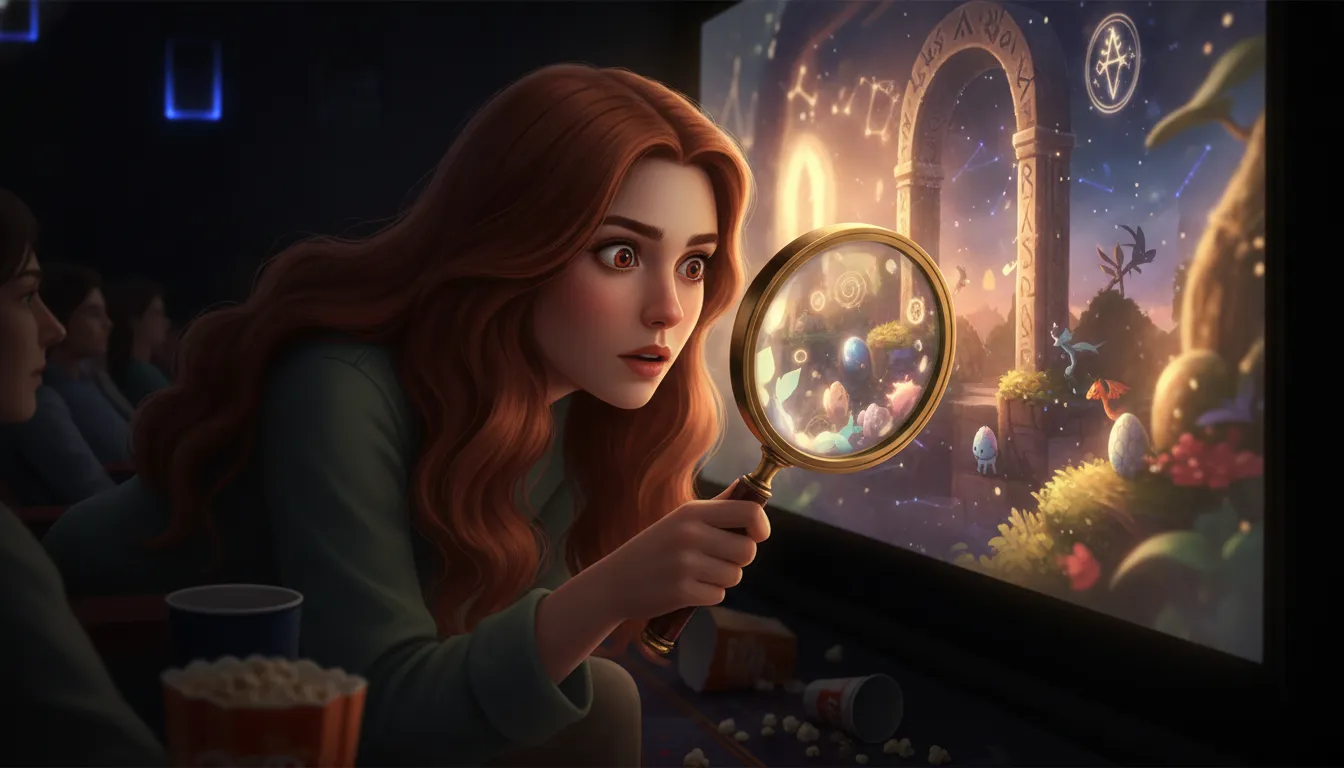
There’s a special kind of satisfaction that comes from watching an animated movie for the fifth time and suddenly spotting something you missed on the first four viewings. A hidden number on a license plate, a background character who actually matters, a painting on a wall that foreshadows everything — animators and directors plant these Easter eggs deliberately, knowing that the most dedicated fans will eventually find them. It’s a secret conversation between creators and the audience, and once you know it exists, you can never watch a frame of animation the same way again.
This phenomenon isn’t limited to one studio or one country. Whether it’s the meticulous world-builders at Studio Ghibli, the legendary storytellers at Pixar, or the bold animators working in anime films, hidden details are baked into the DNA of great animated cinema. Some are playful nods to other films, some are heartbreaking character cues you only understand on a rewatch, and some are so technically precise that they reveal just how obsessively these artists approached their craft. If you’ve ever paused, rewound, or zoomed into a single frame of an animated movie, this article is written for you.
So grab your remote, clear your schedule, and get ready to look at some of your favorite animated films with completely new eyes. We’re diving deep into the hidden details, visual callbacks, and blink-and-you’ll-miss-it moments that only true fans ever catch — and once you see them, you’ll never be able to unsee them.
The Pixar Universe’s Web of Hidden Connections
Pixar is arguably the most famous studio when it comes to planting Easter eggs, and their so-called “Pixar Theory” — the fan-constructed idea that all Pixar films exist in a single connected universe — has been fueled almost entirely by real hidden details the animators placed on screen.
One of the most well-known examples is the Pizza Planet truck, a beat-up yellow pickup that debuted in Toy Story (1995) and has appeared in nearly every Pixar film since. It shows up in A Bug’s Life, Monsters, Inc., Finding Nemo, and beyond, often tucked into the background where only eagle-eyed viewers notice it. Similarly, the Luxo ball — the yellow ball with a red star that appears in Pixar’s early short Luxo Jr. — keeps popping up across their filmography, from Toy Story to Up.
Then there’s the A113 code. This is a real classroom number at the California Institute of the Arts, where many Pixar and Disney animators studied. The number appears in nearly every Pixar film — on license plates, on camera models, on signs — as a tribute to their alma mater. It also turns up in Disney Animation and even in some animated TV shows, because so many graduates of that program went on to shape modern animation. Once you know to look for A113, you start seeing it absolutely everywhere.
Studio Ghibli’s World-Building Hiding in Plain Sight
Studio Ghibli films are masterclasses in visual storytelling, and director Hayao Miyazaki in particular is famous for packing every frame with meaning. In Spirited Away (2001), which won the Academy Award for Best Animated Feature, the bathhouse where the protagonist Chihiro works is loaded with cultural references to Japanese Shinto traditions, including specific design details of the spirits that reflect actual Japanese folklore.
One detail that fans often point out: the food that Chihiro’s parents eat before they transform into pigs. If you look carefully at the dishes, they are not labeled with prices, which in Japanese culture can be a subtle signal of an extremely expensive — or even suspicious — establishment. The visual cue is there from the very beginning, hinting that something is wrong before the transformation even happens.
In My Neighbor Totoro (1988), there’s a famous moment where Satsuki and Mei’s mother, Yasuko, appears to see Totoro from her hospital window. This single frame — easy to miss — carries enormous emotional weight and has sparked decades of fan discussion. Miyazaki confirmed in interviews that it was intentional, a gift to attentive viewers.
Anime Films That Reward Obsessive Rewatching
Anime films from directors like Satoshi Kon and Makoto Shinkai are practically designed to be paused and analyzed. Kon’s Paprika (2006) is layered with visual motifs that blur the line between dream and reality, and careful viewers have noted that specific dream sequences mirror scenes from later in the film almost shot-for-shot, suggesting that the dream world “knows” the future before the characters do.
Makoto Shinkai’s Your Name (Kimi no Na wa, 2016) contains a stunning hidden detail that fans debated for years: Mitsuha and Taki actually pass each other on a staircase in Tokyo midway through the film, before they ever formally meet. The film is structured so that you almost certainly won’t recognize what you’re seeing the first time, but on rewatch, the moment is gut-wrenching. It’s a technical and narrative achievement — the detail works whether or not you catch it, but it hits completely differently once you know.
Disney’s Foreshadowing You Probably Ignored
Disney Animation has a long history of visual foreshadowing that gets overlooked on a first watch. In Zootopia (2016), eagle-eyed fans caught a Breaking Bad reference in the form of blue “Tundra-brand” popsicles — a clear nod to the show’s infamous blue product. But beyond pop-culture winks, Disney often hides genuine plot foreshadowing in the background.
In Moana (2016), the ocean and its behavior around Moana subtly changes throughout the film as her confidence grows. The water is practically a character, and animators programmed it to respond differently to her emotional state — something you only fully appreciate after reading about the production or watching with that lens in mind.
Encanto (2021) is perhaps one of the richest Disney films in terms of hidden visual storytelling. Mirabel’s door — or rather, the lack of one — is visible in the background of multiple scenes long before it becomes plot-relevant. The film also uses color deliberately and precisely: each family member associated with a gift has a specific color palette woven into their surroundings and clothing, which fans have mapped out in extraordinary detail.
Did You Know? A Quick-Fire List of Hidden Details
Some of the best Easter eggs are best appreciated in rapid-fire format. Here are some verified hidden details that reward attentive viewers:
- In Coco (2017), Pixar included a detailed recreation of the ofrenda (an altar used during Día de los Muertos) with photographs that, if you pause and look closely, trace the Rivera family genealogy in a way that’s consistent with the plot revelations to come.
- The Incredibles (2004) contains a retro-futurist aesthetic that was meticulously researched — every piece of technology in the film is designed to look like a 1960s vision of the future, not actual 1960s technology.
- In Howl’s Moving Castle (2004), Sophie’s age visually fluctuates throughout the film in ways that aren’t always tied to the curse — Miyazaki has suggested this reflects her emotional and psychological state, not just the spell.
- Into the Spider-Verse (2018) uses different animation framerates for different Spider-People to reflect their different realities — Miles Morales runs at 24 frames per second in key moments, while some other characters run at lower rates. This is a genuine technical and artistic choice, not a production shortcut.
- In Ratatouille (2007), the food critic Anton Ego’s office and chair are shaped like a coffin, subtly reflecting his role as a critic who “kills” restaurants.
The Language of Color and Sound That Most Viewers Never Decode
Beyond physical Easter eggs, some of the most powerful hidden details in animated films exist in the language of color and sound design. Just as your brain can’t handle these universe facts — try anyway, your brain processes these subliminal signals without you consciously registering them — and that’s exactly the point.
In Inside Out (2015), Pixar’s design team made every location in Riley’s mind saturated with color, while the real-world settings grow progressively more muted as Riley’s emotional state deteriorates. It’s a visual metaphor operating in the background of every scene. By the time color starts returning, you feel it before you understand why.
Sound design carries equal weight. In Princess Mononoke (1997), the forest spirits — the Kodama — make a distinctive clicking sound that was crafted to feel both alien and deeply familiar, rooted in natural sound design that feels instinctually unnerving. Audiences often describe feeling unsettled without being able to explain why, which is precisely the intended effect.
Why Creators Hide These Details in the First Place
The reason studios invest so much time in details that most audiences will never consciously register comes down to one thing: emotional truth. A film that is internally consistent, richly layered, and visually coherent creates a feeling of reality even in a fantastical setting. When everything in the frame is intentional — even the things you don’t see — the world feels alive in a way that pure narrative exposition never achieves.
There’s also a powerful community dimension to Easter eggs. Just as overpowered anime MCs are impossible to stop watching because they tap into something deeply satisfying about mastery and discovery, finding hidden details in a film you love taps into the same instinct. It transforms passive viewing into active participation. Fans become detectives, communities form around shared discoveries, and the film gains a second life long after its release.
The greatest animated films are never finished the first time you watch them. They’re designed to give something different on every viewing, to reward patience and attention, and to create a relationship between creator and audience that grows richer over time. Whether it’s a tiny number on a license plate, a fleeting emotional expression in a character’s eyes, or a color palette that shifts in perfect sync with a story’s emotional arc — these hidden details are love letters from animators to the fans who care enough to look. And the more you look, the more you find. So press play, pay attention, and prepare to never watch animation the same way again.
