

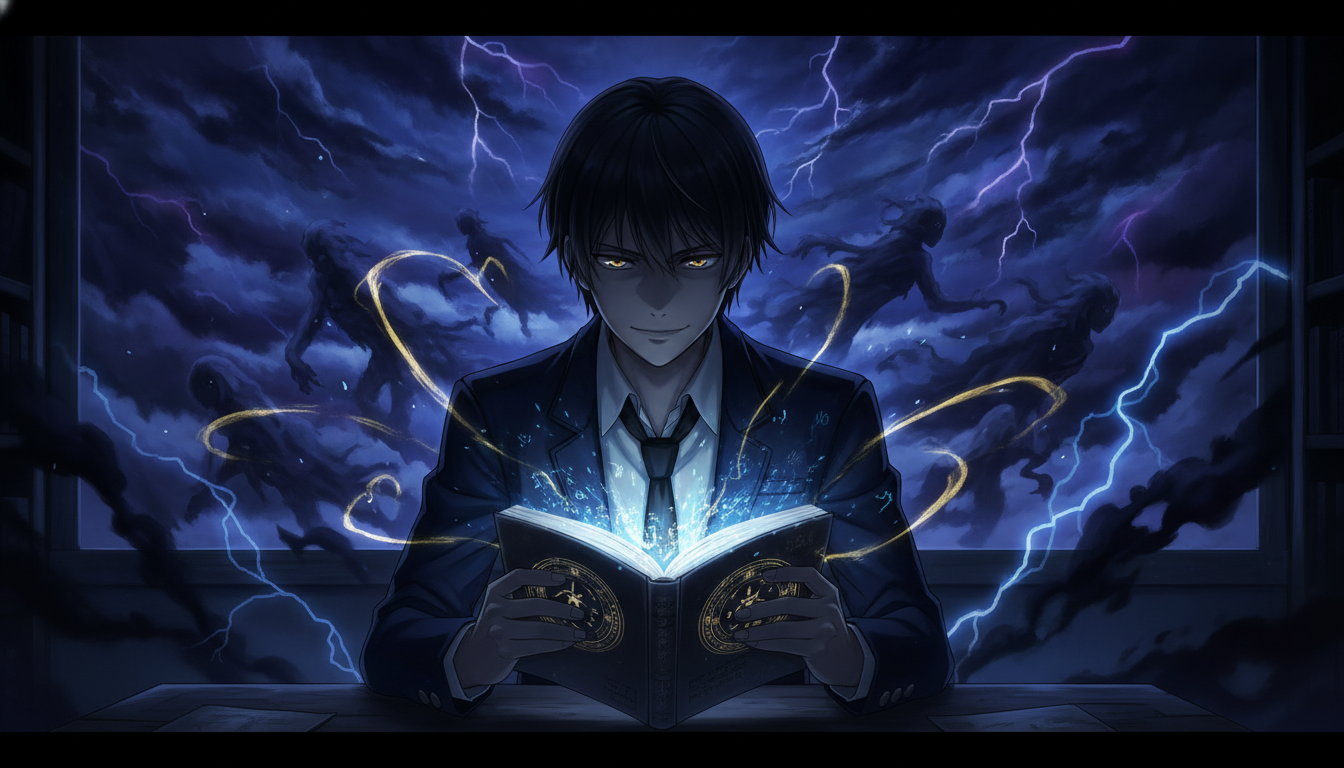
There is a particular kind of dread that only anime can deliver — the slow creep of paranoia as a genius plays chess with human lives, the sinking feeling when you realize the hero and the villain might be the same person. Death Note, which aired from 2006 to 2007, did something almost unprecedented: it turned a cat-and-mouse detective story into a full-blown moral crisis, leaving millions of viewers questioning whether justice and murder could ever share the same sentence. Light Yagami picking up a supernatural notebook and deciding to become a god of the new world is still one of anime’s greatest hooks, and the series remains a cultural benchmark more than two decades later.
But here’s the thing — if Death Note broke your brain, you’re absolutely ready for what else the medium has to offer. The psychological thriller is one of anime’s most fertile genres, producing series that dissect identity, sanity, morality, and the nature of reality with a precision that live-action rarely matches. Whether you’re a veteran fan hunting for your next obsession or a newcomer who just finished Light’s last monologue with your jaw on the floor, this list is your next step into the rabbit hole.
Fair warning: none of these recommendations are light viewing. Grab your snacks, clear your schedule, and maybe keep a notepad nearby — because some of these shows demand to be theorized about.
Why Psychological Anime Hits Different
Anime’s unique visual language gives psychological thrillers a massive advantage over their live-action counterparts. Abstract imagery, unreliable color palettes, and surreal animation sequences can externalize a character’s inner collapse in ways that no camera trick quite replicates. When a character loses their grip on reality, the art itself can fracture. That’s not a trick you can easily pull off on a film set with a $50 million budget.
There’s also the pacing. Long-form anime allows writers to burrow deep into a character’s psychology over dozens of episodes, making the eventual unraveling feel earned and devastating. Death Note leveraged this perfectly — by the time Light’s plan implodes, you’ve spent hours inside his increasingly warped logic. The shows below use the same slow-burn technique to masterful effect.
Monster: The Anime That Proves Humanity Is the Real Horror
If there is one series that can genuinely sit beside Death Note as a moral and intellectual equal, it is Monster, adapted from Naoki Urasawa’s manga and produced by Madhouse, which aired from 2004 to 2005. The setup sounds almost simple: a brilliant Japanese surgeon working in Germany saves the life of a young boy, and years later discovers that boy has grown into a serial killer. What follows is a sprawling, novelistic chase across post-Cold War Europe that asks whether a life saved is a life worth saving.
Dr. Kenzo Tenma is a protagonist unlike almost anyone else in anime — a genuinely good man systematically destroyed by his own goodness. His antagonist, Johan Liebert, is frequently cited as one of the most terrifying villains in anime history, and for excellent reason. Johan doesn’t just kill; he philosophically dismantles people until they destroy themselves. If you want to explore how anime handles genius-level villainy, check out Who Is the Smartest Anime Character Ever? Case Closed. — the conversation around Johan always comes up.
Paranoia Agent: When Society’s Anxiety Becomes a Literal Monster
Paranoia Agent, directed by the legendary Satoshi Kon and aired in 2004, is a mini-series that plays like a fever dream designed specifically to diagnose modern urban anxiety. A mysterious boy on roller blades, known as Shonen Bat (or Lil’ Slugger in some localizations), attacks people across Tokyo — and each victim turns out to be someone on the verge of a psychological breaking point. The attacks are almost a relief for them.
Kon, who also directed Perfect Blue and Millennium Actress, was a master of blurring the line between imagination and reality. Paranoia Agent operates on multiple levels simultaneously — as a satire of media hysteria, a study of collective delusion, and a deeply unsettling examination of escapism. Every episode peels back a new layer of a different character’s inner world, and the series builds toward a conclusion that reframes everything that came before it. It is only 13 episodes, which makes it one of the most efficient brain-melters on this list.
Serial Experiments Lain: The Internet as Existential Nightmare
Released in 1998 and developed by Yoshitoshi ABe, Serial Experiments Lain feels like it was made by people who predicted the 21st century and were not happy about it. The story follows Lain Iwakawa, a quiet teenager who begins receiving emails from a classmate who recently died — and slowly loses track of where her physical self ends and the digital “Wired” network begins.
Watching Lain in 2026, after decades of social media, algorithmic identity, and the blurring of online and offline selfhood, is a genuinely eerie experience. The show was asking questions about digital consciousness and the dissolution of the self before most of its audience had a personal email address. Its famously abstract structure and slow, oppressive atmosphere make it challenging viewing — but the payoff for patient fans is enormous.
From the New World: A Utopia Built on a Foundation of Lies
From the New World (Shin Sekai Yori), which aired in 2012 and 2013, is one of anime’s most criminally underappreciated psychological thrillers. Set roughly a thousand years in the future, it follows a group of children in a seemingly peaceful society where humans have developed psychic powers. The story spans decades of their lives, and each new revelation about the world they live in is more disturbing than the last.
The horror in From the New World is not supernatural — it is systemic. The series is fundamentally about what a society is willing to forget, suppress, and destroy in order to maintain stability. It borrows from dystopian literary traditions in ways that feel genuinely literary rather than derivative, and its willingness to depict moral ambiguity without tidy resolution makes it feel remarkably mature.
Key Facts: What Makes These Thrillers Stand Apart
Here’s a quick breakdown of what distinguishes truly great psychological anime from the pack:
- Unreliable narrators — shows like Lain and Paranoia Agent never let you fully trust what you’re seeing
- Moral ambiguity without easy answers — Monster and From the New World refuse to hand you a comfortable verdict
- Villains with coherent worldviews — Johan Liebert, like Light Yagami, is terrifying because his logic holds together
- Long-form character development — unlike films, these series have time to make you care before they break your heart
- Cultural specificity — many of these shows are deeply rooted in Japanese cultural anxieties, which adds layers of meaning (and Japan’s Weirdest Traditions Will Leave You Speechless is a great companion read for context)
- Atmosphere over action — tension is built through silence, implication, and visual unease rather than fight sequences
Perfect Blue: The Film That Invented a Genre
No list of this kind is complete without Perfect Blue, the 1997 film directed by Satoshi Kon. A pop idol transitions to acting and begins losing her sense of identity as an online stalker, violent incidents, and the blurring of her roles push her toward a breakdown. The film reportedly influenced Darren Aronofsky’s Black Swan and Requiem for a Dream, which is a testament to how far ahead of its time it was.
Perfect Blue is a masterclass in psychological horror built entirely from domestic, real-world anxiety — no supernatural elements required. It is less than 90 minutes long and will occupy your brain for days.
Your Next Obsession Is Already Waiting
The psychological thriller genre in anime is vast, endlessly rewarding, and genuinely unlike anything else in global entertainment. Death Note may have been your entry point, but Monster, Paranoia Agent, Serial Experiments Lain, From the New World, and Perfect Blue are the next chapters of an education in animated unease.
The best part? Each of these shows will give you something Death Note couldn’t — a completely different flavor of existential dread. Whether it’s the quiet horror of a perfect society built on atrocities, or the digital dissolution of a teenage girl’s identity, these series prove that anime’s psychological thriller tradition is one of the most sophisticated storytelling spaces in modern fiction. The notebook was just the beginning.

1 Comment
Pingback: No One Can Beat These Strongest Anime Characters Ever - ICL Geek Curiosities